City of Charlottetown Tree #9301, the sugar maple in front of our house, is nine years old this year. And, this autumn season, it is in fine form:


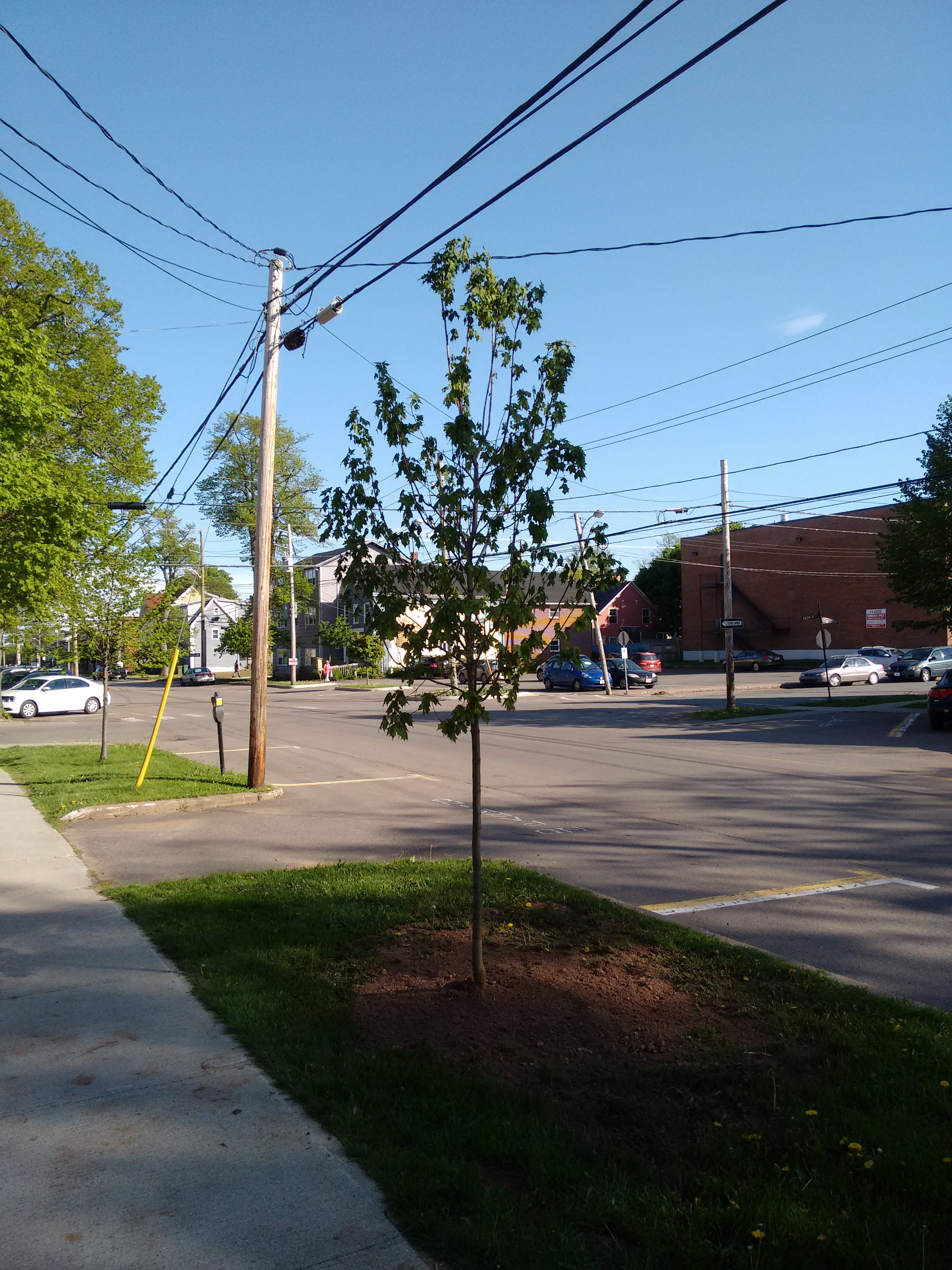
For comparison, here’s the tree on the day it was planted, in June 2016:

City of Charlottetown Tree #9301, the sugar maple in front of our house, is nine years old this year. And, this autumn season, it is in fine form:
For comparison, here’s the tree on the day it was planted, in June 2016:
Charlottetown’s own Nancy White released her album Stickers on Fruit in 2002. From the title track:
Stickers on the berries, the red and the blue
And of course they put stickers on the vegetables too
Well call me thick and call me lazy
But dealing with the stickers has made me crazyStickers on fruit
Stickers on fruit!
God, I hate those stickers on fruit!
Take me away to the institute
Where I won’t have to deal with stickers on fruit!
I bought some oranges at Sobeys the other day; sure enough, every orange had a 4012 sticker on it, a number I had to type into the self-checkout machine when I checked out.

I wondered, unpacking the oranges, who assigns these numbers? Is it Jeff Jenkins? Sobeys? The government?
Who assigns these numbers is the International Federation for Produce Standards:
IFPS is composed of national produce associations from around the globe. The long-term objective of the federation is to improve the supply chain efficiency of the fresh produce industry through developing, implementing and managing harmonised international standards.
In the IFPS system, number 4012 is the record number for large navel oranges (4013 is the code for small navel oranges, 3107 is the code for medium ones).
From the IFPS User Guide (a fascinating read if you like reading about standards and labelling schemes):
What is a Price Look-Up (PLU) code?
IFPS PLU codes are 4 or 5 digit numbers which have been used by supermarkets since 1990 to make check-out and inventory control easier, faster, and more accurate. They ensure that the correct price is paid by consumers by removing the need for cashiers to identify the product; e.g., whether or not it is conventionally or organically grown. They are primarily assigned to identify individual bulk fresh produce (and related items such as nuts and herbs) and will appear on a small sticker applied to the individual piece of fresh produce. The IFPS PLU number identifies produce items based upon various attributes which can include the commodity, the variety, the growing methodology (e.g. organic) and the size group.
The 4-digit IFPS PLU codes for produce are assigned randomly within a series of numbers within the 3000 and 4000 series. The 4-digit codes are for conventionally grown produce. The prefix of ‘9’ would be placed in front of the 4-digit conventionally grown code for organic produce. In the future, the IFPS will begin assigning IFPS PLU codes utilizing the 83000 and 84000 series; however, unlike the “9”, the leading digit “8” will have no significance.
The Canadian member of the IFPS is the Canadian Produce Marketing Association.
PLU Finder is a nice little website that wraps some helpful consumer information around each PLU code. For large navel oranges, for example:

Fish tacos are $6 at Fin Folk Food in Tracadie every Tuesday.
They are very good.
And very popular; here’s the parking lot at supper time yesterday:

Not only are the tacos very good, but the view is even better:

Lord knows I’ve had my disagreements with Mr. Banks, the proprietor, over the years. But it’s hard to argue with what he’s created here.
Justin Vernon and Jim-E Stack dig in deep on the Bon Iver album SABLE fABLE for BBC6. It’s a masterclass in modern music producing.
Sometimes blogging feels like a solo act.
I now have an owner’s manual for a part of my body.
I made an access request for the surgical notes from my radial head replacement operation in August. It was from these notes that I learned what had been installed in my elbow:
On the back table, we assembled the Wright Medical Evolve 24 mm standard head and the 7.5 mm standard neck.
Wright Medical was founded in 1950:
Started in 1950 by orthopaedic salesman and innovator Frank O. Wright, our first product was an “all-rubber walking heel” for leg casts – an original conception of the founder. From there, the product offering was quickly expanded to include orthopaedic implants and instrumentation as well as soft goods, like arm slings and splints.
By the time of Frank Wright’s death in 1975, orthopaedic implants and instrumentation had been firmly established as the foundation of the business. Within a few short years, our soft goods lines slowly disappeared and we were ready to forge ahead as a dedicated provider of orthopaedic surgical solutions.
After Wright died, the company was acquired by Dow Corning in 1977; it went through a series of ownership changes over the decades until its acquisition by Stryker in 2020.
You may recognize the name “Stryker” from the adjustable beds in hospitals, although that’s but a slice of its business, a business that includes pretty well everything medical (Catherine died in a Stryker bed, so it’s a brand name seared into my brain).
The Wright Medical Evolve that was installed in my right arm has an installation manual for surgeons, something I like to think of as an “owner’s manual” for this new part of my body:
The Evolve Radial Head prosthesis was designed to reduce abnormal kinematics and therefore problems with articular wear and pain and utilizes a spacer concept with a smooth stem. The smooth stem can move slightly in the proximal radius so that the radial head tracks with the articular surfaces, reducing abnormal kinematics and therefore problems with articular wear and pain.
The manual has a chart of the sizes of radial head available; I’ve highlighted mine:

I wear (embed?) a mid-range head and stem.
There is a very detailed description for surgeons on how to install the new head and stem, filled with language like:
Grasp the trial stem with the trial stem handle so that the handle sits below the trial head. Insert the trial stem into the medullary canal. Screw the trial head onto the trial head handle. Holding the trial head handle in line with the trial stem handle, slide the trial head over the trial stem platform.
That page has a diagram that illustrates the procedure:

It’s weird to consider that was all being done to my elbow while I was under anaesthetic.
The most bracing parts of the owner’s manual come at the introduction:
- The patient should be advised that the device cannot and does not replicate a normal healthy bone, that the device can break or become damaged as a result of strenuous activity or trauma and that the device has a finite expected service life.
- Removal or revision of the device may be required sometime in the future.
Time will tell whether I’ll wear this radial head out, or whether it will get me through the rest of my life.
I went into The Bookmark this afternoon for one last look around before they close their Queen Street location this weekend in preparation for their move around the corner to Kent Street.
Realizing this would be my last visit to the place I’d visited hundreds of times (and spent thousands of dollars), I felt a need to capture some images of the old place.


During my tour, I got to have a delightful chat with longtime store manager Lori Cheverie, after which she and with co-owner Dan MacDonald took me on a tour of the new location, set to open on October 14.
The new space, at 111 Kent Street, is, they told me, 50% bigger. It’s also their opportunity to reimagine how the store is laid out. Though it’s absent stock at the moment, signs are that they crafted something lovely.


I can’t wait to see it when it’s full of books and pens and notebooks!
Later in the afternoon, the shop posted a photo of its new sign to Facebook:

Looking at that new sign I realized something that I hadn’t realized in all my years as a patron: it’s not The Bookmark, it’s just Bookmark.
At first I thought there was no way I could have been getting this wrong all these years.
But I checked the store’s website (emphasis mine):
At Bookmark, we strive to contribute to our local arts and culture scene by hosting events with local, national, and international authors.
…
Top selling recent releases available at Bookmark.
…
Here are our picks for what’s coming soon! Shop local and pre-order your copy at Bookmark!
It’s true. No The.
It’s going to take some retraining for me to say “Meet me at Bookmark” or “Maybe they have it at Bookmark,” but I’ll get there.
(And I apologize to the shop for getting it wrong all these years!)
If you want to make your own last pilgrimage to Queen Street, you’ve got this weekend to do it.
Two years ago, I wrote about a wish-list of 9 magazine shops to visit in Europe that I’d collected from the stockist list for Robida magazine.
The was a really helpful list: it led us to visit both Edicola 518 and Frab’s while we were in Italy last year. I aspire to visit the other seven.
Four years ago I wrote about GeoJSON Collectibles:
I like the idea of GeoJSON Collectibles: digital artifacts that can be shared around like we used to share cassette tapes, with no websites or apps or dependencies on proprietary formats or services required. You can take my GeoJSON, and turn it into your GeoJSON, adding your own route variations and annotations.
Gluing those two ideas together, here’s a collectible GeoJSON file of those 9 magazine shops (see them on a map).
I thought about all of this again because I was reading the Coffee issue of F magazine this afternoon, and found a list of coffee shops in the index that I wanted to be able to “collect” in the same way:

Here’s the GeoJSON file of those coffee shops (and here’s a map).
I’ve been to two of those shops, both in Oslo during our trip there 10 years ago: Fuglen and Tim Wendelboe. Just 11 more to visit.
When my physiotherapist measured my elbow extension two weeks ago, it was at -20º. This morning’s measurement was -6º.
I’m really happy about that.
As Lisa will attest, I’ve been annoyingly religious about doing my physio three times a day.
With my eye on the 0° prize, this hasn’t been as difficult as I thought it would be. This means that, more often than not, if you were to pop into our house by surprise, you’d find me lying on the couch with a 5 pound weight hanging off the end of my right arm.
My physio program got updated again today, and for the next two weeks, here’s what I’ll be doing:
To think that, just three months ago, I would’ve had no idea what pronation and supination were. Now I live and breathe them.
It’s been 10 weeks since I fell off the box and injured my elbow an 8½ weeks since my surgery. My arm is still uncomfortable, at least a little, most of the time. I can’t reach as far as I’m used to, and I certainly can’t lift what I used to. But doing the physiotherapy, and seeing it demonstrably pay off, helps bolster my faith that, eventually, this will all be a satisfying memory.
Those “putty squeezes” you see in the list of physio exercises are done with a ball of goo called “therapy putty” that looks and behaves a lot like the Silly Putty of my childhood. It comes in different colours, each denoting a different amount of resistance it offers. I started with yellow, and have levelled up to pink.
One of the interesting characteristics of therapy putty is that the harder you squeeze it, the more resistance it offers.
This is because it’s what’s called a non-Newtonian fluid:
In physical chemistry and fluid mechanics, a non-Newtonian fluid is a fluid that does not follow Newton’s law of viscosity, that is, it has variable viscosity dependent on stress. In particular, the viscosity of non-Newtonian fluids can change when subjected to force. Ketchup, for example, becomes runnier when shaken and is thus a non-Newtonian fluid.
I prefer to think of it is simply being kind of freaky, slightly outside nature.
Here’s a time-lapse video I shot showing it slumping slowly, over several minutes, from a ball into a lump:
Earlier in the month, in anticipation of mounting Lisa’s exhibition at The Gallery, we went in search of a way of creating removable vinyl letters for the show’s signage. We were happy to discover that, at the Charlottetown Library Makerspace, there is a Cricut machine that’s free to use.
You can think of a Cricut machine as a kind of computer controlled X-Acto knife; at least that’s what we were using it for: you load a blank sheet of self-adhesive vinyl, use Cricut’s software to come up with a design, send the design to the machine, and the machine cuts the design into the vinyl. It’s really quite magical.
To start the process, I created the lettering for the design in Cricut Design Space, on my laptop at home:

We picked up a roll of removable vinyl sheet at Michael’s in Charlottetown, and headed to the library.
The software stores the designs “in the cloud,” so we were able to go to the library and sign in under our account once we were ready to “print.” The cutting process was remarkably fast: it took about two minutes.
Once the cutting was completed, came the fiddly process of “weeding” the vinyl to remove the parts that aren’t letters. Lisa proved very good at doing this:

Once the weeding was done, we lay a piece of transfer paper over the letters, and then used that to transfer the letters to the wall of The Gallery:


The weeding and transferring parts were a little fiddly, but, once we got the hang of it, it all worked pretty well. We are both very happy with the results on the wall.

The Cricut system, especially for those of us used to the openness of the 3D printing world and its tools, is regrettably closed and proprietary: it feels kind of like the Sodastream of digital tools. The only way to send designs to the machine is using Cricut Design Space, and while it’s quite capable, it’s also an advertising machine for all things Cricut: supplies, clipart, fonts, etc.
Of course what Cricut lacks in openness, it benefits from in ubiquity: a lot of people know how to use Cricut machines, the machines are widely available at hobby stores, as are the materials.
Using the Cricut was our first real introduction to the library’s makerspace, a space that holds a bunch of really useful machines and tools. There’s a 3D printer, a machine to digitize VHS videotapes, a heat press for T-shirts, a bunch of sewing machines, a laminating machine, a drawing tablet, a button maker, and soldering stations.
The makerspace is open seven days a week, from 2:00 p.m. to 5:00 p.m. Use of the tools and machines is free; you just pay for the materials. What a great resource for our city this is.
 I am Peter Rukavina and this is my blog. I am a writer, letterpress printer, and a curious person.
To learn more about me, read my /now, look at my bio, listen to audio I’ve posted, read presentations and speeches I’ve written, see things I’ve favourited elsewhere, or get in touch (peter@rukavina.net is the quickest way).
I have been writing here since May 1999: you can explore the 25+ years of blog posts in the archive.
 You can subscribe to an RSS feed of posts, an RSS feed of comments, an RSS feed of favourites elsewhere, or a podcast RSS feed that just contains audio posts. You can also receive a daily digests of posts by email. I also publish an OPML blogroll.
Instagram • YouTube • Vimeo • ORCID • OpenStreetMap • Internet Archive • PEI.art • Drupal • Github.