We went for a walk at Fullerton’s Creek Conservation Park in Stratford this afternoon. If not for Oliver visiting a few times last year without me, I never would have known it existed.

The sun was shining and the trail had been packed by those who walked out earlier; it was a very pleasant walk to the overlook that affords a view of Fullerton’s Marsh.

Although the park is clearly signed prohibiting snowmobiles, snowmobiles clearly cut through regularly, so I’d avoid the area around dusk or when visibility is poor.

🗓️

I walked into my bedroom late this afternoon to find the sun shining through the blinds, for a fleeting moment, so as to cast a single perfect sunbeam on my bookshelf.

🗓️

I walked into the kitchen tonight to put the dishes in the dishwasher and found a mouse standing on the stove looking up at me. It was a cute mouse, as mice go, but still.

For the longest time it was Catherine who was our liaison to the mouse kingdom: she grew up on a farm, and was well familiar with their ways.

A few years ago, as moving around became more difficult for her, and as I started to be last one to bed and first one up in the morning, I had no choice but to take over the diplomacy. I did not come by it honestly, and I still don’t. But I’ve figured it out.

It’s unusual to see a mouse around this time of year: their interest in our kitchen is generally restricted to a few weeks in spring and a few weeks in fall. But here was a mouse—a cute mouse, but still—in the middle of the winter. So I set the traps, with a barely-there amount of peanut butter, as instructed by my physicist friend, and in the morning, if things go according to plan, it will fall to me—who else is there—to empty them.

You may be asking “how can he go to sleep at night knowing that mice will probably be setting up camp in his bedcovers while he sleeps?” That is a good question.

The answer lies in the nature of my bedroom door, which, fortunately, is magic.

My bedroom door, like most of the doors in this 194 year old house, doesn’t close smoothly. But it does close, if given a little shove, and that is the source of its magic.

When Catherine’s illness got to the point where she needed a bed of her own, and moved across the hall, for the first time in many years I was sleeping by myself every night. It was cold and lonely, yes, but in a way also a sanctuary: a place all my own. The shove and gentle thud when I closed the door at the end of every day at bedtime, long after Catherine and Oliver were fast sleep, became a kind of airlock for for me, an avatar for keeping whatever exigencies might have filled yesterday, and might again fill tomorrow, at bay.

During the years Catherine was sick, that door allowed me some small measure of personal geography; I credit it, and its thud, for helping me keep my head above water.

It also proves useful in any number of other ways: it’s very helpful for meditation, for example, to have the rest of the world not exist for a time. And it keeps the mice, and, indeed worry about the mice, on the other side.

Good night.

🗓️
Mice  •  100 Prince Street  •  Catherine  •  Doors

I love William Denton’s imagination:

In this STAPLR composition, one one-minute iteration of Vexations is played for each minute of help given at any desk at York University Libraries that day. It keeps a running counter of how many more minutes it should play. Let’s say that at 0900 someone checks their email and answers a quick research question that takes them five minutes. They enter that into our reference statistics system, where STAPLR sees it and counts 5. It starts to play five iterations. One minute later, the counter is at 4. One minute later, the counter goes down to 3, but there’s another question in the system, this time a virtual chat that took 10 minutes to answer, so the counter goes up to 13. After one iteration it goes down to 12, then 11, then up again if there’s another question. If the counter reaches 0 it will wait and start back up when there’s another question answered.

STAPLR is Sounds in Time Actively Performing Library Reference.

See also CBC Spark Interview: SoundCloud + Pachube + Energy from 2011.

🗓️
William Denton  •  Music  •  Data  •  Libraries

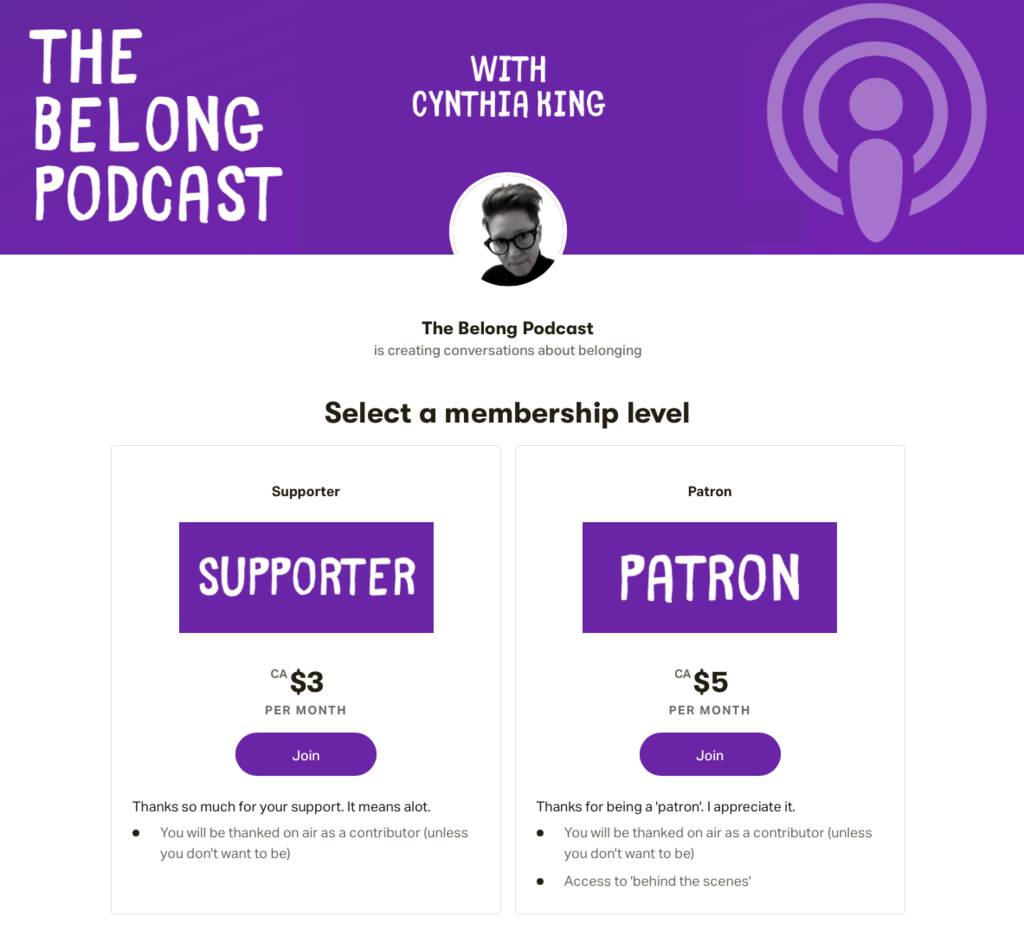
My friend Cynthia is producing The Belong Podcast. Among other things, it’s Canada’s preeminent source of interviews with people named Peter (Rukavina, Bevan-Baker, Mansbridge). But, more importantly and more interestingly, it’s a podcast where people, often people who’ve experienced not belonging, can discuss their lives. 

When we talk about the new opportunities the digital realm offers for new people to make new things, Cynthia’s effort is what we’re talking about.

And now she has a Patreon, where you can support her in her efforts. 

At this hour, I am her only patron, meaning that when she released an video update yesterday, BTS Video about barking dog, I was the audience. If that’s not worth $5/month, I don’t know what is.

Will you consider joining me in patronage, for $3 or $5 a month?

Screen shot of The Belong Podcast Patreon page.

🗓️

Buried at the bottom of a cupboard in our library, I found the stained glass fish that used to grace our piano window. I restored it to its former home.

🗓️

As the rest of our world unravels, here on the Island a seal gets a ride in the back of a police cruiser.

Every reporter deserves the occasional exploding bus-fire eater-magic cat story: today was Shane Ross’ turn.

🗓️
CBC  •  Seal  •  Police  •  Winter

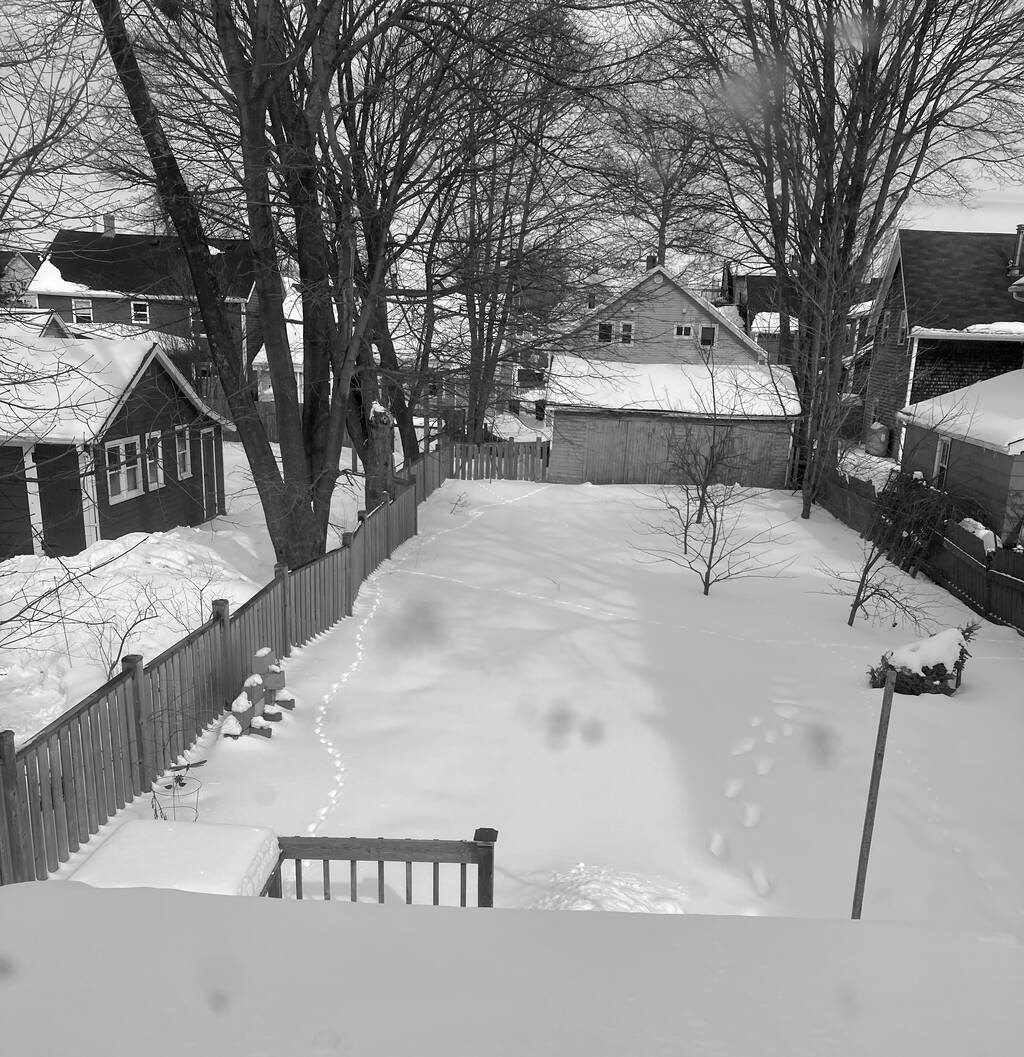
A view from the back hallway window at 100 Prince Street. The tracks on the right are human tracks, mine, made during my regular trudge back far enough to get a good look at the snow and ice on the back roof. The tracks on the left are from animal unknown, and I just love them.

A view out the back window of my house at the snow in the back yard, with animal tracks leading along the left side near the fence.

🗓️
100 Prince Street  •  Animals  •  Tracks  •  Snow  •  Winter

I ran into my friend Suzanne this week in the Sobeys checkout line. I hadn’t seen her in a long time, since the before before the before. The effect was not unlike what I expect opening the door of the fallout shelter to emerge into the nuclear winter would be like: we compared notes, as one might, on how sheltered life was going, and drew a little strength from knowing we’d shared something of the same experience.

Megan Hallinan wrote in November about a bar in Rome that forbid COVID talk:

There’s a bar in Rome (bar in the Italian sense meaning that it primarily serves coffee) where they have taken the revolutionary step of forbidding talk about COVID by anyone who steps foot inside. It’s a refreshing idea, and at this stage in the pandemic calendar one that I don’t think many people will complain about.

On reflection, I realized that most of my conversations, for as long as I can remember, have been COVIDy: Where’d you get that mask? Are you still in Code Magenta? You went to see live theatre?! How you holdin’ up? What’s the deal with celery? (COVID talk apparently involves a lot of folksy contractions).

Between COVID talk and grief talk (and, for a while there, insurrection talk) there’s not a lot of room left over for loftier ruminations. I could use some lofty ruminating.

Years ago my neighbour (and Catherine’s roommate) Mike Johnston pitched a talk show set on a bus, and snagged Margaret Atwood as a guest for the pilot:

Even more impressive, Johnston finagles the participation of Ms. Atwood. Drawing on his friendship with the late Canadian poet Al Purdy, whom he used to book for poetry readings at Peterborough’s Red Dog Tavern, Johnston coerced the author to film an interview for the pilot; Atwood appears gracious and bemused in the segment, and she even signs the roof of the bus in a good-luck gesture. “She was awesome,” he says. “And she had really great skin, too.”

I was thinking about Mike and Atwood this morning because my social worker told me that I could be intimidating, which I found surprising, as I have never thought of myself that way. Atwood, surely, is the most intimidating living Canadian, and I wonder whether she feels that. Or, like me, considers herself a lucky idiot. What kind of friends do you end up with if you’re intimidating?

As if by magic, midway through writing this, my friend Martin phoned and offered to deliver Vietnamese sandwiches for lunch. He arrived 45 minutes later, and we spent the next 2 hours (mostly) not talking about COVID (or insurrection). We did, however, talk about grief for a bit.

Earlier in the week Martin pointed me to a post by his friend Ivan about grief. He mentions the Widow We Do Now? podcast, which I indirectly led him toward, a very helpfully irreverent podcast for people with dead husbands (and wives) that, like Ivan, I’ve been binge-listening.

I wrote to Ivan after reading his post, in part:

I don’t know why hearing tales of those on a similar journey is comforting, but it is.

I’ve found the same thing to be true of the monthly grief support group: who would think that a Zoom populated exclusively by the grieving could be anything other than a catalyst for embarrassed silence. But, no, it turns out there’s a magic to it, and that talking and listening to others who, no matter who and when and how, are grieving is helpful. In a way, what we talk about is irrelevant: just showing up to bear witness to each other is the key.

The estimable Rose Cousins released a lovely cover of Whitney Houston’s I Wanna Dance With Somebody this week (Rose Cousins’ middle name is Millicent, by the way; that endears me to her even more).

The night before Oliver was born we watched Message in a Bottle, starring Whitney Houston’s friend (and former costar) Kevin Costner. I’d forgotten until just now that the plot concerns love letters written by Costner’s character Garrett to his dead wife Catherine, with the dramatic tension being “Garrett cannot quite forgive Catherine for dying and leaving him.” I’ve been there. The tension resolved only when, in a sense, Garrett emerges from his fallout shelter.

Megan Hallinan’s post continues:

Much like politics, we’re all tired of talking about COVID: what it means and how it influences every single decision we make. And when we are not talking about it, we’re all still thinking about it. My internal chyron has had these same two topics looping around for the entire year and good God I am worn out.

As much as I’ve found talking about grief to be powerful and important and, in the end, necessary, I feel worn out in the same way: being defined by, and defining myself by, absence. It can be exhausting.

I’ve been reading John Kim’s book Single On Purpose, and this paragraph hit me over the head:

I’ll tell you why you feel lonely. Because what you get from an intimate partner is something you can’t get from anyone else. Because those conversations after work and those waffles on Saturday morning help the world make sense. Because spooning puts you to sleep like a little baby. Because tongues feel fucking good. Because looking into someone’s eyes for longer than three seconds reminds you that we’re not meant to do life alone. Because being emotionally naked makes you feel alive. Because you can’t really tell your friends how your day went every single day or you won’t have any friends. Because we’re meant to give and share, lose ourselves and find ourselves through others, and love, hard. Because ordering in is so much better when you have someone.

If I’d read that a year ago it would have plummeted me into a cascade of tears as I lay, paralyzed, on the cold metal cot in the back corner of the fallout shelter. Reading it today doesn’t do that, because, hell yes, I’ve been there, I know that, and wasn’t that a blessing. But also because I know that, even after the nuclear winter, nature finds a way, and it reminds me of life’s possibilities.

One of the things we return to frequently in discussions among the grieving is whether grief with a side of COVID has made the process easier or harder. Opinions vary: one person’s loneliness is another person’s time for quiet reflection; some take solace that the world is, in a sense, also grieving. That’s something that’s always hit home with me, and I now again find my own situation mirrors that of the world around: with the back of the COVID curve seemingly broken again, and the pace of vaccination picking up, the fallout shelter doors, if not enthusiastically thrown open, are at least no longer welded shut.

To the point where, when I write “Who knows what might happen next?”, it can be a statement of possibility and hope, not of despair.

🗓️
Grief  •  COVID-19  •  Catherine  •  Margaret Atwood  •  Mike Johnston  •  Martin Rutte
🗓️
Colorado  •  Branding  •  Wordmark

About This Blog

Photo of Peter RukavinaI am . I am a writer, letterpress printer, and a curious person.

To learn more about me, read my /now, look at my bio, listen to audio I’ve posted, read presentations and speeches I’ve written, see things I’ve favourited elsewhere, or get in touch (peter@rukavina.net is the quickest way).

I have been writing here since May 1999: you can explore the 25+ years of blog posts in the archive.

You can subscribe to an RSS feed of posts, an RSS feed of comments, an RSS feed of favourites elsewhere, or a podcast RSS feed that just contains audio posts. You can also receive a daily digests of posts by email. I also publish an OPML blogroll.

Instagram • YouTube • Vimeo • ORCID • OpenStreetMap • Internet Archive • PEI.art • Drupal • Github.