
I had lunch with Bob Rosenschein from Atomica, which is a product I know primarily from its connection with ActiveWords. If you haven’t tried out Atomica yet, you should: its essence is making every word, everywhere on you computer screen clickable. Bob is an interesting guy, who describes his product well. Check it out.
I have discovered that one of the useful educations of having a child is that you learn how to pee with one hand. This is an invaluable still to have when at a conference and trying to balance laptop and related stuff. Thank you Oliver.
🗓️
Well, the new Jetta took me from PEI to Camden in fine style (thanks to Alan and Craig for sending me to Bob, Nettie and Tom at Sherwood VW — you were right!).
You can watch Pop!Tech live via Quicktime, and also read live blogging from Robert Scoble and Dan Gillmor.
I’m typing this live from the Camden Opera House floor during the coffee break on Saturday morning, courtesy of a wireless Airport network. Conclusion: cutting the umbilical cord is way cool. You wouldn’t think it would matter that much, but iut does. It’s transportative; it changes the nature of the laptop tool into something completely different. It’s a new medium.
Conference is something of a personal odyssey for me — I’m taking a decidedly less shy approach to the whole thing, and remembering to talk to people when I would otherwise cower away in the corner. Although I suppose I am cowering as I write this. Key to this, I have discovered, is asking people to talk about themselves and their passions; people love doing this. I have my grade 13 biology teacher Judy Libman to thank for this (thanks, Judy).
More updates later in the day, cowering notwithstanding.
🗓️
The insurance world is changing. My wily brother Mike knows more about the background details of this — demutualization and the like — but here on the front lines you see everyone from banks to grocery stores to television commercials trying to sell you home and auto insurance.
Growing up in Ontario, my parents’ insurance company was State Farm and their agent was a man named Allan Bradley.
When I was really young, I got this confused with Allan Brady, Rob Petrie’s boss on the Dick Van Dyke Show. As you might imagine, I was very impressed, both by the fact that Mr. Brady could run a TV show (within a TV show) and also sell insurance, and also by the fact that my parents would contract with such a star for their insurance needs.
When I got older — driving age — I remember Allan Bradley always being the one my father held up as the reason that I couldn’t take the car out. “Oh, the car’s not licensed for travel to Toronto,” he would say, holding up the spectre of Allan Bradley’s wise judgement as proof. (Later, when I was more rebellious and wily myself, I actually phoned Allan Bradley myself and the jig was up).
When I moved away from home and bought my first car (a 1978 Datsun 510), I went first to State Farm for a quote, thinking that the long association of my family with the firm would give me a good rate. It didn’t. And so I ended up with an anonymous outfit called Dominion of Canada as my insurer, and I’ve been with them ever since. (I thought they were anonymous until I followed that link and found that their first President was Sir John A. Macdonald who, by sheer coincidence, helped to concoct Confederation of the actual Dominion of Canada just next door to where I write this).
When I moved to Prince Edward Island, I needed a new broker, and I found Gordon Full Insurance. I got 7 years of good service from them until Gordon decided to retire and merged the business into Hyndman and Company, of which it had been some sort of secret division for some time in any case.
Hyndman and Company was founded in 1872 by Fred Hyndman’s great-grandfather. Fred is now at the helm, two generations later. When I did a story on the history of the telephone number several years ago for CBC’s Island Morning, my research found that theirs was one of the first telephone numbers in Charlottetown, and every time the numbering system changed, they just tacked on an extra number or so. So the kernel of their phone number is very, very old too.
I’ve always gotten excellent service from Hyndman’s: they took us through a natural disaster (of sorts) this winter when the evil snow and ice infiltrated our house and made the walls fall off. And today, when I wanted to switch over car insurance (more on that later), they did the whole thing over the phone in about 3 minutes. And they knew who I was when they answered the phone.
Part of our responsibility, if we want the world to be less anonymous and big box evil, is to support local, long-standing businesses. Especially businesses that are firmly rooted in our downtown business district. You can’t go wrong buying insurance from Hyndman and Company in either regard.
🗓️
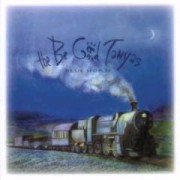 If you are looking for a new direction in your musical tastes, you cannot go wrong with the the Be Good Tanyas, a self-described “group of ramblin’ gals” from Vancouver.
I heard them for the first time on KPIG’s Please Stand By live music show this past Sunday (listen here), and immediately ordered their album Blue Horse. It arrived today (such is instant gratification in the modern age).
Their music is bluegrassy folk. Simple instrumentation, elegant vocals. If you liked Michelle Shocked’s Texas Campfire Tapes (i.e. Michelle Shocked before she went all “big band”), then you’ll like this.
🗓️
Way back in August, I wrote here about how Chapters censors the Internet at their in-store public access terminals. I sent a letter to Heather Reisman, their Chief Executive Officer.
Today I received her response, through her President, Retail, Michael Gagnier. You can read the letter (35KB PDF); the most interesting sentence is:
We feel that there is a difference between Internet access and access to books, in that a computer monitor is an open forum where children can easily see what is on-screen, as opposed to books, where items inappropriate for children are between the books covers.Is it just me, or does this seem insane?
My situation — not being able to read Doc Searls’ weblog because it had the word shit in it — is proof positive that these silly filtering schemes don’t work. They don’t protect children from anything (whatever that means).
I thought bookstores were supposed to support the idea that the free and unfettered flow of information in any form is a Good Thing.
I have a child. What lesson do I want him to learn from this? Certainly not that it’s okay for large corporations to decide what’s appropriate for him to read and what’s not. I’d far rather have him catch a view of a couple of errant penises — which I can explain to him — than to give up his — and everyone’s — fundamental right to freedom of information.
🗓️
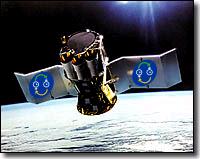 Of all the junk mail I’ve received recently, most interesting is the Connect, the newsletter of the European Space Agency’s Telecommunications Department. Whatever motivated them to add me to their subscription list, I can’t imagine. Their introductory letter starts:
Dear Madam/SirYes, it’s those darned old potentially high barriers to entry that have kept me from owning my own satellite.
You may never have considered extending your range of products and services to include satellite communications. Alternatively you might have been discouraged by the complexity of the field and the potentially high barriers to entry…

🗓️
There are some usability problems with PEIauto.com, but it appears to be the first automobile sales website on the Island to have attracted a critical mass of dealers.
🗓️
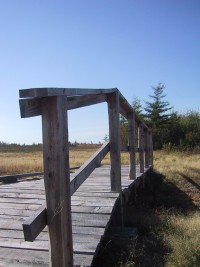 The Bedeque Bay Environmental Management Association, BBEMA to its familiars, is an organization worthy of support from every Islander.
Today I had the pleasure of taking a tour of the Maple Plains Agro-Environmental Demonstration Project, a joint venture of BBEMA and farmer George Webster.
The Big Idea at Maple Plains is research and education surrounding sustainable agriculture: in other words, figuring out how we can adjust the way we grow our food so that we make less of an impact on the land.
Maple Plains is an actual working farm, where actual real potatoes and other crops are grown. And there’s actual real research going on there: research on run-off, filter strips, buffer zones, strip cropping and more. There’s a weather station and a significant educational effort involving tours, and outreach into the schools.
In short, BBEMA and their partners are doing the kind of stuff that a lot of people are saying we need to do before the agricultural bubble bursts; they’re laying the groundwork for the kind of sustainable farming that will inevitably become common practice if we’re going to continue growing food here and not completely screw the place up.
The BBEMA people impressed me with the degree to which they are firmly rooted in the practical: they understand how the world works, how to make projects happen, and how to preach the sustainable gospel without coming off as whacked out weirdo hippie freaks.
You can join or make a donation. Given that a donation is an investment in the long-term health of our province, I would encourage all readers to make a donation to the extent that they are able; feel free to drop a note in the Discuss This box when your cheque is in the mail.
🗓️
About This Blog
 I am Peter Rukavina and this is my blog. I am a writer, letterpress printer, and a curious person.
To learn more about me, read my /now, look at my bio, listen to audio I’ve posted, read presentations and speeches I’ve written, see things I’ve favourited elsewhere, or get in touch (peter@rukavina.net is the quickest way).
I have been writing here since May 1999: you can explore the 25+ years of blog posts in the archive.
 You can subscribe to an RSS feed of posts, an RSS feed of comments, an RSS feed of favourites elsewhere, or a podcast RSS feed that just contains audio posts. You can also receive a daily digests of posts by email. I also publish an OPML blogroll.
Instagram • YouTube • Vimeo • ORCID • OpenStreetMap • Internet Archive • PEI.art • Drupal • Github.