
This is TV premiere week for the major U.S. networks. While some shows jumped the gun and started last week, Monday was the beginning of a sudden onrush of new content. And I’ve been paying attention (the sleep in my eyes is a testament to this). Here’s my take after days one and two:
Journeyman on NBC (pronounced Journey Man it seems) is excellent. The basic “average American guy gets afflicted by time travel virus” has been tried before, but never with production values, writing and a cast like this. I think it has staying power.
K-Ville on Fox seems promising too. It’s a fairly standard buddy-cop format, set in New Orleans. But one of the cops is an ex-con, the supporting cast is solid, and the pilot’s story-line was compelling. I’m not as convinced that this show will last; it depends a lot on where episode number two goes.
I get a lot of flack from Catherine for my devotion to The Unit, returning on CBS, mostly because it appears on the surface to be a celebration of the miltary-industrial complex and America’s prowess. Which it is. But it’s also a weekly dose of David Mamet on television, and that’s not be trifled with. Besides, I could watch Dennis Haysbert read the phone book and I think it would be interesting, and I’ve got a crush on Rebecca Pidgeon. Last night’s season opener revealed a snappy new opening credit sequence and a story that was somewhat less celebratory of military might (although things did get blown up).
Catherine also refuses to watch Kid Nation on CBS; she’s offended by its blatant exploitation of children. So am I. But that doesn’t keep me from watching. The show is basically “Survivor for Kids in the Old West” — take 40 kids, dump them in a faux wild west town in the desert, and see what happens. Unfortunately, given that there are kids involved, the show can’t really hope to be a realistic Lord of the Flies remake, and so in lieu of children going insane and eating rats we are given cheesy reality show hi-jinx cut with soulful interviews with mournful 8 year olds. Ultimately it’s not all that interesting, mostly because you know that nothing real is going to happen.
I’ve watch two of the crop of nerd-based shows so far. The Big Bang Theory on CBS stars Johnny Galecki, who I really like in the final seasons of Roseanne back in the 1990s. Alas the show is a tumult of nerd jokes and pop-culture references that seem demographically peppered over the plot rather than central to it. Such as there is a plot. Perhaps it will find an audience. But I won’t be in it. Similarly the drama Chuck on NBC is packed full of pop-culture references, but is a drama in the school of The Greatest American Hero, and indeed shares many of the sensibilities of that ABC show from the 1980s. There’s not much to like about Chuck, and I wouldn’t be surprised if it doesn’t last more than 3 or 4 episodes before cancellation.
On the DVR and waiting for watching tonight are the season premiere’s of the returning House from Fox and NCIS from CBS. There’s also the U.S. edition of Gordon Ramsay’s Kitchen Nightmares (I love the U.K. version), the premiere of ABC’s Dirty Sexy Money (which John Doyle glowed about in the Globe this morning), and a big night for NBC with the opening of the Bionic Woman remake and the new drama Life. It’ll be a busy night.
Oliver is into his third week of grade one, and after a week away at Yankee, I’m back on track as his “walk to school in the morning” parent.
If you know me at all you know that waking up at the same time every day to do the same thing in the same way is tantamount to poking myself with a sharp stick. I am a creature of habit, yes, but my creaturedom requires improvisation, or at least the possibility of improvisation, to work properly.
In other words, I’ll probably be home for dinner tonight, but I could also be in Berlin.
And yet somehow I have successfully managed to leave the house every morning at 8:10 and get Oliver to Prince Street School for the 8:25 a.m. bell without fail. I have had to rewire significant parts of my brain to make this work, but so far the rewiring seems to be working.
Other than the sheer regularity of it all, the most startling revelation that’s come from doing the same thing at the same time every day is the realization that there are a lot of other people doing this too.
Apparently most people are creatures of habit, perhaps more by circumstance than desire. And so every day on our walk to school we see the same woman walking her dog on the same route, and the same mother dropping her daughter off at the Zion kindergarten, and the same Dan Misener-look-alike walking to work. This morning I noticed that the same small bird is perched on top of the traffic light at the corner of Prince and Kent every morning too.
Yesterday I lollygagged in bed 10 minutes later than usual. I was in no danger of falling out of line, but from Catherine’s reaction — “are you taking Oliver to school today?” — it was obvious that she still harbours some doubts about my long-term abilities in this regard. Indeed I think that part of my steely resolve on this issue is to simply to demonstrate to Catherine that I am not a total lay-about and that it is possible for me to make some contribution to the efficient running of the household, no matter how small it might ultimately be.
In the meantime I have to remember that salving my stressed psyche by introducing random improvisations into other parts of my day — I might each lunch today, or I might not — is perhaps not the most effective way of completing the rewiring. Although it’s still nice to delude myself into thinking that I could wake up tomorrow morning in Bangkok.
One of the long-standing features of The Old Farmer’s Almanac are the so-called “left-hand calendar pages.” These pages, one for every month, contain astronomical timetable information — sunrise, sunset, length of day, moonrise, moonset, moon’s place in the heavens, and so on.
And when I say “long-standing,” I mean long-standing, as these tables have been there since the first edition of The Old Farmer’s Almanac was published in 1792, two hundred and fifteen years ago. Here’s the September 1793 left-hand calendar page:
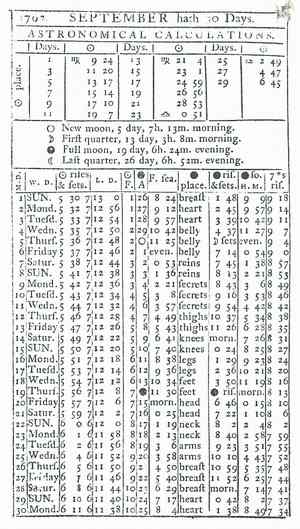
While the columns have changed a little, and the typeface is different these days, that 1793 page is substantially the same in format as the ones you’ll find in the 2008 The Old Farmer’s Almanac that went on sale last week:
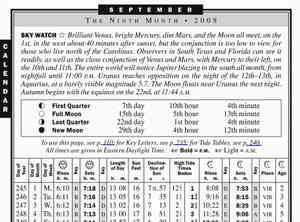
One of the limitations of ye olde print world is that these pages have been pegged to a specific location; for the national edition of the Almanac in the U.S. it’s Boston; for Canada it’s Ottawa. This means that if you live elsewhere, as most people do, you need to use conversion tables printed in the back of the book to correct for your location.
For the past couple of months I’ve been working on a web-based application that does away with this limitation, allowing the left-hand calendar pages to be generated for any location in the U.S. or Canada. This application — dubbed My Local Almanac — went live an hour ago, and I’m quite proud of it.
Take a look at this sample page for Dublin, NH and you’ll see that it bears an awful lot in common with that page above from 215 years ago.
Needless to say the process of creating this application has taken me deep into the heart of astronomy, creating algorithms to quickly compute the various columns of information. I’ve learned about the great zodiac debate (sidereal vs. tropical; or “do we use the heavens as they were a long time ago, or as they are tonight?”), about places with 5 high tides a day, and about how the moon sometimes neither rises nor sets in the north. I’ve learned about the Equation of Time and about how it’s noon when the sun is directly overhead, but only if your longitude is along the Standard Time Meridian for your time zone.
I’ve also learned a lot about handcrafting PDF files (EZPDF I bow before your excellentness) and how to effectively deliver products that take 2 or 3 minutes to construct behind the scenes.
All that’s left to do now is sit beside the terminal waiting for the first customer to come along and make the first purchase. Perhaps it could be you: My Local Almanac.
Cover of the September 18, 2007 Monadnock Ledger-Transcript: headline reads “Fructose levels cloud ongoing slushee debate” and the story concerns whether or not slushees should be allowed in the cafeterias of local schools.
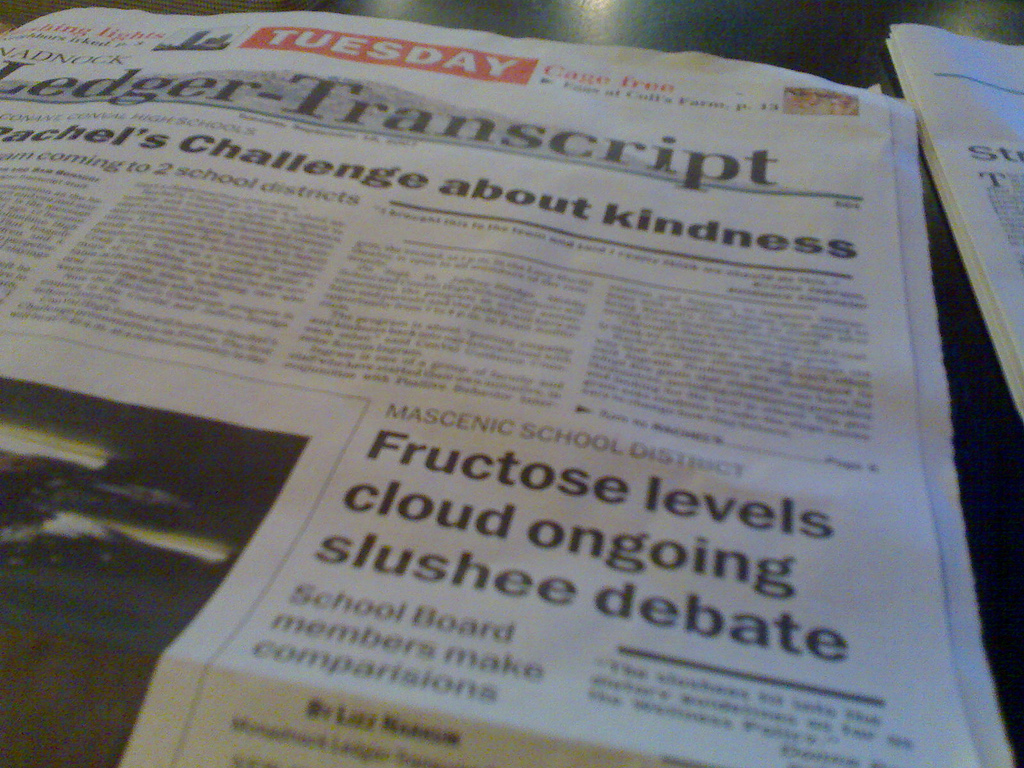
From this morning’s Monadnock Ledger-Transcript, dateline Peterborough, New Hampshire:
At 6:45 pm a Riverview Apartments woman reported her cat was in her bathtub dieing and asked police to remove the cat because she was concerned that it wasn’t healthy to have the cat around her children. Sgt. Richard Nelson picked up the cat, took it to the recycling center and disposed of it.

I’ve always wondered how the geography of Prince Edward Island maps over the geography of my home-place of southern Ontario. Now, thanks to Google Maps and Acorn, I know:
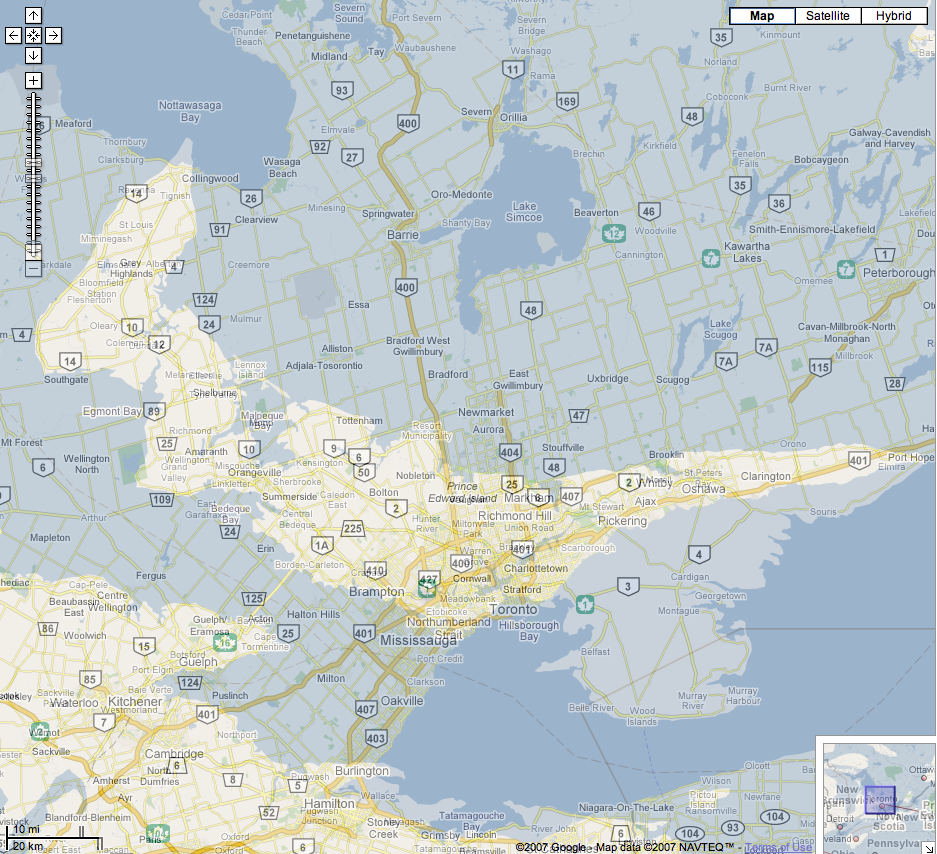
I’m sure variations in latitude and map projections mean this isn’t a completely accurate size comparison, but it’s an interesting ballpark nonetheless.
Every once in a while I get an email from one of you in the readership asking for travel advice. Sometimes the questions are specific — “I need a good hotel in downtown Boston” — but, more often than not, it’s general advice you’re seeking. Here’s a question like that from yesterday’s email:
I’m determined to take a trip to Europe next year with my boyfriend, and it will be my first trip abroad. I would really like to do a tour of Scandinavia and The Netherlands.
I don’t know anyone who has really visited that area… and you seem fairly proficient in securing seat sales, and finding neat places to stay and whatnot.
While every trip is different, and every traveler is different, here are suggestions, gleaned from my own experiences, that might help.
Pack light. This is the number one way to increase the enjoyment of any trip. Pack what you would normally think reasonable, then cut it in half. Don’t feel like you have to plan for every eventuality and ever possible weather event (you can buy a raincoat, or a sweater anywhere in the world). Ideally you will fit everything into one medium-sized backpack. The benefits: you don’t need to check your luggage on the airplane, if you’re in a new city in the morning it’s not a hassle to carry your bag with you before you check in to your night’s lodging, and, most of all, you’ll feel considerably more footloose and fancy free.
Don’t obsess about travel deals. If you travel in the off-season to Europe (late October to April) from Canada you’ll pay about $650 to $900 return per person for air travel. If you get a quirky good deal you can take this lower — we did Boston to Dublin return for $400 each last year, but we had to get to Boston! — but I’ve never seen the Air Canada return fare from Halifax to London lower than $398 before taxes ($646 all-in). This doesn’t mean you shouldn’t shop around, but don’t put off a trip just because you haven’t found the “deal of the century” on the airfare.
Consider your flight options. Even though I just suggested you don’t obsess about getting a deal, you have lots more options for getting to Europe from Atlantic Canada than ever before, and these are worth exploring for flexibility in price, destination and schedule: Air Canada flies Halifax to London; Zoom from Halifax to Belfast, Glasgow, London and Paris; Canadian Affair from Halifax and Fredericton to London; Condor flies from Halifax to Frankfurt; Corsair from Moncton to Paris; Icelandair flies Halifax to Reykjavik (and beyond). Add in flights that route through Montreal, and you have a lot of choice.
Think about flying from Charlottetown. It’s almost always cheaper to fly out of Halifax when you’re going to Europe. And while saving $300 or $400 might seem like a fantastic idea months before you leave, when you arrive in Halifax on your return flight and are faced with a 4 hour drive back to Charlottetown after sitting on an airplane for 8 hours after getting up at 3:00 a.m. Halifax time, you’ll wish you bit the bullet. The last couple of trips we’ve taken we’ve paid the Charlottetown premium, and have never regretted it.
Take a shower when you land. Whether you use an airport lounge (Air Canada has a very nice arrivals lounge at Heathrow) or public showers (almost all international airports have them tucked away somewhere, sometimes free and sometime for a small fee), you will feel about 100 times better after you shower, especially if you’ve flown overnight. You’re going to be battling jet lag, lack of sleep, and a journey to your final destination; it’s worth it to take an hour or two, have a shower, get a good breakfast, and then continue on.
Remember that Europe is small. Here are two maps that shows the relative size of eastern Canada and the U.S. to a good chunk of Western Europe:
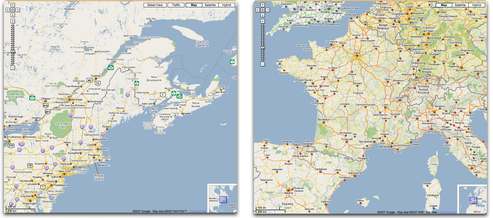
Google says that it’s a 11 hour drive from Charlottetown to Boston; which is about the same as the drive from Paris to Florence. This means both that you can see a lot of Europe relatively easily, and also that you can be flexible with where you start and finish your trip (when we took our cheap flight to Dublin last year our final destination was Porto, Portugal). The train and discount airlines can get you almost anywhere you want to go in Europe cheaply and quickly.
Consider small cities. If your regular everyday life is in Charlottetown, being dropped into the middle of London or Paris can be perplexing. There are a lot of smaller cities in Europe that are just as interesting and yet far more manageable: rooms will be cheaper, you will find your way around more easily, and you’ll avoid the lines and other congestions of the mega-cities. Who’s ever heard of Ancona, Italy, for example; yet it was my first experience of the country (we took the ferry across from Croatia and landed there), and it was fantastic. The secret of Europe is that almost anywhere — even the cities of which Lonely Planet says “a second-rate industrial city not worthy of your time” — are sufficiently different from Charlottetown to hold considerable interest. I’ve had loads of fun in Zaragoza, Perpignan, Cheb, and Genoa; I’ve only driven through Paris on the way out of town, and I’ve found London overwhelming every time I’ve visited.
Don’t bring guidebooks. While it might be impossible to resist the urge to pre-inform yourself about your destinations, I’ve found that every time I’ve traveled without a guidebook in hand — whether by decision or circumstance — the trip has proved more interesting. If you travel with a guidebook you’re going to end up at the places the guidebook sends you, whether for lodging, sights or food. Travel on your own wits, and using the advice of locals, and you’ll randomly end up in places you never imagined. A chance encounter with a Russian poster-art exhibition trumps a visit to yet another “significant Catherdral” any time.
Book a room for your first and last night. And then leave the rest to chance. Of course this is more difficult if you’re traveling in the heart of the season to a popular place. But if you’re in the off-season you’ll almost never have a problem finding a room, even if you show up in a new city at 4:00 p.m. It’s this approach that found us a room in a 500-year old building in the heart of Ceske Krumlov, a riverside guesthouse in Chiang Mia with awesome watermelon punch, and staying overnight at a bizarre health spa in Toplice. Not having an assured room is, of course, somewhat stressful, especially the first couple of times you go into it; once you realize that things have a way of working themselves out, and after the first amazing room-by-happenstance, you’ll never go back. That all said, having a room pre-booked for the night you arrive, and for the night before you leave, makes things a lot easier, and this is a time that random chance is best set aside.
Don’t underestimate the stress of travel on a relationship. No matter how much in love you are, how compatible your everyday lives are, how juiced you are to travel together, life on the road is different from life at home. Different enough that it’s almost like you’re starting a new relationship when you travel. Some lucky couples find their travel relationship sings as smoothly (or better) than their home relationship. Others finds themselves completely incompatible. I’ve had two friends each break up with their travel-partner mid-trip because of the unexpected stresses of travel (and, oddly given the trips were on different continents, the same woman was involved in both cases). Most people seem to find their way. But you have to be prepared to be twice as flexible as you usually are, learn to recognize the signs of a nearing total melt-down, and, generally, not expect things to work like they do off the road. If you’re planning an extended trip and have never traveled together, I suggest a short “training trip” somewhere close by (Toronto, New York, Boston) so that you can get a feel for your partner’s travel style. The last thing you want to do is end up in downtown Paris on your first afternoon only to find that you each interpret “hostel” in a completely different way.
Don’t worry about language. It helps to have a small phrase book in your pack to help with stickier situations. But you’ll be amazed how many people speak English (and 5 other languages) in Europe. And how much you can achieve with sign language. Remember that in any given situation there are only so many possible things that can happen: you walk into a bakery, you’re probably looking for bread; get on a bus and point to the fare box, you’re probably wondering how much the fare is. With this in mind you soon realize that there’s almost no situation than cannot be conquered; learn the words in the local language for “good morning,” “thank you” and “a cappuccino, please” and you’ll be set.
Don’t worry about money. Of course if you don’t have a lot of money you’ll have to worry about it at least some of the time. But with ATM machines in absolutely every corner of the world, and the Euro in use almost everywhere in Europe, the days of travelers cheques and wiring money and complicated currency exchange are over. Expect your credit card to be less useful in some places than you might expect (you can’t use a North American credit card to pay for French highway tolls, for example), keep a day’s worth of walking around money on hand, and if you’re traveling with a partner split your cards and cash between the two of you. Otherwise, rest easy in the thought that an ATM will never be more than a few blocks away and don’t walk around worrying about money: even if you lose your wallet (or it gets picked), the worst that can happen is that you pick up a pay phone, call back home and have some emergency cash sent Western Union. I lost all my travelers checks the morning after I arrived in South Korea 10 years ago, my mother get her purse snatched in Wenceslas Square in Prague, a friend got his wallet and passport lifted in Italy while he was asleep; in all cases we figured things out and continued our travels.
Consider a longer stay. While it can be fun to do a blitz through Europe — 10 countries in 15 days and the like — consider the possibility of traveling to one city, renting an apartment for two weeks, and traveling slow. You can find apartments for rent on craigslist and other similar sites — try Googling for “flat in Berlin” or “short-term rental Milan” and the like. You’ll pay a lot less, can unpack once, and you’ll get to know the food, people, and everyday life of your chosen destination in a completely different, more intimate way than if you breezed through in a few hours.
Some of these approaches will work for you, others will seem anathema. My best advice is simply to relax, be flexible, and seek out new experiences.
CBC Radio 3 is the only reason to get Sirius Satellite Radio. And now you don’t even need that: stream this. Cool.
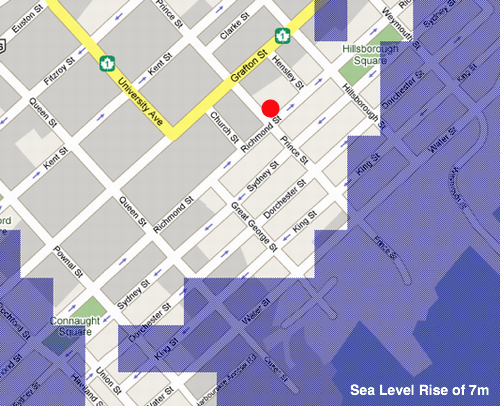
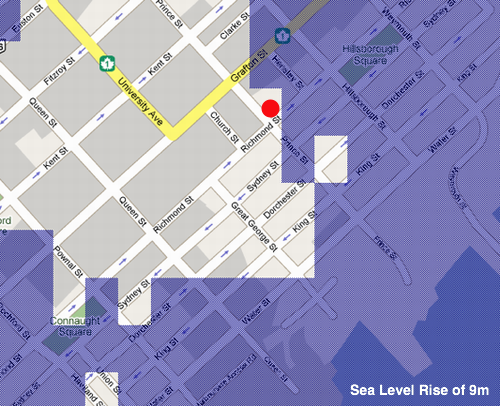
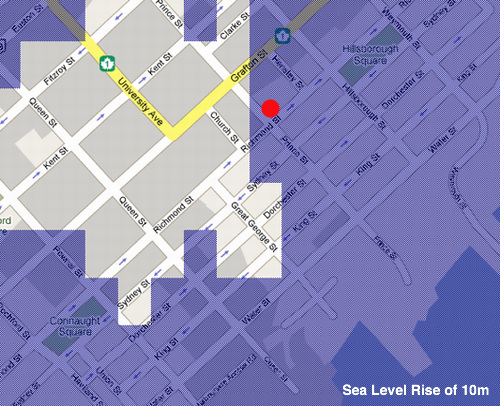
From Flood Maps (about), three visions of the future of our house at 100 Prince Street in Charlottetown as sea levels rise 7m, 9m and 10m.
About This Blog
 I am Peter Rukavina and this is my blog. I am a writer, letterpress printer, and a curious person.
To learn more about me, read my /now, look at my bio, listen to audio I’ve posted, read presentations and speeches I’ve written, or get in touch (peter@rukavina.net is the quickest way).
I have been writing here since May 1999: you can explore the 25+ years of blog posts in the archive.
You can subscribe to an RSS feed of posts, an RSS feed of comments, or a podcast RSS feed that just contains audio posts. You can also receive a daily digests of posts by email.