
We leave for Italy in a week for a two-week family vacation. And so I got in my car and drove out to the remotest tundralands of Charlottetown to visit the CAA in their new “you can’t help but drive here now — cars, aren’t they great!” location to get an “International Driving Permit.”
I seem to go back and forth on this seemingly useless piece of documentation: in odd years I bite the bullet, pay the $27 ransom, and get one; in even years I don’t, and thus risk immediate imprisonment in an Italian roadside offender prison.
Tourist literature seems to be split on whether an IDP is actually needed or not, with the majority view recommending it. But I’ve always been suspicious of this, and I’ve never actually heard of anyone being asked to show their IDP to rent a car, or otherwise.
As near as I can tell the sole practical function the IDP is to translate into other languages the words “private passenger” on the back of my PEI driver’s license — in other words to let the Italian highway police know that I am not licensed to drive 18 wheelers on the autostrada.
Why it takes two passport-sized photographs and a $15 fee (and why it expires after a year), I do not know.
Have you or anyone you know ever found that having an IDP was required or useful when traveling?
I went to book my tickets for PlazeCamp this morning, and the Air Canada computer system was down, so my travel agent couldn’t make the booking. Now I hear that their computers are down all over the world, and that they are checking everyone in by hand.
Here’s the understated Air Canada bulletin. Their operational status page has no information on this, but looking at the flight departure information for Pearson Airport it’s obvious that all hell has broken loose, with about half of Air Canada flights delayed, and with delays of 30 to 90 minutes common.
CBC is on the story, and has a somewhat less obtuse assessment than Air Canada’s:
“It’s totally chaos out here. There are hundreds and hundreds of people in lineups that are absolutely going nowhere,” said Catherine Clark, a CBC producer with Marketplace who was waiting for a flight.
I’m happy to announce that we’ve just set the date of PlazeCamp, aka “Plazes Developer Day,” for Saturday, January 12th, 2008 at Plazes HQ in Berlin.
As anyone who has been involved with Plazes for a while knows, the Plazes API has gone unloved and unappreciated since the relaunch of the server earlier this year (which is not to say that there hasn’t been a lot of work internally at Plazes focused on this!). Among other things, PlazeCamp is a “coming out” party for the soon-to-be released brand-new Plazes API. It’s also an opportunity for the Plazes development team to welcome the developer community back into their home (both digital and physical).
The date has been set, you can book your tickets now. Details on format will follow, but you can expect a mixture of the formal and the informal, with plenty of time for actual developing and hacking, and plenty of time to eat, drink and be merry.
To register for PlazeCamp, just “Me Too” this Plazes Activity.
Okay, here’s something cool about the CBC Radio One program Spark: this morning at 11:00 a.m. I taped an interview with host Nora Young. While the episode that my interview will form part of won’t air until next Wednesday, the raw audio of the entire thing is online.
This is wonderful on many levels, perhaps most so because it allows listeners to understand better the voodoo that happens between the raw unvarnished interview and the polished, edited version that goes to air.
You cannot truly appreciate the wonders of Nora Young until you’ve sat on the other side of the microphone from her: she is one of those rare broadcasters who is curious, a good listener, and capable of both understanding and emitting sarcasm. It was a pleasure to be her guest.
While the terrorist threat level may have lessened, this is not to suggest that CBC Charlottetown is without its challenges. Witness this shocking bottled pop controversy.
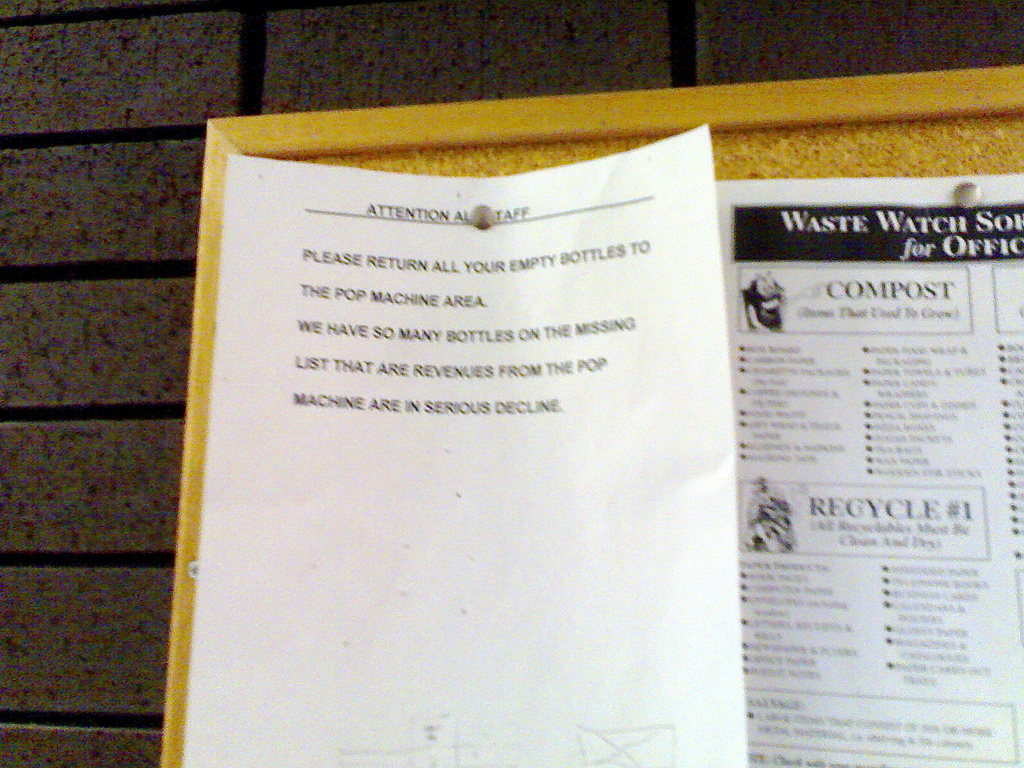
Revenues from the pop machine are in serious decline (emphasis mine).
What’s missing from this picture? The security guard post at CBC Charlottetown is history. After it was installed shortly after 9/11, every visitor to the station had to identify themselves and sign in. For regular visitors it was like a security guard was posted at the front door of a friend’s house.
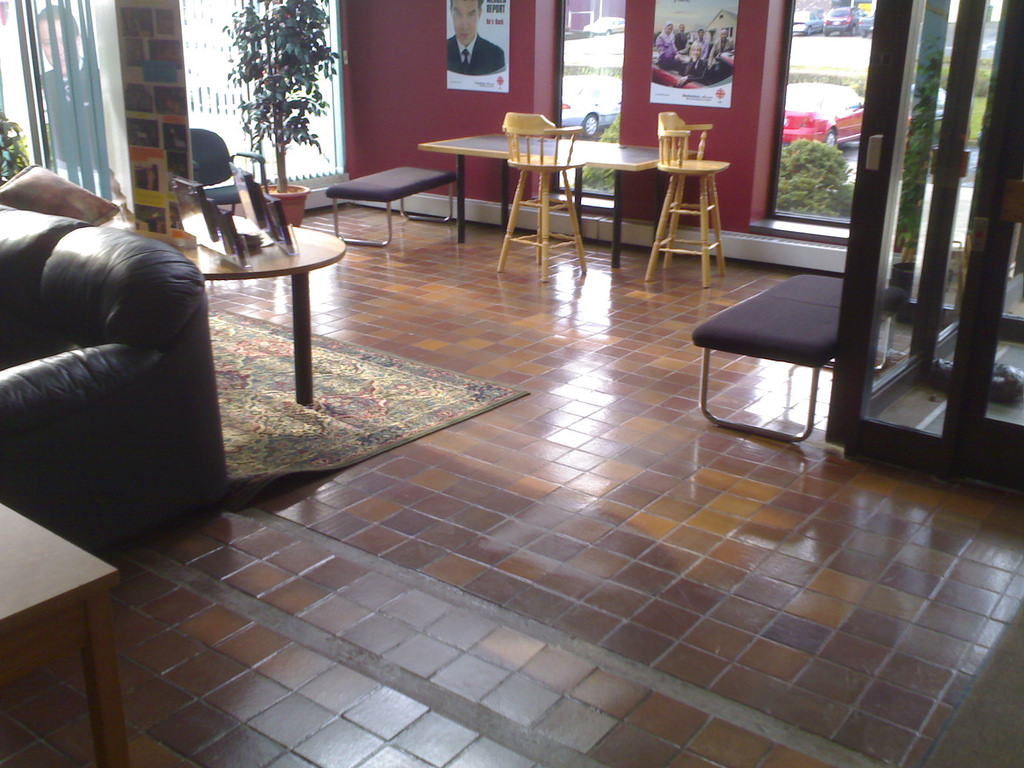
Thankfully cooler heads have prevailed, perhaps realizing that the cost and energy expended by trying to product producers, reporters, hosts and technicians from terrorist threats wasn’t a worthwhile effort. When I visited today, and glided in the front door unimpeded, it felt like coming home again.
When I was a kid, music was a commodity, now it’s an ocean. I remember distinctly going into Sam the Record Man and buying 45s — two songs! — with money saved up from my paper route. Now, through iTunes, Limewire et al I have, essentially, access to all music ever made.
While this is heady and, by today’s generation expected and natural, I think that this era too will pass, and, again with technology as the enabler, we’ll return to a rather pre-historic era where music is hand-crafted and hand-delivered. After experiencing a generation of boundless, easy access to more and more generic music, I think we’ll seek out unique music experiences and a physical, more obvious connection to music makers.
By way of example, here is what arrived in the mail today from Issa (aka Jane Siberry):
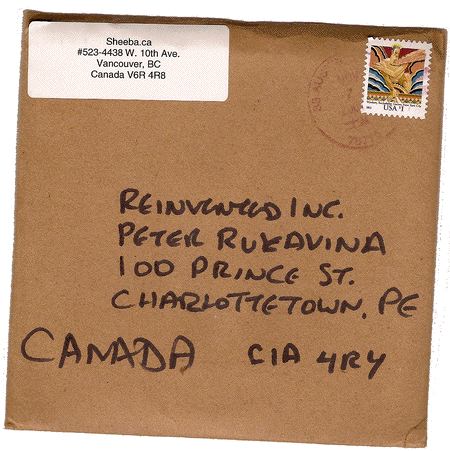
Inside was a CD with two songs. I paid $15 for it — $7.50/song. I choose the price, and my receipt said:
1 x MAILORDER WILDERNESS (tour CD single) to help fund Issa recordings EF (education factor): disc=$1.5/paypal fee= .45/postage about $1 (US cities) so please pay above $3 if you want to provide revenue to Issa. = $15.00
I haven’t even listened to the music yet, and I already think of this as my most-treasured bit of music for the year.
This approach is not a return to music-as-commodity, nor is a “music as ocean.” It has more in common with patronage than anything else.
In its least soulful interpretation it is a realization of the untapped equity offered by a personal relationship — or at least the appearance or perception of a personal relationship — with the artist. In a more positive light it’s all about self-determination, disintermediation, DIY and all that other cool stuff.
But whatever it’s about, it’s really really cool to get a special, hand-addressed CD in the mail. You can’t buy the physical object anymore, but you can buy the MP3 files contained thereon.
When I first arrived on PEI, 14 years ago, I was almost immediately swept up into the maelstrom of Victoria Row, the stretch of historical Charlottetown street where the PEI Crafts Council, where I was working, was located. For some reason the businesses of the street decided that it should be me, a complete outsider (and not a business owner at that), who should lead their ragtag business organization. And so I spent a pleasant summer mediating the competing interests of the various merchants and restaurateurs (“sure having a brass band playing on the street is great for you, but it’s scaring away my customers!”).
Beyond the internecine business warfare, our little group actually managed to do some good that summer: we worked with the Red Cross to organize a big outdoor fund-raising concert to support their efforts in Rwanda.
Nobody worked harder on pulling that concert off than Sandra Furrer, owner of the Black Forest Café. Somehow, between the demands of soup making and bread baking and running her restaurant, Sandra found the time to organize sponsors, find bands to play, and myriad other tasks. She even donated her jean jacket to be raffled off (it ended up with my brother Steve).
A few years later Sandra sold the café and moved away. From time to time I would hear news of her from friends who kept in touch. And today came the sad news that, at the young age of 39, she died from cancer last month. Her friends placed an obituary in today’s paper:
May 8, 1968 — October 24, 2007 - Our friend and loved one passed away in Baden, Switzerland, from cancer. The former owner of the Black Forest Cafe in Charlottetown will be greatly missed by family and friends near and far. Sandra leaves her parents, Inge and Kurt, her siblings, Sabine (P.E.I.), Rahel and Jonas. Nieces and nephews Alice, Florian, Sarah, Allieanna, Andrin, Benjamin, Hannah and Sophie. Sandra shared her love of food and wine with colleagues and customers at the cafe and at many memorable feasts. Raised with an appreciation of opera and classical music, Sandra shared her passion for all genres of music. An avid reader, Sandra’s library was filled with books in the five languages she spoke fluently. Her passions included movies, art, photography and dance. She encouraged and displayed the work of several Island artists at the cafe. Sandra first moved to P.E.I. as an au pair and her love of children enriched many young lives. She was the proud godparent to five children, including Lucas LeClair (P.E.I.). Her ashes will be spread in one of her favourite places, Tocino, Switzerland.
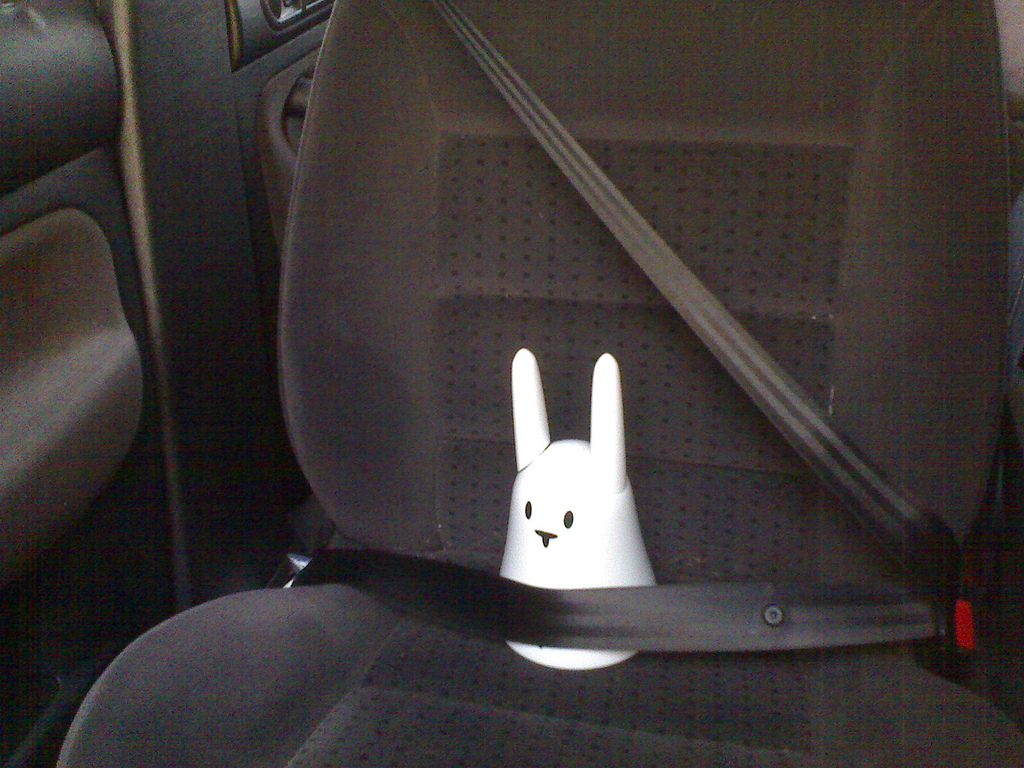
Antigone, our wifi-enabled rabbit, is coming with me to CBC Charlottetown this morning to record an interview for a future episode of Spark. There’s no way I could expect Antigone to walk all the way out there, so we took the car. Oliver insisted that she wear her seatbelt:
About This Blog
 I am Peter Rukavina and this is my blog. I am a writer, letterpress printer, and a curious person.
To learn more about me, read my /now, look at my bio, listen to audio I’ve posted, read presentations and speeches I’ve written, or get in touch (peter@rukavina.net is the quickest way).
I have been writing here since May 1999: you can explore the 25+ years of blog posts in the archive.
You can subscribe to an RSS feed of posts, an RSS feed of comments, or a podcast RSS feed that just contains audio posts. You can also receive a daily digests of posts by email.