
I seemed to have missed the fact that Casa Mia is now open at 8:00 a.m. (thank goodness for The Buzz). Now I can get my morning coffee right after dropping Oliver at school, without an awkward “stop at the office for a half hour” delay.
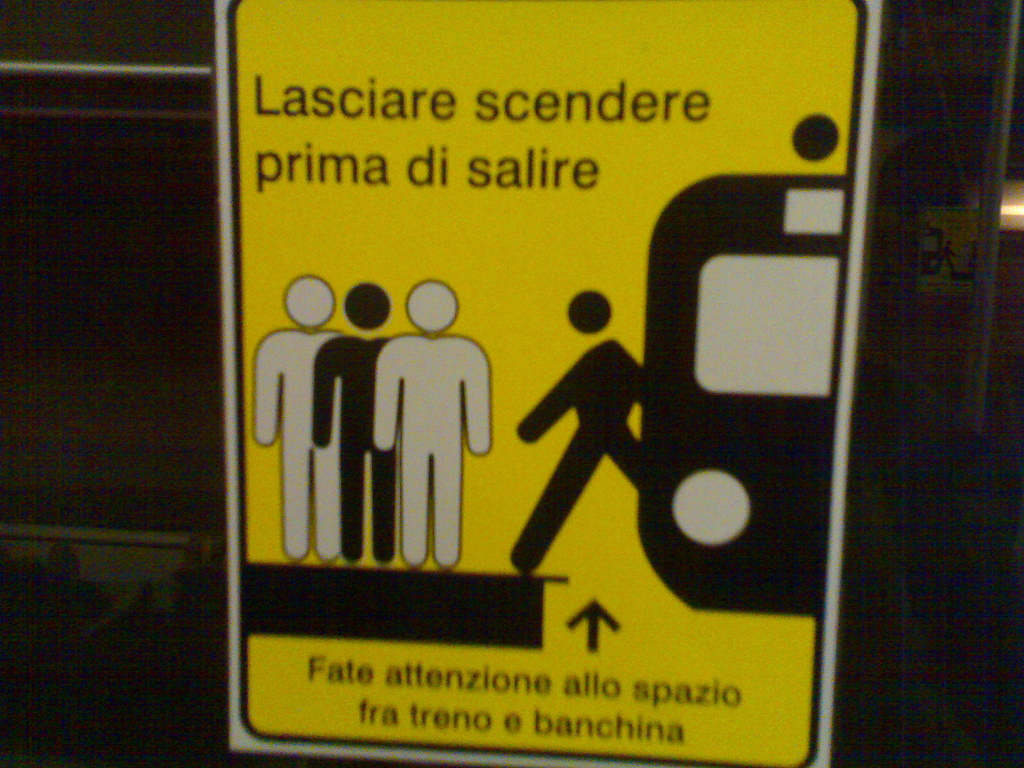
Spotted on the Metro in Genoa: Fate attenzione allo spazio fra treno e banchina means “pay attention to the space between train and the platform.” In London they simply say “Mind the Gap,” which, by compare, seems a miracle of brevity.
Regular readers will recall that I run cold on religion, alternatively passively dismissing all things related to it and actively making fun of those that don’t. And I’m not in line to change my take. But visiting the Duomo in Milan — the impressive cathedral at the heart of the city — I did have cause to ponder, if nothing else, the enormity of the collective delusion.
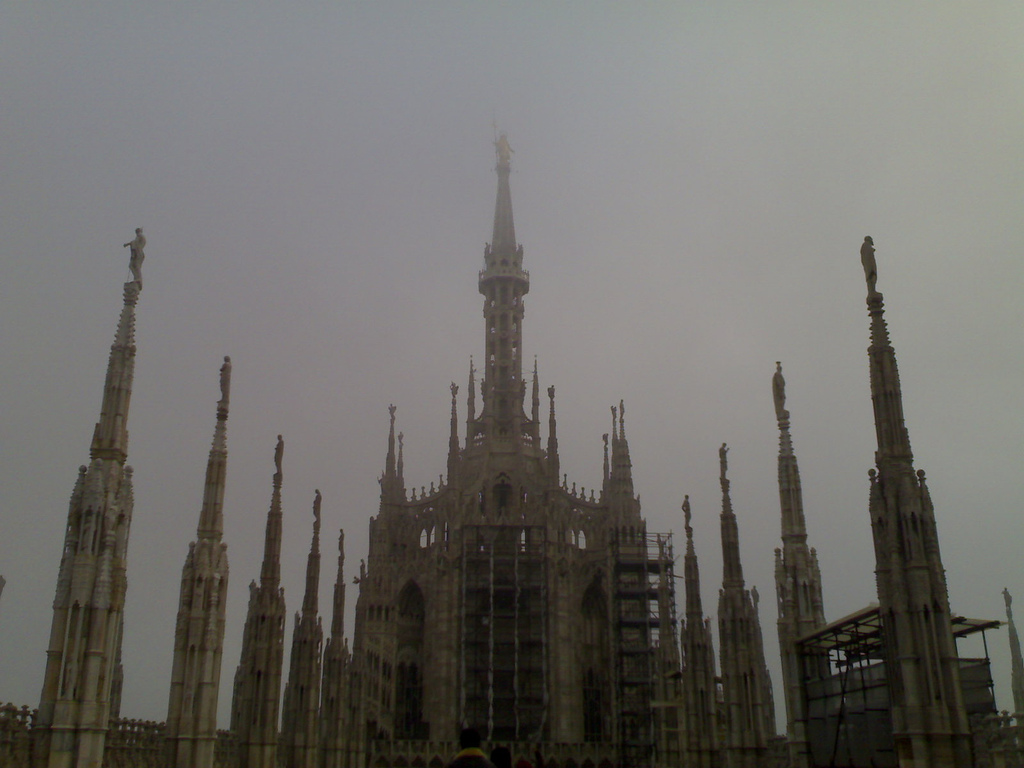
To construct a building so grand, so impregnated with mythology, so much a part of the city that surrounds it, over the hundreds of years it took to create speaks to something substantial.
The Guardian, Prince Edward Island’s newspaper of record, has traditionally had a web presence that’s lagged about 4 years behind current design and usability trends. This has improved a lot in recent months: they’ve got RSS feeds and Nigel Armstrong and user-generated content.
And now they’re about to release a snazzy new digital edition of the print paper.
Their last try at this involved installing software on your machine and was more “hobbled PDF” than “leveraging web technologies” (although still nice to have access to when you’re in Kathmandu).
The new version, branded Smart Edition, has much to recommend it:
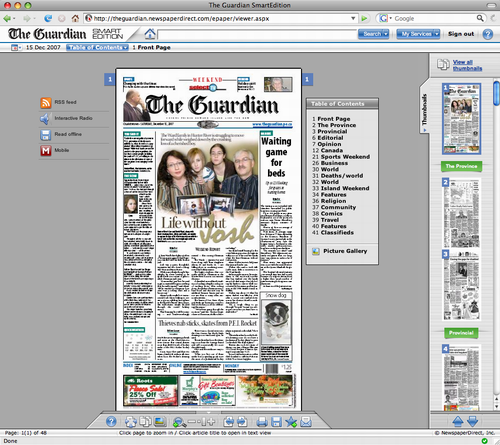
There’s no extra software to install — it’s a completely in-browser application. Among other nice features you’ll find:
- Integrated RSS feeds — links in the RSS call up pages in the Smart Edition.
- Text-to-Speech — get any story read to you (with a not-bad-sounding robot voice).
- Photo Index — a clickable thumbnail index of all the images in the print edition.
- Full-text search — searches everything, including the text of classified word-ads.
- Alerts — email alerts for keywords (they call this “Monitors”).
- Front Page by Email — you can sign up to receive the front page graphic by email as soon as it is published.
- Offline Viewing — which does require installation of Windows-only application.
- Mobile Edition — a mobile-optimized version of the paper is available (it works great on an iPod Touch).
- Social Software Links — built in article links to Digg, del.icio.us, and built-in blog posting for Blogger, Wordpress and Livejournal.
Of course The Guardian didn’t built all this out themselves — they’re using NewspaperDirect technology. But kudos to them for realizing that it might be worthwhile to experiment with a modern feature-rich approach to web delivery.
The Smart Edition is currently in testing and isn’t being officially marketed yet (although you’ll find a “Today’s Smart Edition” link on the side in the left-hand sidebar under the weather).
We arrived home from Italy yesterday to find Brian Mulroney testifying on Parliament Hill. Once I turned on the television I couldn’t turn it off: it was compelling television, both because of Mulroney’s skilled rhetoric and because of the questioning (and sometimes goading) he received from the members.
The most amazing thing about Mulroney’s testimony is that by the end of it he had me thinking that it was the most normal thing in the world to have $225,000 in cash squirreled away in safe deposit boxes, cash that doesn’t get income tax paid on it until the heat is on five years later.
It’s only on sober second thought that the craziness of it all bubbles to the top.
If you have an opportunity to watch the video, I recommend it: you’ll learn a lot about how to win friends and influence people.
If you have cause to drive in Italy — and if you want to visit the hinterlands you likely will find yourself navigating the hills and valleys in a rental car — you may be daunted by the prospect of an otherworldly road experience. I know I was. So here’s a small guide — based, mind you, on only two weeks experience — for North Americans looking to take the plunge.
First, rent the smallest possible car you can that will fit your party and its luggage. There are 2 or 3 classes of rental cars smaller than the smallest possible car you can rent in the U.S. or Canada; get one of those if you can. You’re going to find yourself driving through impossibly narrow streets and alleys at times, and if you rent that comfortable-looking Volvo sedan you’re going to regret it. You’re also going to pay about double what you’re used to for gasoline in Italy (albeit in more fuel efficient cars), and you’re going to want the maximum parking flexibility. So go small.
Of course when you’re speeding down the autostrada at 120 km/h in your tiny SMART car with trucks all around and BMWs zooming by you doing 180 km/h you’re going to feel tiny and vulnerable. But that is a good feeling to have, because you are tiny and vulnerable, and there’s no use trying to insulate yourself from that with bigger doors or better shocks.
You’ll have all the regular chains — AVIS, Hertz, etc. — available to you at most airports, plus European or Italian agencies as well. The past two times I’ve gone looking, booking through easycar, which often acts as a broker for others, has resulted in rates 50% lower than anything else I’ve found. Your mileage may vary.
Next, get familiar in advance with the basic Italian road signs: knowing the difference between “Do Not Enter” and “No Parking Here” is really useful. As is knowing words like “Exit” and “Entrance.” If you get an International Driving Permit from CAA or AAA you’ll likely get a handy booklet about all this; study it a little on the plane ride over.
You will find yourself paying a lot more road tolls than you are used to. Make sure you leave the airport with some cash. Generally you’ll enter a toll road and receive a ticket from an automated machine and then, when you exit sometime later, you’ll pay the poll either to a person or a machine. The machines take bills and coins and have English text, and it’s pretty easy to figure everything out. Just be sure to stay out of the lanes marked “Telepass” — you don’t have one of those. Just use the lanes marked with a graphic of cash and you’ll be fine.
As to driving itself, it takes some getting used to. The best mindset to enter with is that you’re going to become part of a living traffic organism. If you come to understand how that organism works, and what other parts expect from you and what you can expect from them, you’ll do okay. If you try to drive like you’re in Summerside then you will get quickly frustrated (and will likely attract the wrath of other drivers).
Of course the only way to actually learn how the organism works is to join right in. So expect some early wrath enduring and just try not to do anything too stupid you’re first time out (you can always take the next exit instead of veering across 3 lanes and over a median).
In general it’s safe to assume that absolutely anything is possible, and indeed likely. Spaces you wouldn’t think that delivery truck could squeeze into — it will. The car that looks like it’s pulling out to pass you on a blind mountain curve actually is.
The traffic wants to flow; anything that stops the flow will be rejected or routed around like a foreign invader. You never, ever stop for pedestrians, even at crosswalks. Get used to roundabouts, and understand how they work, because there are thousands of them, and the flow demands you glide through them without hesitation.
While driving on the highways and super-highways will be familiar to you — with the exception of the very, very, very fast drivers and the 120 km/h speed limit — driving inside cities, town and villages is likely a breed apart from anything you’ve ever experienced. Italian cities evolved long before the automobile so they’re not optimized for it. There are more one-way streets, more “turn right, then left, then right, then left, then U turn” moves required. And, as I suggested above, narrower streets than seems physically possible.
The best way to know if something is possible — “could my car actually fit in that tiny space” — is to watch what others are doing. Indeed that’s the best way to learn everything you need to know.
Once the driving stops, the search for parking starts. In my experience almost every community of any size (with the possible exception of Milan) has parking available somewhere. Usually your best tactic if you want to see the centre of a given town is to get off the highway and follow the signs for “Centro”. Then you look for the big white-on-blue “P” signs, which will generally lead you to underground parking garages (in towns and cities), or community parking lots just outside the village centre (for smaller places). Sometimes you’ll pay for parking, sometimes you won’t.
If you’re booking a hotel in your next city along the highway, ask if they have parking. Suburban hotels likely will have their own lot; downtown hotels sometimes have a garage of their own, or an arrangement with a nearby garage, but you’ll likely pay 15 to 25 EUR a day for the privilege (although we only paid 5 EUR a day in the off season in Genoa).
Of course it’s possible — very possible — to visit Italy without a car at all. You can take the train, or the bus, between major cities, and even into the hinterlands. But by doing so you will miss the joy of taking a random exit off the highway and finding yourself, 5 km up the road, in the middle of a 1000 year old village with a great view of the Alps. The next time we’re in Italy we’ll likely not rent a car; Florence, Rome and Venice beckon and there’s no reason to have a car there. But this trip I’ve certainly glad we had one, as it allowed us to see parts of the country that would have otherwise been unaccessible to us.
As I sit here in our hotel in Revere, MA, by my reckoning we’ve been up since 1:55 a.m. local time when we got up in our hotel north of Milan. So it’s been a long day. I am always confused by the fact that it seems to take 2 hours longer to travel west across the Atlantic than it does to travel east; as a result just as you’re thinking “well, at least this flight will be over soon” you check your watch and realize you’ve still got 4 more hours to go.
Alitalia prove to be an efficient and capable airline. There was no “wow” factor, but nothing went wrong, all their lines were short, and we arrived early going both ways. Milan’s Malpensa airport was a joy to travel through, especially compared to airports like Heathrow and Frankfurt: it’s compact, uncrowded, and doesn’t force you to march through a obstacle course of “retail experiences” on the way to the boarding gates.
As it turned out, our “airport hotel” — Hotel Motel Luna — was 2 km from the shore of the famed Lake Maggiore. Alas we arrived after dark, and hurried off to the airport in the morning, so didn’t lay eyes on it. Another time.
The hotel, although a fair distance from Milan Malpensa, turned out to be an excellent choice: not only was the hotel itself beautiful, clean, and staffed by an extremely capable manager, but it was a straight 120 km/h shot down the highway to the airport, a trip to about 20 minutes with all the planets aligned.
The ongoing trucker strike in Italy played havoc with our plans to return our rental car with a full gas tank: every gas station we passed on the way to the airport had huge 1970s-style lines of up to 25 to 50 cars, in some cases extending out onto the highway itself. Fortunately our car rental agency — Locauto — was accommodating and only charged us regular price for the gas we didn’t fill up. Seems like we got out of Italy while the getting was good; the New York Times reports:
In the northern city of Milan, Antonia Carapacchi, owner of Citta del Sole, an upscale toy store, registered “a distinct drop in sales and clients” in the last two days, the result, he speculated, of parents choosing to use increasingly sparse gasoline on more pressing needs. Unlike clothes or books, he said, toys have only one important season, Christmas, the moment the unions decided to strike. “They’re going to plunge the entire industry into crisis,” he predicted gloomily.
We’re back to the Island tomorrow, weather-willing.
Fourteen years ago Catherine and I were passing through Napanee, Ontario on our way to our new home in Prince Edward Island. After dinner her grandmother Hazel caught me alone in the kitchen and slipped me an envelope with some cash in it. “We realize that you and Cathy probably aren’t going to get married,” she said, “so this move is as close as we’ll come, and we wanted to give you something.”
It was the nicest thing anyone ever did for us.
Hazel died this week. I will miss her dearly.
The next time you are in Oleggio Castello, Italy, be sure to dine at Trattoria della Commedia. We had a wonderful last meal in Italy there. The gnocchi in gorgonzola and honey was particularly mind-blowing.
Our Big Activity for today — and our last for Milan — was to visit the Museo Nazionale della Scienza e della Tecnologia Leonardo da Vinci, the “National Museum of Science and Technology.”
We’d been in Vinci itself, or at least nearby, earlier in the week, and had flirted with other aspects of Leonardoisme our entire trip, but had yet to dive in. This was our chance.
And by all evidence the museum is a fantastic one, full of interactive exhibits, labs, and fun activities. Alas almost all of the fun is available only if you’re in a school group or if you happen to visit on weekend afternoons. Otherwise you’re left to gaze forlornly through the sealed doors of the “iLabs” and pass on to static old-school exhibits on things like “the history of nickel” and “the wonders of plastic.”
All was not lost, however: their telecommunications exhibit had promise (although Lisbon does a much better job at the switchboard simulator), and a special exhibition about women and their bodies was well done (Oliver is now fully labially literate). They also have a very neat collection of ships, locomotives and airplanes, and a retired submarine onsite.
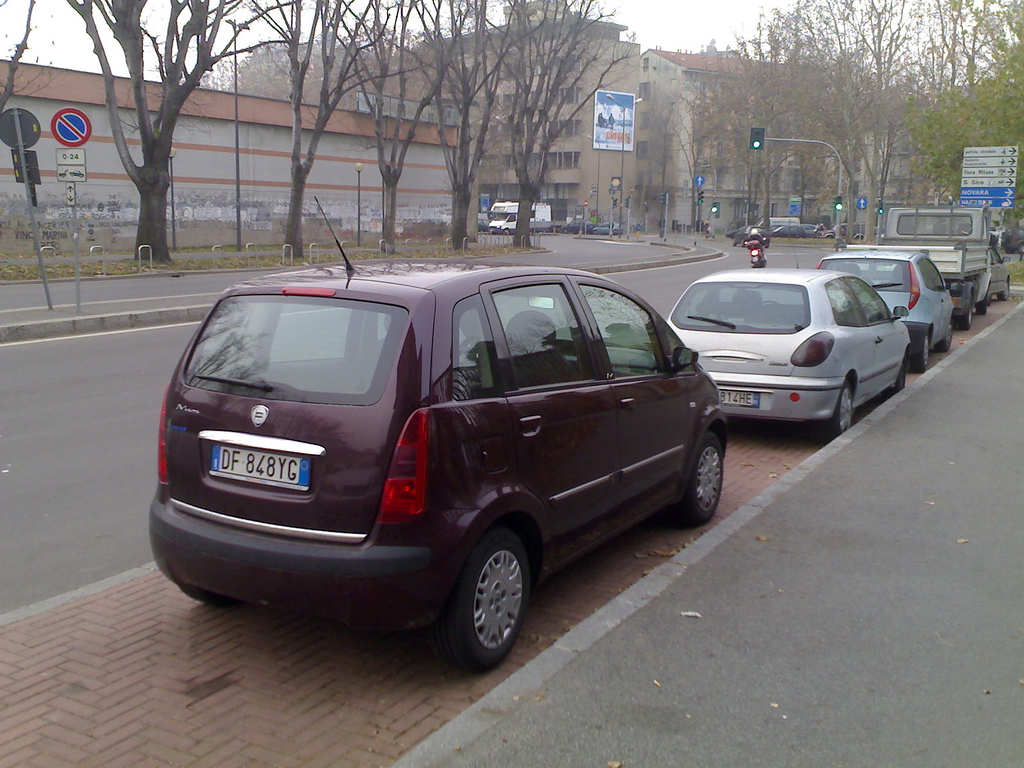
Finding a parking space for the museum — our visit was on our way out of town — was an interactive adventure in its own right. The traditional “parking garage” doesn’t seem to exist in Milan, so one is left to battle everyone else for the small number of on-street spaces. Once we found a space (it took about 20 minutes and lots of looping around) I spent the next several hours absolutely convinced that our car was going to be impounded (a suspicion heightened by the “No Parking, 0-24” sign on the street).
Fortunately my worries were for nothing, as the car was there when we returned.
And then began our struggle to get out of town. Without a map. With only a vague idea of where we were going. Somehow — largely due to Catherine’s talent for improvisational navigation — we succeeded, and here we are in the Hotel Motel Luna, a self-described “airport hotel” that seems like its awfully far from the airport (although they tell us we only need to leave 20 minutes to get there in the morning).
In a few minutes we’ll strike out to find a place for our last supper in Italy; in the morning we head to Boston.
About This Blog
 I am Peter Rukavina and this is my blog. I am a writer, letterpress printer, and a curious person.
To learn more about me, read my /now, look at my bio, listen to audio I’ve posted, read presentations and speeches I’ve written, or get in touch (peter@rukavina.net is the quickest way).
I have been writing here since May 1999: you can explore the 25+ years of blog posts in the archive.
You can subscribe to an RSS feed of posts, an RSS feed of comments, or a podcast RSS feed that just contains audio posts. You can also receive a daily digests of posts by email.