
I’d been pinning my hopes for a future life in Europe on the faint notion that I might somehow acquire Croatian citizenship by virtue of the fact that my grandfather was born there (or at least in some earlier version of “there”). Then, when Croatia gets admitted to the EU (which, of course, is not a done deal), I’d be in.
Alas, at least according to this consular information sheet, I’m too far out of the loop to qualify.
Given that the three other points of my genetic compass all go back at least one more generation in Canada, I think hanging my hat on the ancestral claim to European citizenship notion isn’t exactly solid.
Time to fall back on Plan B — getting PEI admitted to the European Union.
Dan, Steven, Isaac, MikeG and I went out to lunch at Royal Tandoor for this first time this afternoon.
The whole place is looking a lot better than it did in its former incarnation as Forbidden Palace: there’s a new paint job, new counters and new china.
Although there are promises of a menu at a later date, right now they’re operating in a “buffet only” mode, which seems to be a good approach for a non-Indian-food-aware market. The buffet is set up along one wall of the restaurant, near the back, and consists of a series of cold dishes followed by a series of hot ones:
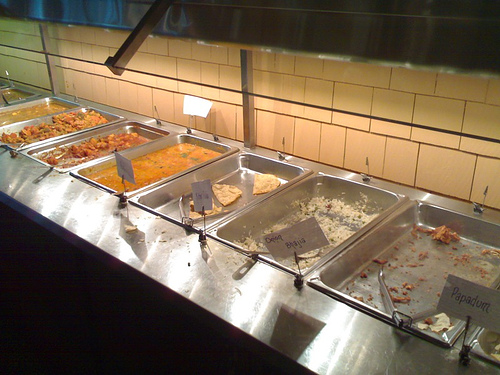
There was surprising variety in the offerings: chutney, salads, poppadoms, dal, a nice potato dish, etc. They lean heavily to the vegetarian side; of all the dishes on offer, only 3 contained meat. The food had a much stronger kick that the food at former Taj Mahal restaurant next door; it won’t burn your heart out, but it’s not the usual “tamed down for the Island palate” you usually find. That’s nice. Isaac pointed out that there was, in fact, nothing actually made in a tandoor oven on offer.
Although the buffet style doesn’t involve a lot of service per se we were well served by various water refillers and plate take-awayers. They only took cash for payment today; I suspect this is a temporary glitch.
The place was packed today, with everyone from Lobie Daughton to regular people; this certainly bodes well for a healthy future (although they did have a flyer in The Guardian last week, which is probably artificially inflating their early numbers).
It will be interesting to see how things develop from here; ideally they’ll leave the buffet in place for lunch (at $7.99 you can’t beat the value) and mature into a slightly more formal arrangement for supper.
Dan reminded me at lunch today that I have yet to update the Interactive Charlottetown Bus Map for the schedule and route changes that took effect on June 12. I took a stab at starting the update tonight, and got as far as getting routes #2 and #3 completed. The job involves a lot of typing (of schedule data) and fiddling (with map data because of minor route changes), so it takes longer than you would think. Although there was some procrastination involved in there too. I’ll aim to have the rest of the routes done by the end of the week.
It seemed only logical to me that NetNewsWire, where I keep my “whose feeds am I subscribed to” information, should somehow be able to relate to XFN — the “XHTML Friends Network,” the self-described “simple way to represent human relationships using hyperlinks.”
Because NetNewsWire lacks any mechanism for storing XFN information itself, I crafted an AppleScript-based solution that stores my relationship to each feed’s author in a SQLite database. You can download my Define XFN Relationship script and try it for yourself. Here’s how:
- Download the NetNewsWire-XFN.scpt file, rename it to something handy like “Define XFN Relationship” and move it to ~/Library/Application Support/NetNewsWire/Scripts — the directory where NetNewsWire scripts are stored.
- Edit the script and change the variable databasename to a location on your own machine (it’s hard-coded to a location on my machine right now; yes, this could be more elegant).
- Select a feed in NetNewsWire and select the “Define XFN Relationship” script from the Scripts menu.
- Select the XFN relationship(s) you have to the author of the feed you’ve selected — this brief introduction and this detailed background should get you started on what means what. Yes, the user interface is ugly.
- Click OK.
- Rinse and repeat.
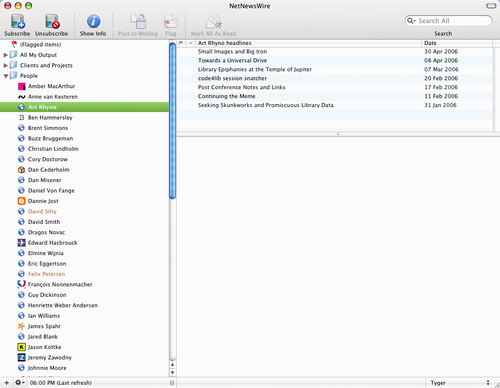
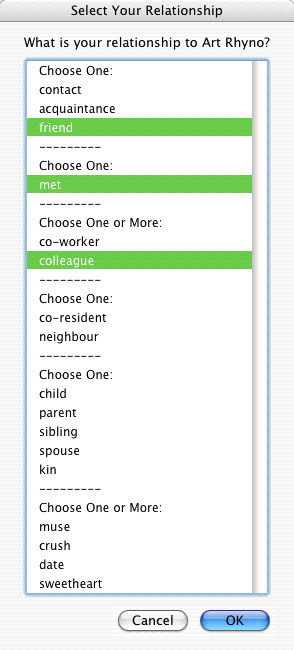
Here’s what it looks like in operation — I’m defining Art Rhyno as a friend and colleague who I’ve met:
First, I select Art’s feed in NetNewsWire…
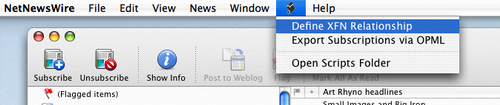
Next I select the “Define XFN Relationsip” from the Scripts menu…
And finally I select the reltionships that I have with Art:
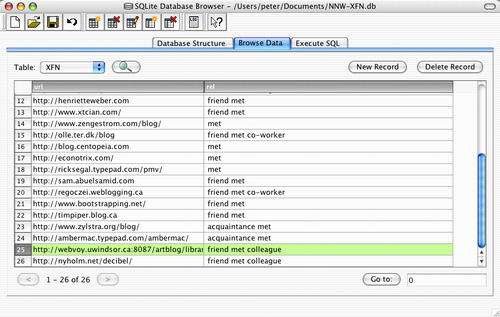
Right now I haven’t created anything that actually does anything with the data — the logical next step would be to write a companion script that outputs a blogroll file with the XFN relationships coded as described here. I’ll do that soon. In the meantime, you can use the handy SQLite Database Browser to look at the database file you’ve created:
If you’ve ever been out with Kevin O’Brien and seen him order a cup of tea, you’ll recall his explicit instructions to the server that the tea be served with actual boiling water.
I’d always thought this habit a bit neurotic on Kevin’s part, but after having had an opportunity in Europe to regularly be served tea made this way, I now understand completely.
Tea made with boiling water — as opposed to merely “hot” water that’s been sitting around all day on top of a Bunn-o-matic is simply much, much better tea.
And so I apologize to Kevin for thinking him neurotic, and encourage one and all to request the boiled.
As a side note, I wonder if it’s actually possible to make good tea any more now that many of us have switch to the “auto shut-off” kettles.
As another side note, I’ve suddenly realized that when I ordered “chá com leite” in Portugal this was most often being interpreted as “I’d like some tea, and I’d like some milk.” As a result I was served a pot of tea and a pitcher of hot milk. And paying for both. Mind you tea made with boiling water to which hot milk is then added is absolutely fantastic, and worth the price. But the question remains: how does one order “tea with a little milk” in Portugal.
 With some helpful pointers from the Apache on Series 60 folks, I’ve been able to set up my Nokia N70 mobile phone to share the Internet connection of my iMac. While it’s not a “mobile data” solution — I still have to be within Bluetooth range of my iMac to use it — it’s an excellent stop-gap measure that lets me explore the mobile web without paying thousands of dollars in data charges.
I’ve put together a little tutorial that goes through the steps I took to get this working reliably for me. The whole process has something of a “doing your own brake job on your car” feel to it. But it does work, and with some fiddling you can make it work reliably in your setup.
Cynthia Dunsford has written a nice synopsis of her trip to Les Îles de la Madeleine that should serve as a good introduction to anyone thinking of visiting (the most common response you get from Islanders when you ask them if they’ve ever been is “we really want to go over someday”).
About ten years ago Catherine and I went over with our friends Mike and Yvonne from Halifax. It rained for the three days we were there, but we had a good time anyway. At the time — and I suspect this is still true — it was much like one imagines PEI to have been like for the tourist 40 years ago.
About This Blog
 I am Peter Rukavina and this is my blog. I am a writer, letterpress printer, and a curious person.
To learn more about me, read my /now, look at my bio, listen to audio I’ve posted, read presentations and speeches I’ve written, see things I’ve favourited elsewhere, or get in touch (peter@rukavina.net is the quickest way).
I have been writing here since May 1999: you can explore the 25+ years of blog posts in the archive.
 You can subscribe to an RSS feed of posts, an RSS feed of comments, an RSS feed of favourites elsewhere, or a podcast RSS feed that just contains audio posts. You can also receive a daily digests of posts by email. I also publish an OPML blogroll.
Instagram • YouTube • Vimeo • ORCID • OpenStreetMap • Internet Archive • PEI.art • Drupal • Github.