Regular readers may recall that I’m somewhat stationery-obsessed. Drop me in a new city and I’d far rather visit the local stationery shop than almost anything else. It’s why, in part, I love Berlin so much.
Stationery is obviously an important part of the cultural landscape in Japan: the quality, and breadth of products available was awe-inspiring. The Ito Ya store in Tokyo Ginza was dizzying: 5 floors of everything from name seals to date books to fountain pens to fine Japanese paper. It was a miracle we emerged with me only having spent $100. But it’s not only at the high end: I saw a better selection of stationery in “100 Yen shops” (aka “dollar stores”) than at any dedicated stationery shop in Canada.
One of the items seemingly unique to Japan was the pack of “word cards.” I saw these for sale everywhere, and the form-factor was pretty standard: a deck of small blank white cards, perhaps 50 or 100, bound together with a locking metal ring.
I’d never seen anything like these in other countries, and I asked my Japanese friend Nori about them; he confirmed that they’re extremely popular in Japan, and that they’re a “tool for students for remembering foreign words, historical facts, chemical formulas and so on, writing a name or title on one side and something need to remember on the other side.” The name for these in Japanese is is 単語カード, or “tango kādo” and a Google image search shows the variety of designs they’re available in.
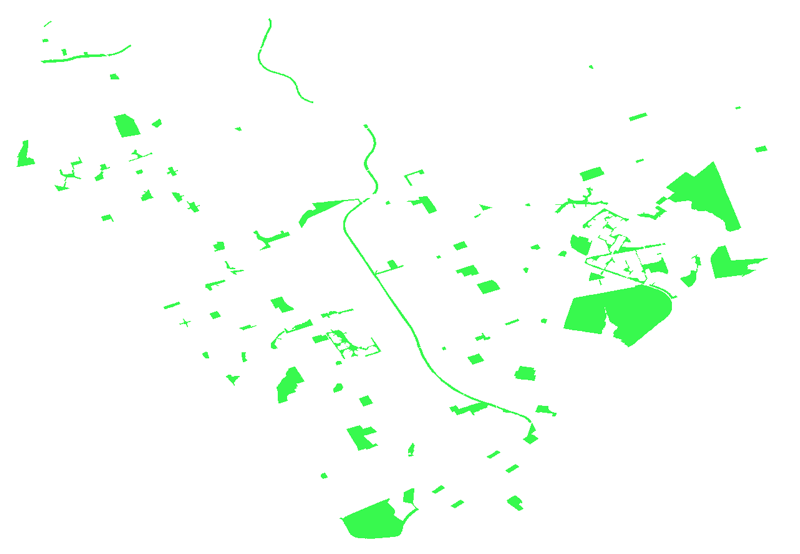
Since receiving an ESRI Shapefile of the Charlottetown zoning map I’ve been experimenting with different ways of looking at and publishing the information in it. Here, for example, is a map showing all the areas in the city that are zoned “Open Space”:
I generated this map using the open source MapServer GIS tool to create a WMS server that I then displayed using the excellent Leaflet JavaScript library. I’m working my way through the process of re-learning GIS fundamentals so that I can reproject this map over top of an Openstreetmap of Charlottetown; in the interim, standalone it’s an interesting way to visualize how much (or how little) parkland we have. Permitted uses under this zoning are:
active and passive recreation;
band shell;
Campground;
curling Club;
Golf Course and driving range;
Officers Club;
Open Space;
Park;
pavilion;
Public Park;
public recreation centre; and
trails and fields.
Here’s the same map, but only showing parcels zoned “Institutional” (cemeteries, fire halls, hospitals, libraries, and so on):
I’ll continue to plug away at this. In the meantime, the easiest way to experiment with this information yourself is to grab this KML file of the zoning map and load it into Google Earth.
The old “Enter Quietly, Please” sign on the theatre door beside our office has always bothered me. And so, faced with a strong desire to procrastinate this morning, I decided to develop an alternative. I especially like the rousing romantic duet between Abraham Lincoln and a cowboy that’s being interrupted.
My favourite quote from my chat with Nora, if I don’t say so myself, is “I don’t know what the answer is, but I gotta imagine that there’s a better way to deal with all this than prohibiting people on PEI from learning Norwegian for 21 days.” The panel that follows has thought much more deeply about these issues than I; it was good to heard the broader context.
One of my favourite purchases in Japan came from TRUCK Furniture: it’s a porcelain-handled rubber stamp of the Japanese word お知らせ, which is “announcement” in English.
Osaka wasn’t even on our radar while we were planning our trip to Japan. We knew we wanted to visit Tokyo, and Oliver was bound and determined to stay in the 9 Hours Hotel in Kyoto, so they were set. But Osaka wasn’t in our plans.
We’d left the end of the trip free, however, and so we had 2 or 3 days unplanned. I’d assumed we head off into rural Japan to experience the less frenetic side of the country, but it turned out to be remarkably difficult to book lodging at the last minute in the rural areas of the country – everyone was heading out into the warm spring air, I suppose – so when we cut our trip to Kyoto short a day we decided to head 40 minutes south to Osaka for the weekend, a move spurred, in part, by snagging a fantastic deal on a last minute room at the Hyatt Regency Osaka.
We found Osaka to be an unexpected delight. More manageable than Tokyo and with a distinctly different flavour, we spent a great weekend there. Here are the kid-focused highlights.
Perhaps the best children’s museum of our trip – indeed, perhaps the best children’s museum we’ve ever visited – Kids Plaza Osaka was just wonderful, and it’s a must-do for any family with children visiting the city.
The facility is built around a multi-level castle-like structure designed by Austrian artist Friedensreich Hundertwasser. I think you could have fun for hours if all you did was explore its towers and slides and ladders and balconies. As you can see in the video above, it’s teeming with kids running and sliding and enjoying the novelty of it all.
Extending out from this castle core are floors devoted to “playing” and “making” and “trying.” There are science-museum-like activities about this like animation, the human body, ecosystems, and a television studio were kids can record an entire newscast (you can watch our try, kindly facilitated by an English speaking guide who wanted to make sure we had a chance at the end of the day). There’s a set of exhibits about the music and clothing and language of countries around the world, a food lab with an activity about the 11 types of sugar, and a really create activity that lets kids use a wheelchair to navigate around a transit station set to see what challenges they’d face.
The signage and interpretation is almost all in Japanese-only, but the activities are so clear and well-signed with pictures that it’s not really an issue.
Kids Plaza is located in a busy neighbourhood filled with restaurants – we ate in the Mos Burger right across the street – and it’s directly connected to the Ogimachi metro station.
The Osaka Science Museum, in what seemed to us like “downtown Osaka,” was, like the science museum in Tokyo, a solid old-school science museum in the style of the Exploratorium. It was the least accessible museum we visited language-wise, but with the help of our translating mobile phone we managed to make our way.
The museum is spread out over 4 floors and you buy your tickets in the basement and then immediately take the elevator up to the 4th floor to start your visit (there’s an option to purchase a planetarium show ticket for an additional fee at the ticket desk, but we were warned off this as there was no English translation available). Each floor has a different focus: magnetism, astronomy, earth science, chemistry, physics. Surprisingly, it was the earth science floor that caught most of our attention, especially a series of displays illustrating the elements and their relationships to everyday materials:
(That’s a fuzzy photo, but on the top is “earth” and then below it the component materials of earth, and below each of those the more refined versions of those components, and below those the products made from those materials).
Other highlights include a Rubik’s Cube-solved robot in the first floor lobby, and a really fun traffic signal exhibit on the first floor (where you can turn the signals on and off with switches, something that, personally, made me feel omnipotent).
There’s a not-too-exciting-but-serviceable cafeteria on the first floor (you can exit the museum to eat and then re-enter if you like; just show your ticket stub). But we highly recommend you head across the street to Graf Studio (right on the river-side), where you’ll not only find tasty food and drink, but an intriguing marketplace of locally-made products.
This museum certainly qualifies for the “weirdest architecture in a children’s museum” award: shaped like a UFO landing on Earth, big bang is a sort of hybrid between a children’s museum and a science museum. Located about 40 minutes south of central Osaka by train near a large shopping mall complex, Big Bang was, well, weird. In a mostly enjoyable way.
Oddly, given the shape, there’s not too much emphasis on space or astronomy: on the top floor there was a mixture of science museum activities and a recreation of a historical Japanese street scene where the alleyways played hose to a kindly man showing kids how to wind and throw a traditional wooden top. The highlight of this area was a darkened room that captured your motion and converted it into colourful animations on the screen in front of you; Oliver loved this:
One floor below was a dinosaur and alligator-themed play area. It was noisy and full of activity – the dinosaur is hollow and filled with darkened passageways. Kids seemed to love it; Oliver was a little put off.
Big Bang was unique in the museums and children’s centres we visited for requiring additional ticket purchases for a lot of the activities: the animated 3D movie on the top floor, the crafts activity on the second floor, and an activity we never quite got a handle on that took place inside the tall tower you see in the photo above, all required tickets. One activity that didn’t was a really neat “draw a character on a piece of paper, scan it, and watch it become part of our animated world” exhibit; it’s difficult to do justice to in words, but suffice to say, here’s (our) Archie riding a dinosaur in outer space:
Almost all of Big Bang is Japanese-only, making it a little hard for the English speaker to penetrate completely. We receive a photocopied English-language guide when we arrived that was helpful, but incomplete. I wouldn’t make Big Bang my first stop in Osaka, but we had fun, and for the crazy building alone it’s a fun visit.
Right next door, connected to the train station, is a large shopping mall complex with many places to eat. We particularly enjoyed the “conveyor belt sushi” restaurant that’s close to the station; there’s also coffee, crepes, and a Baskin Robbins inside the mall, and a nice MUJI store if you’ve some additional time to spend.
Charlottetown businessman and aviation pioneer Bob Bateman died this week. I met Bob only once, at a breakfast in West Royalty a few years ago, but over the years he showed me great generosity several times.
Back in the early 1990s when Bob was operating Prince Edward Air I approached him on behalf of a Red Cross Rwanda fundraiser that we were organizing on Victoria Row to see if he might donate a prize for our raffle; without hesitating he offered a flight to Halifax and a stay at the Lord Nelson (ironically, and somewhat embarrassingly, it was my brother Steve’s name that the late Gene Maclellan drew from the hat at raffle time; Steve never redeemed his prize).
Years later, in 2003, when I learned that my friend Catherine Hennessey had never seen Prince Edward Island from a small plane, I emailed Bob about the possibility of getting her up for a flight; his quick reply:
Catherine is a friend, and has my deepest respect for all the good she has done for both Charlottetown and PEI. It would be our great pleasure to offer her an aerial sightseeing tour. In fact, I would like to do the flying. And, don’t worry about any costs; it’s on us!
I had the pleasure of working with Bob’s son Scott during my time with the Province of PEI, and I have always admired the work that Bob’s family has done to support the autism communiy on PEI.
My thoughts are with Bob’s family today; they, and Prince Edward Island, have lost a good man.
Over 13 days in Japan Oliver and I got to experience an incredibly child-focused country. Between children’s museums and science museums and neighbourhood children’s centres, it’s obvious that Japan cares about its children and invests a lot of money and effort in creating facilities to entertain, educate and enliven them. Here are our favourites in Tokyo.
This was our first stop on our first full day in Tokyo and we spent 6 hours there. It’s a stunning building in the futuristic Odaiba district, and it’s filled with interactive exhibits about science, nature and astronomy. We particularly enjoyed the 3D dome-theatre trip through the universe (included in the ticket price and available with English translation via headset), the robots, and the display of electronic artworks. Much of the interpretation is in both English and Japanese, and the staff were able to help us in English most of the time. There’s a nice café on the upper level that’s very child-friendly.
By fortunate chance, this museum of design was hosting a child-focused exhibition called Design Ah! during our visit, and we spent two hours experiencing it with a gaggle of Japanese families on Saturday morning. The museum building is intriguing: mostly underground, at the edge of a park, and filled with twists and turns.
The Design Ah! exhibit was truly amazing: an introduction to design for children that involved both interactive activities – learning how to fold fabric into a holder for books, paper folding, coin rubbing – as well as intriguing deconstructions of things like a soy sauce decanter and a public school. There was music and video and stunning visuals.
By far the most interesting exhibit of the show was a Kinect-driven machine that took movement and translated it into Japanese language characters; hard to describe, but this video does it justice:
There was also a pretty fantastic 360 degree video room teaching kids about numbers, colours and shapes; here’s a clip from the “counting” section:
The Tokyo Midtown development is right across the park, and there are plenty of places to eat and drink there (there’s not-too-bad coffee in the Dean & Deluca café in the basement and a nice French bakery on the main floor).
If Miraikan is the flashy new kid on the science museum block, the longstanding workhorse is the Tokyo Science Museum. Very much in the classic Exploratorium model it turned out to be an unexpected gem, perhaps because it has been able to resist the corporatizing and infotainment tendencies that have afflicted museums like the Ontario Science Centre in recent years.
There were several highlights here, but the big one was Oliver’s starring in the demonstration of liquid nitrogen in the science show in the “Workshop” area of the museum, ably guided by Mr. Hamashi, who was perhaps the best science communicator I’ve ever enountered:
The area devoted to an exploration of mechanics was also particularly well-done, with a bunch of activities involving moving big metal balls around. There’s no better way to understand mechanical principles – levers, inclined planes, pulleys – than experiencing it all physically, and the mechanics exhibits did this very well:
Also worthy of note was an entire wing of the museum devoted to the northern lights. In a dozen exhibits there was discussion of the sound, light and electricity of aurora borealis with a depth that I’d never seen elsewhere.
There’s not much English in the museum, although we were helpfully given an English-language map and guide on arrival. There’s a tiny café with two seeminly-competing vendors offered rice and noodle dishes; you’re on your own to figure our what’s what. The museum is on the edge of a very pleasant park that makes for a nice walk to and from the metro station.
Admitedly a niche museum, but a good one nonetheless. Located in the basement of the Toppan Printing company, the museum provides a good overview of printing and communication from pre-Gutenberg through the digital age. While there are some interactive elements, most of the exhibits are more classically “museum-like,” the notable exceptions being a good introduction to wood block printing using a classic Japanese image deconstructed into its individual plates, and an exhibit where you can use rubber stamps and different coloured inks to assemble a calendar on a postcard.
The really great thing about the Printing Museum, however, is the workshop area where printers provide a hands-on introduction to letterpress printing. This was initially a little frustrating for Oliver as it was conducted entirely in Japanese (it was mostly lost on me too, although many of the concepts were familiar). But once we got an opportunity to actually print, things took a turn for the better. We had a chance to print on a Gutenberg-style press, and then to make some business-card-sized prints on an Adana Eight Five (my first press; they have a nice collection of about a dozen of them for larger workshops).
The museum is a little off the beaten track, and there’s no much around restaurant-wise, but it’s easily reached by a couple of metro lines.
This might have been our favourite place of all, partly because it was lots of fun, and partly because it demonstrated such a strong commitment to child welfare: in one building is a gym, a pool, an art studio, a music studio, a video library (with viewing pods), a play hall, a homework room, a computer lab, a roof garden filled with tricycles, and a child development and wellness centre.
It’s an “all you can eat for one price” place: you pay $4 for kids and $6 for adults and then everything is available to you. We started our visit in the art studio where there was a pre-planned craft activity, making a whirlygig. The instructions were provided in Japanese by an animated and patient instructor, and after 20 minutes of cutting and pasting and gluing and colouring we had ours made:
From there it was up an outdoor twisty-turny exercise track with stations every once in a while with things like hoola hoops and stilts, up to the fifth floor rooftop garden where Oliver had much fun racing around on a hand-operated tricycle:
The view from the fifth floor rooftop is pretty neat too:
Next it was back down to the fourth floor to the music studio, where they had every manner of musical instrument available for playing:
We had a lot of fun playing the xylophones:
A quick turn through the video library – 20,000 tapes and DVDs and about a dozen little rooms with players for watching them – and we were off, having spent a couple of hours having a lot of fun. I can imagine that if we lived in Tokyo, especially when Oliver was little, we’d have spent a lot of time here.
There’s a café on the first floor, but there are also lots of places to eat in the Omotesando neighbourhood where the castle is based.
Tokyo itself…
The simply fact of being in Tokyo itself is enough to entertain and delight anyone for weeks on end. Between conveyor belt sushi (Pintokona was our favourite) and the metro and the coffee shops and the parks and just walking around the crazy bright-lit streets, I can’t imagine any child being bored in Tokyo. Nor, indeed, any adult.





 I am
 You can subscribe to an