Harry Holman recently published an account of a wintertime journey from Charlottetown to Halifax in 1867, over two posts: one, two.

While the tale of the journey across the Northumberland Strait is itself harrowing, Harry reminds us that travellers first had to get from Charlottetown to Cape Traverse:

The road was utterly chocked with snow, in many places twelve feet deep, but my driver was an old stager at the work and knew well how to find a track even when there was no trace of a sleigh having passed over the ground before us. We had a splendid horse who worked as if he was aware that the journey had to be done, and that the better he stuck to it the sooner his night’s rest would come. The whole distance is about thirty-four miles by the road, but the devious route we had to follow made the distance nearly half as far again.

About seven o’clock we stopped for supper at a very decent house, which I will call, by courtesy, an inn. Here was good and substantial refreshment for man and beast.

I was pleased to see my driver showed himself deserving of the excellent horse he had, by the great care he bestowed on him ere he thought of even entering the house.

After an hour’s rest and having laid in a good source of caloric, we started in again. The cold was now intense. Notwithstanding that I was buried in buffalo robes. I felt as if dressed in muslin.

I shall never again complain about the interminably long 45 minute drive to Borden-Carleton, and the 13 minute drive over Confederation Bridge, by which we now complete the same voyage. 
🗓️
Charlottetown  •  Halifax  •  Ice Boat  •  Harry Holman  •  Northumberland Strait

I had an appointment with my nurse practitioner at 9:15 a.m today, during which I had some blood drawn to allow them to run some tests.

I got a call back from her office at 1:45 p.m. with the results (everything in range).

Clearly our health care system has significant issues. But it’s also clear that, at least sometimes, it works amazingly smoothly and efficiently. 

🗓️

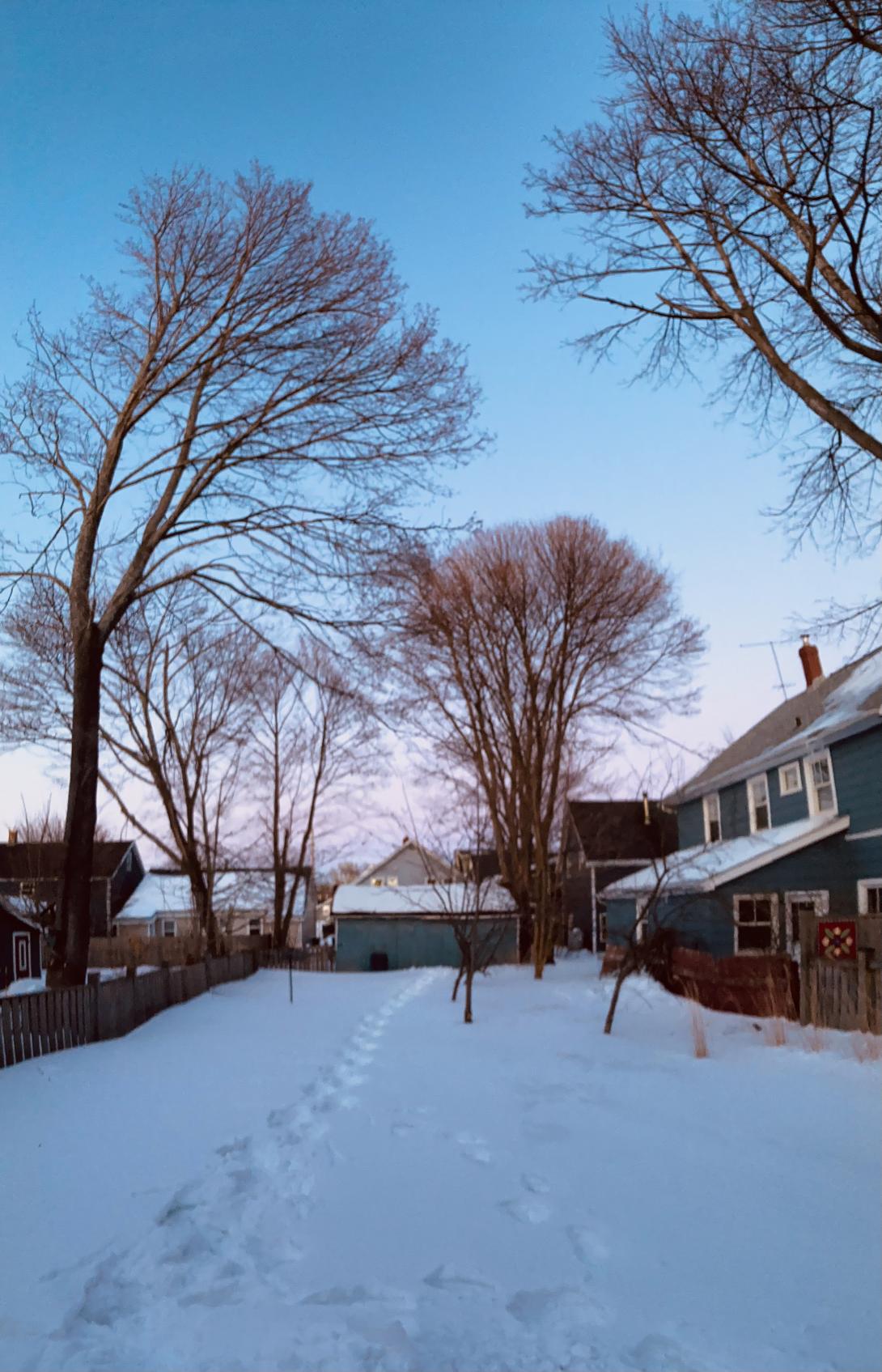
Looking for the extension ladder to help deal with ice dams on the back roof. It wasn’t there. I’m not actually sure we own an an extension ladder. But it was a nice snowshoe. 

My back yard, covered in snow, with tall trees looming in the background. There are snowshoe tracks leading to a blue building at the back of the yard.

See also this summertime photo of the same view. 

🗓️

The Kimberly-Clark “Professional” paper towel dispenser—product name “ICON Rolled Towel Dispenser”—is a thing of functional beauty. 

Rare in the paper-towel dispensing machine world, it just works. 

There’s no need to frantically wave hands in just the right spot, no need to crank an emergency backup crank, no need to pull out paper towel with wet hands (which always causes the towel to disintegrate). You just rip off a piece of paper towel and a new one rolls out to replace it:

In Charlottetown I’ve seen them at Papa Joe’s and Tekila; weird to say, but I’m more inclined to eat at places that have them.

🗓️
Washroom  •  Kimberly-Clark  •  Design

Our printshop has ended up, for reasons neither Lisa nor I can remember, with an uncommon amount of yellow ink. 

Some of this yellow in is Akua Diarylide Yellow, which is a rich, lovely yellow that cries out to be used.

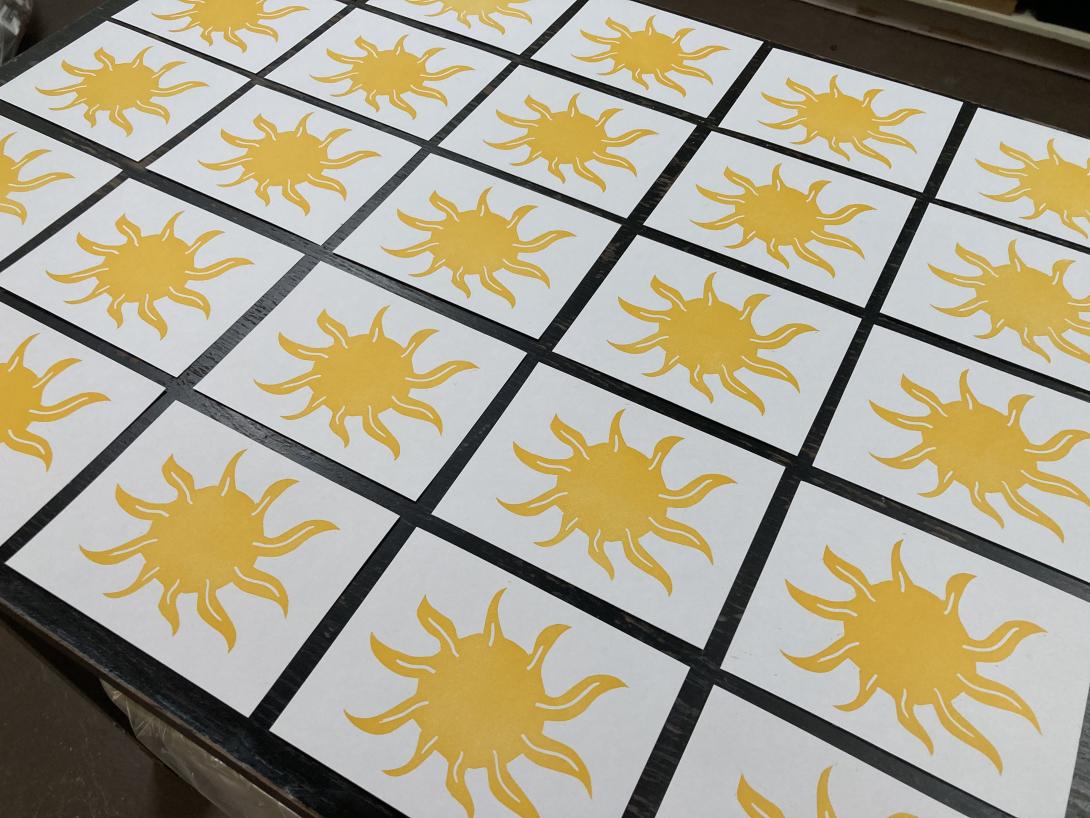
I took advantage of this yellow-glut yesterday, carving a lino block of an abstract sun into Japanese vinyl, and printing 50 copies to become part of a larger date book project I’m working on:

A grid of 25 small cards, each printed with an abstract yellow sun, laid out on a black table to dry.

🗓️
Linoblock  •  Akua  •  Ink  •  Printmaking  •  Yellow  •  Video

I’ve just finished reading the post reclaiming our emotional sovereignty: repairing the cultural poverty that currently meets disorganised states, by Jason Field. 

It is not a light read; it’s a dense 20,472 words masterwork that, despite the foreign terrain for me, prompted more ah-ha moments than anything I’ve read in recent memory.

If I had to select a single paragraph that explains why, it’s this one:

In this renewed ability to hold ourselves, the logical next step comes to put down some of the bags that we have picked up along the way. This can be scary on the first presentation. Knowing how heavy they have been in the past, we must prevent ourselves from projecting one data point into the future indefinitely.

Oftentimes, we think we can pretend something hasn’t happened, I’ve tried that for decades, but the body knows, and our day is not ours (lost sovereignty) because of it. Until we face what was previously too much, we will have great difficulties calling ourselves sovereign over our experience, and our body is here to help us through it too.

So much of my own work in recent years has me return to the statement “I’m not the kind of person who…,” and surely that’s exactly what “projecting one data point into the future indefinitely” is all about.

I remember a visit to a psychologist a decade ago in front of whom I, genuinely, honestly, asked “I’m wondering if it’s possible that I’m feeling things that I’m not aware of.” 

Looking back at that now, I realize how naive I was, how almost everything about me was working hard to “pretend something hasn’t happened,” and how, in the years before and since, my body has been trying to tell me this.

Later, Field writes:

We can’t (and shouldn’t) pretend disempowering events never happened.

But we can commit to re-building ourselves and, in doing so, become the agent of our own rescue.

His post is a compelling treatise on how to start doing that.

It’s not an easy read. It took me three days. But it was a worthwhile effort.

🗓️

Ten years ago, at pei.consuming.ca, I released a web app that displayed the current Prince Edward Island electricity load, and the proportion of that load being met by wind energy generation.

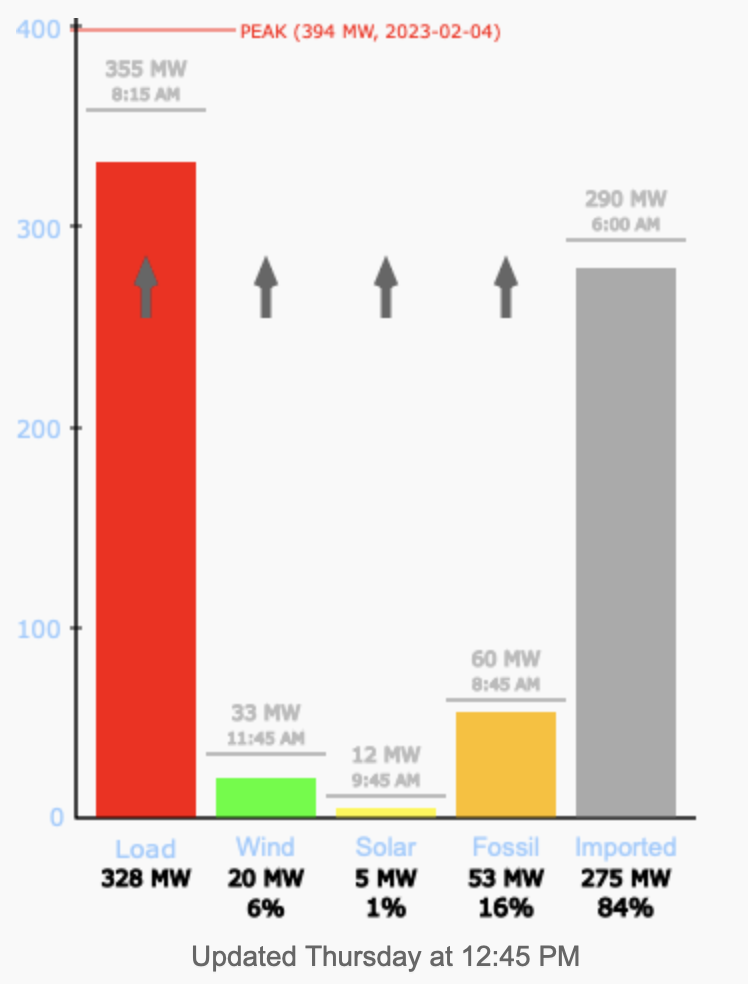
Ten years later, the app is still there, recently updated to include generation from local solar and diesel plants, and energy imported by submarine cable.

What once looked like this:

Screen shot of the PEI.consuming.ca site in 2015. It's a bar graph with two columns: in red is the Load, showing 232 MW, and in green is Wind energy generation, showing 11 MW and 5%.

Now looks like this:

Screen shot of PEI.consuming.ca site in 2025

The app pulls data from the Province of PEI, and from the New Brunswick System Operator, and is updated every 15 minutes.

🗓️

I was proud to play a small role in this week’s episode of the CBC Radio This is PEI podcast. 

I am, it seems, the canonical source of the audio and video of the Peter Pan Burger Basket $1.99 television commercial directed by my friend Dave Moses, and featuring a cast of Charlottetown legends. 

The producers reached out to me when they couldn’t find it elsewhere, and I found a copy squirrelled away in my archives.

It’s a great podcast episode, and has me wanting a Peter Pan Burger Basket something fierce.

🗓️
CBC Radio  •  Podcast  •  This is PEI  •  Peter Pan  •  Dave Moses

Remember that cold I alluded to back in early January, the one I claimed had “broken”? 

Well, 24 days later, illness holds onto me with its steely claws. Sore throat. Cough. Congestion. An evolving variant of what hit me earlier.

The earliest I could get an appointment with the nurse practitioner or doctor in my “medical home” was February 24, and I couldn’t wait that long: I’m not sleeping, I’m tired, and having a constant cough is debilitating.

So I decided to chance making an online appointment at the Boardwalk Clinic with SkipTheWaitingRoom.com, something I’d tried to do several illnesses ago, but had always failed at because all available appointments disappeared mere minutes after the 7:00 a.m. opening bell.

Today I was ready: at 6:59 a.m. 

I started clicking “reload” on the appointment page.

Reload. Reload. Reload.

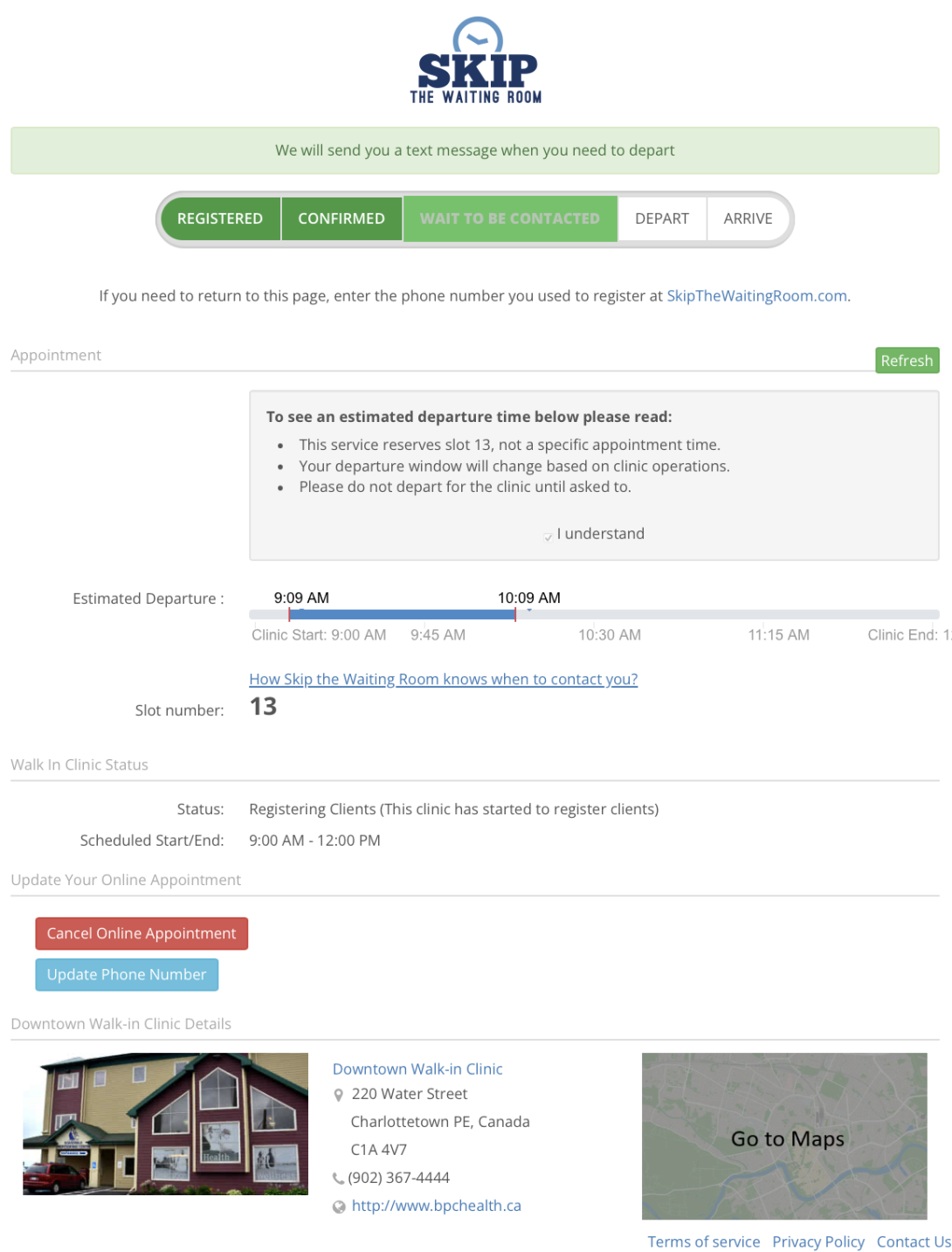
Just as 7:00 a.m. struck, a booking link appeared: I was, in the blink of an eye, already assigned booking slot #13.

From there the process was flawless: I filled in my personal information, gave them my travel time to the clinic, confirmed my appointment via SMS, and was given access to a status page that showed me a constantly updated window when I could expect to receive an SMS to leave home.

Screen shot from Skip The Waiting Room, showing the status of my booked appointment.

I got the text to leave at 9:38 a.m., I arrived at the clinic at 9:45 a.m., got ushered to an examination room at 10:08 a.m., and saw a doctor about 5 minutes after that.

Diagnosis: my viral infection of yore inspired a bacterial sinus infection. Kindly Dr. Beck prescribed me antibiotics for that (“Amoxicillin/Clavulanic Acid”), I got the prescription filled and (I hope) I’m on the road to recovery.

🗓️

In his post Fix Three Broken Things, David Cain writes about the “psychic injury” of having broken things in your life:

All broken things, no matter how easily they’re fixed, levy ongoing costs to well-being. They cause psychic injury every time you see or interact with them. The Buddha’s word for human angst or suffering was dukkha, referring to a wagon wheel that turned unevenly around its axle. The wagon still gets you from town to town, but the ride is grinding and bumpy.

Catherine’s art piece had been leaning against a wall in the print shop for more than a year, waiting to be cleaned up and moved. It was a glaring “broken thing” and, indeed, every time I opened the door to the print shop its presence there made my day a little more grinding and bumpy.

Reading Cain’s post was the straw that broke the camel’s back, as it raised the profile of the “psychic injury” relative to the perceived pain of actually fixing the broken thing. 

In the end, it took me about two hours from start to finish to prepare the art piece, call the Palliative Care Centre to get permission to drop it off, load it into the car, drive out to the Centre, unload it, and come home. Peanuts, relative to the daily grinding bumpiness.

Cain’s post finishes:

But the moment that thing gets fixed, the relief is surprisingly deep; you were bearing more pain than you knew. And so close to its end the whole time!

Exactly.

🗓️
DIY  •  Mental Health  •  David Cain

About This Blog

Photo of Peter RukavinaI am . I am a writer, letterpress printer, and a curious person.

To learn more about me, read my /now, look at my bio, listen to audio I’ve posted, read presentations and speeches I’ve written, see things I’ve favourited elsewhere, or get in touch (peter@rukavina.net is the quickest way).

I have been writing here since May 1999: you can explore the 25+ years of blog posts in the archive.

You can subscribe to an RSS feed of posts, an RSS feed of comments, an RSS feed of favourites elsewhere, or a podcast RSS feed that just contains audio posts. You can also receive a daily digests of posts by email. I also publish an OPML blogroll.

Instagram • YouTube • Vimeo • ORCID • OpenStreetMap • Internet Archive • PEI.art • Drupal • Github.