I have participated in two protest rallies in my life.

The first was at the gates of the Warkworth Institution in Ontario in the late 1980s, a silent protest against the possible reintroduction of capital punishment in Canada.

The second was a few years ago in front of Province House, a reproductive rights rally organized by the PEI Reproductive Rights Organization.

In both cases the issues at hand were ones I felt so deeply about that I felt I had no choice but to lend my voice, and to set aside my feeling that change is better made quietly, deliberately and collaboratively that through shouting.

Tonight I’ll rally again, along side my son Oliver, in front of the Legislative Assembly at a Rally for Democracy.

Why?

Many different reasons; but chief among them is a feeling, based on years of experience, that a diverse table is a better table, and that the current government’s move to slow the progress toward proportional representation in the Legislative Assembly is a move that ignores the fierce urgency of evolving the way we govern Prince Edward Island.

One of the things I’m most proud of regarding my term as president of the PEI Home and School Federation is the degree to which we increased the diversity of the two yearly meetings of our membership. We decided that having many people with a stake and role in public education around the table would improve the quality of the discussion, so we extended invitations beyond our usual invitations to the Minister of Education and their deputy, and broadened the list to include school trustees, school board staff, senior leaders in the Department of Education, representatives of the education unions, and to community members with an interest in education.

Which is how I found myself around a table this past April with Home and School members talking about how we could improve playgrounds. One of the people who joined us was Ricky Hood, at the time the official trustee of the English Language School Board, and someone with decades of experience in public schools. Ricky participated eagerly and helpfully in the conversation that ensued, and was able both to provide some historical insights, vision as to what the possibilities and limitations might be, and, perhaps more than anything else, made the conversation more like a planning session among partners than a cry into the wind.

It confounds me, in light of this, and many other similar examples, that so often the calls to broaden the diversity of the conversation is reacted to with a strong anti-viral response.

For example, back in 2013 home and school members passed a resolution Cross Appointments Between Health PEI and English Language School Board, our reasoning well-expressed in the preamble:

WHEREAS in recent years there has been a move to centralize the operational authority for both health and wellness (through the creation of Health PEI) and education (through the creation of a single English Language School Board), and

WHEREAS there is an increasing awareness of the connections between mental and physical health and success in education, and

WHEREAS many operational issues relating to public school education can benefit from the perspective, resources and services of the health system, and

WHEREAS many operational issues in relation to mental and physical health can benefit from the perspective, resources and services of the public education system,

The response?

The Minister of Education: As this resolution is a school board matter, I will defer the decision on this resolution to the school board.

The English Language School Board: Therefore, the English Language School Board understands that the Minister of Education has sole authority to increase the number of members for each school board.  The School Act does not authorize a school board to increase the number of its members, ex officio or otherwise.

Health PEI: The resolution regarding cross-appointments between Health PEI and the English Language School Board tabled by the Home and School Federation is certainly a very interesting proposal to consider. At this time, in my role as Chair, I have discussed the proposal with our Nominations Chair. We would welcome the opportunity to discuss our cunent nominations process in more detail.

So, in other words, one “sounds interesting” and two conflicting “not my departments,” pointing the finger toward the other.

Needless to say, no action was taken.

This viral response against increased diversity was on strong show in the Legislative Assembly last Tuesday as it debated Motion 80, the government’s “hold on there, let’s not get carried away” response to the interpretation of the plebiscite results.

Hon. Robert Henderson used the opportunity to re-debate the very notion of proportional representation:

I mentioned before, in New Zealand, 13 political parties, seven parties represented, coalitions are always the norm, and parties leading the coalition tend to be really down to just two parties, the National Party and the Labour Party, that always lead the coalition.

In Israel, if you take a look at that one, which is directly a proportional representation system, term limits are four years. It has rarely lasted four years. Since implemented, no party has ever won a majority government. Voters select a party on a ballot and parties have 42 days then to form a coalition. If you look at their voter turnout, in 1992, 77%, and in 2006, 63%.

If you look at another parliament that might be a little bit closer to PE, Iceland has 15 parties that are on the ballot of which seven have seats in the legislature. Iceland, population is about double ours. They have about 237,000 eligible voters. They have 63 seats in their parliament and in the most recent election the Independence Party had 21 seats, the Pirates had 10, Greens, Progressive Reform, Brighter Futures, so there are seven parties have seats in the House. This is a system that has been in place for some time.

Greece is another one. Greece has 300 seats, of which 288 are represented by 56 particular ridings of which 12 are off lists. Forty years they’ve been doing some form of this system. They had to change it 17 times to try to get it a little more closer to a system that worked from direct proportional representation to a system now that’s called a reinforced proportional representation. In Greece 20 parties, eight parties in parliament, have over 9 million voters. Since 2007 – I think this is a neat point – eight elections in Greece. I know Greece has its problems, but PEI has had three elections during that period of time.

What Mr. Henderson is suggesting, I think, is that diversity is bad for government, leads to instability, and therefore, logically, that our current system is better.

Bush Dumville, MLA pursued a different, more direct tack, suggesting that what you and I might call “diversity” is really government by “special interest groups”:

The proportional representation lobby and Honour the Vote campaign is well organized with advertisements, robocalls, social media pressure, and even there was a suggestion on Facebook for civil disobedience. It appears to be a well-funded lobby of special interest groups. I do not want our province to be covered by special interest groups. I want PEI to be governed by parties which have broad-based policies and which garner the support of a wide range of Islanders.

A first-past-the-post electoral system discourages single issue or limited issue parties and encourages parties to develop broader policies that appeal to the majority of voters.

What both Hon. Mr. Henderson and Mr. Dumville appear to assume in their statements is that a more diverse parliament would work in the same fashion is today’s less diverse parliament, only with heightened  cacophony and chaos.

What they ignore is the possibility that increased diversity might not only increase the quality of the discussion by integrating a broader collection of viewpoints, but that the very nature of how the discussion is conducted – the spirit of the discussion, so to speak – would change as well.

In addition to Islander’s well-worn love of the duopolistic practice of politics, which generally descends into daily variations of “we’re the best; you’re an idiot” in the legislature, there lurks, deep in the cultural DNA, another, even more powerful impulse, which is the spirit of collaboration. This spirit is on daily display from one end of the Island to the other in the way we conduct our lives outside of the legislature, and there is no reason to think that it’s not possible to bring it inside the rail as well.

For example, at a provincial home and school meeting, when the representative of the western end of the Island mentioned that it was unreasonable to expect people from West Prince to drive to Charlottetown or Summerside for home and school training workshops, the reaction of their peers on the provincial board was simply to organize workshops in West Prince, not to descend into internecine geo-rivalry discussions. In my experience this is the rule rather than the exception: it is only on the floor of the Legislature that we seem to lose our ability to think and act collaboratively.

But what of this fierce urgency? Why should we not, as the government suggests, simply wait for 2023 for proportional representation to be introduced?

Here’s an excerpt from remarks by U.S. Secretary of Education Kathleen Sebelius on the anniversary of the March on Washington:

When Dr. Martin Luther King, Jr. spoke at the March on Washington, he described a “fierce urgency of now.” He reminded a divided nation that we need one another, and that we are stronger when we march forward, together. “We cannot walk alone,” he said. “And as we walk, we must make the pledge that we shall march ahead. We cannot turn back.” 

A half century later, Dr. King’s words have renewed meaning.

For every little boy or girl in America whose health lies in the balance, there is an urgency of now.

For every one of our neighbors who lives day-after-day in fear because they do not have insurance, there is an urgency of now.

For every mom or dad who has faced bankruptcy because of a mounting medical bill, there is an urgency of now.

Without the opportunity to live a healthy life, there is no opportunity to live the American dream or participate fully in our communities. Without the freedom which comes from having access to quality health care, there is no freedom to reach our full potential in the workforce or watch our kids or grandkids grow up. Without the security of health insurance, there is no economic security for middle-class families, and so many other families working their way into the middle class. 

The time for division and debate has passed. Now is the time to march forward.

While Dr. King was speaking of a different division in a different context, I believe the spirit of his words – the fierce urgency of now – applies here on Prince Edward Island as we sit as this juncture.

A call for increased diversity in the way we govern ourselves is urgent because for too long we have chosen our representatives from a smaller subset of the population, one that doesn’t reflect the many hues of the human experience on Prince Edward Island. What Mr. Dumville fears in the integration of “special interests” into the legislature looks very different if you are someone whose voice has never had a place there; I believe we cannot forge a truly progressive, prosperous, just Island together until we right this historical wrong.

I believe a step toward more proportional representation is one way we can do that; to delay is to turn a blind eye to an obvious course toward improving our lot, a course that was well and definitively expressed through the plebiscite.

And so tonight I will join my voice with others to make it clear that I expect the results of the plebiscite to be honoured in both letter and spirit, and I expect to be able to sit in the public gallery of a more diverse, collaborative Legislative Assembly in 2019.

🗓️

Like many people on Prince Edward Island, I’ve been glued to my TV set this week watching the live broadcast of the Legislative Assembly as members debated two contrasting motions related to the recent electoral reform plebiscite in which Islanders chose Mixed Member Proportional representation as our new mechanism for electing MLAs.

Motion 54, introduced by Peter Bevan-Baker and seconded by Sidney MacEwen was the “okay, let’s do this thing!” motion.

Motion 80, introduced by Hon. Wade MacLauchlan and seconded by Pat Murphy was the “hold your horses, let’s not get crazy” response.

During debate on Motion 80, Peter Bevan-Baker, as part of making the point that Islanders who didn’t vote should not be considered in the deliberations, quoted a tweet I made on November 8, in reaction to early signs from the government that it was not planning to act definitively on the results of the plebiscite:

I could not agree more. We cannot give these wasted votes any credence as we debate the result. Let us confine our  discussion to those Islanders who made the effort to get out and to vote.

As one Islander so poignantly tweeted the day after the results were released – by which time, I should say, the hon. Premier had so rapidly and casually dismissed the results as, I quote, doubtful – here’s the tweet: I studied and discussed the options. I  watched the videos, took the bus in the rain to the polling station to vote. My choice won. What did I do wrong?

Indeed.

This is the first time I’ve had a tweet quoted on the floor of the Legislature. It may be the first time I’ve had a tweet quoted anywhere.

The feeling behind the tweet is one that’s only amplified in the days since: I took the effort to learn the options available, inside and out; I took the effort to talk about the options with my able-to-vote 16 year old son; I discussed about the options with friends and colleagues.

And I did take the bus, in the rain, to vote.

And yet the government has chosen, for reasons I cannot completely fathom, to try to equally-as-much divine the intent of the non-voters in charting its course forward, reeling back the intent of the plebiscite to a generalized expression of a wish for change.

Although I didn’t ask my tweet be quoted – it was a surprise to hear it – I’m proud to have unknowingly loaned the words to Peter Bevan-Baker to help to make his case.

And I remain optimistic that we’ll be voting MMP in the next election.

🗓️

There’s nothing I like more than a good old before-and-after haircut photo series. Cut by Zack Squires at The Humble Barber.

Before Haircut Photo

After Haircut Photo

🗓️

We bought a couch at Leon’s last year. And beds and appliances before that, stretching back over 20 years. Today they rewarded me by robocalling my mobile phone in the middle of the day.

🗓️

If you don’t understand introversion, watch this. That’s what it’s like. Almost exactly.

🗓️
Animation  •  Video  •  Introversion

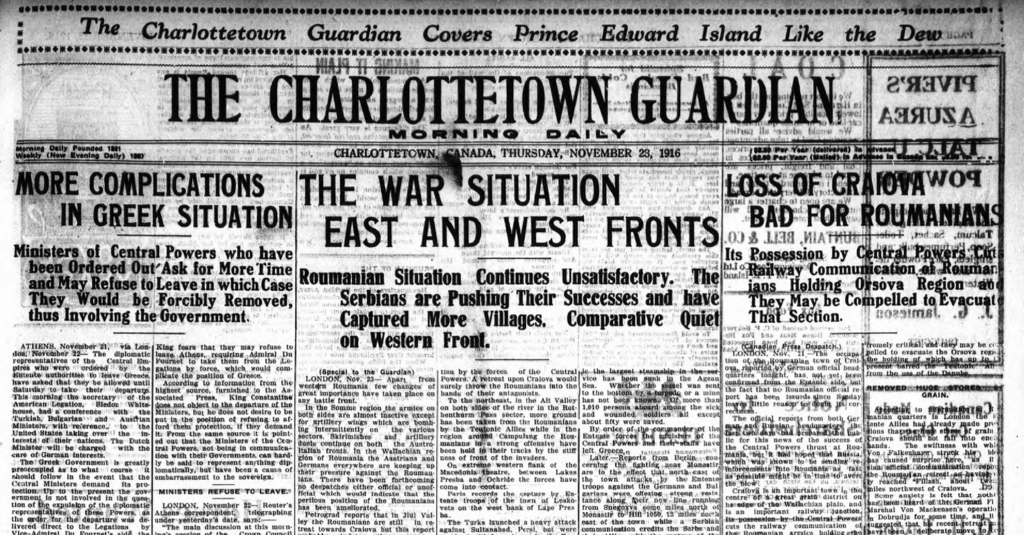
An interesting copy of The Guardian from 100 years ago today, with significant bleed-through of page two’s contents onto the front page. This continues throughout the issue. I wonder if it was thin newsprint or over-inking.

🗓️

It turns out to be remarkable simply to set up the live video from the PEI Legislative Assembly to stream to a television with an inexpensive Raspberry Pi running the open source Kodi media centre.

Here’s how I did it.

First, I bought a Raspberry Pi 3 and an SD card from ModMyPi in the U.K. They have good prices, and inexpensive and quick shipping (6 days from order to receipt).

Next, I installed OSMC, a Raspberry Pi-focused version of Kodi, on the SD card. OSMC is very, very easy to install: just download an installer to your desktop or laptop computer, burn the image onto the SD card, and insert the SD card into the Raspberry Pi.

Powering on the Raspberry Pi with the OSMC SD card inserted leads through a simply configuration process — enter wifi credentials, set time zone, etc. The most important option to be sure to check is the one to enable SSH access to the device, which will allow a file to be transferred to it later.

Now is the somewhat tricky part.

On another computer, create a file called peileg.strm with the following contents:

#EXTM3U
#EXTINF:-1,PEI Legislative Assembly+
http://http-delivery.isilive.ca/live/_definst_/pei/live/chunklist.m3u8

Now you need to get that file onto the Raspberry Pi.

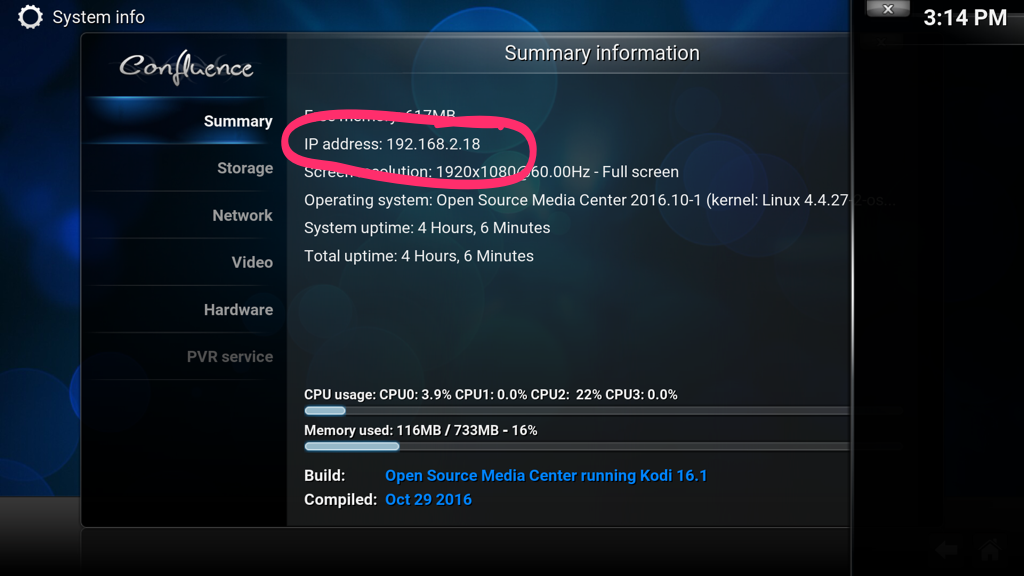
First, you need to find the IP address of your Pi; navigate to System > System info and note the value beside IP address. In this example, it’s 192.168.2.18:

Find your IP address

Next, from the command line of the computer where you created the peileg.strm file, transfer the file to the Pi:

scp ./peileg.strm osmc@192.168.2.18:/home/osmc/Movies

The 192.168.2.18 is the IP address you noted earlier.

You’ll be prompted to enter the password for the username osmc on your Pi (default is osmc; you should change it!).

Now that the file is on your Pi, you simply need to play it.

Navigate to Videos > Files > Add videos. In the Add video source dialog, click Browse, then select Home folder and click OK. If a Set Content dialog pops up you can ignore it and click OK.

At this point you should have video source called osmc, and inside it, under Movies, you’ll see the peileg.strm:

The peileg.strm file

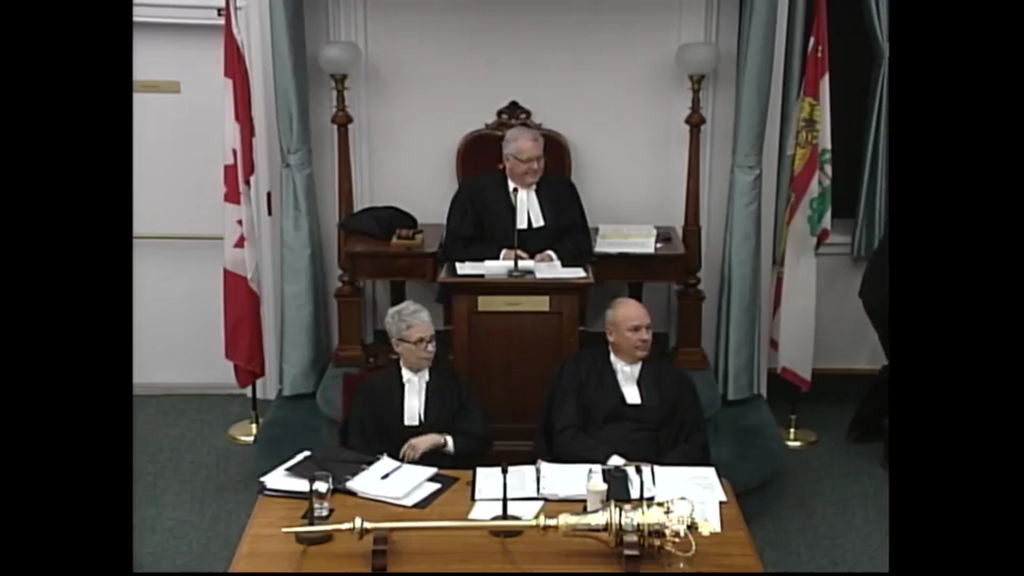
To play the Legislative Assembly livestream, simply click on that file and, presto:

The Legislative Assembly livestream

🗓️

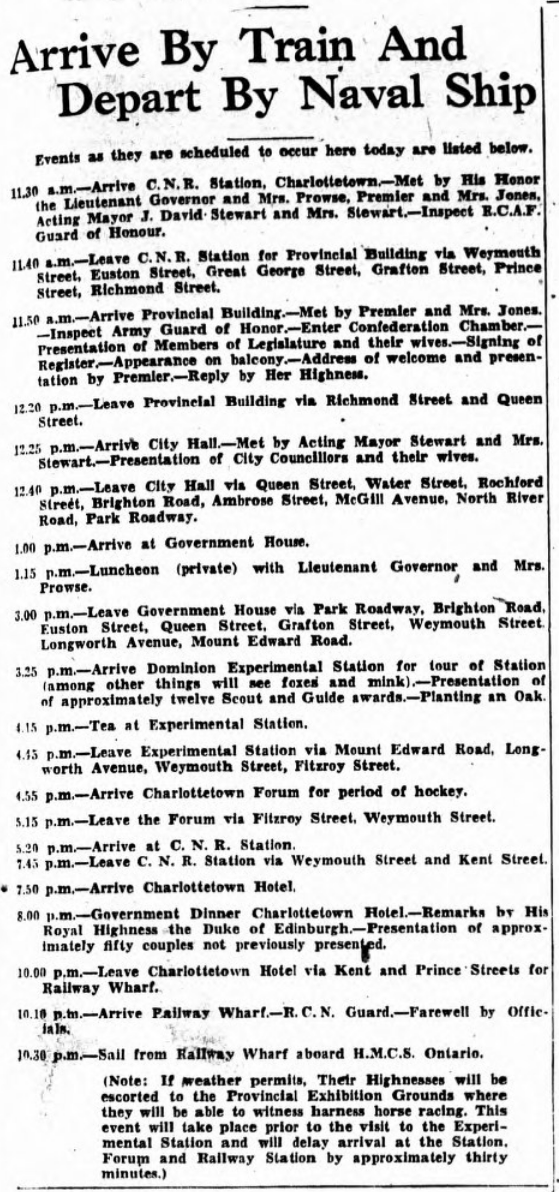
Sixty-five years ago this month Prince Edward Island played host to Princess Elizabeth and the Duke of Edinburgh, a visit celebrated on the front page of The Guardian:

The Guardian, November 9, 1951

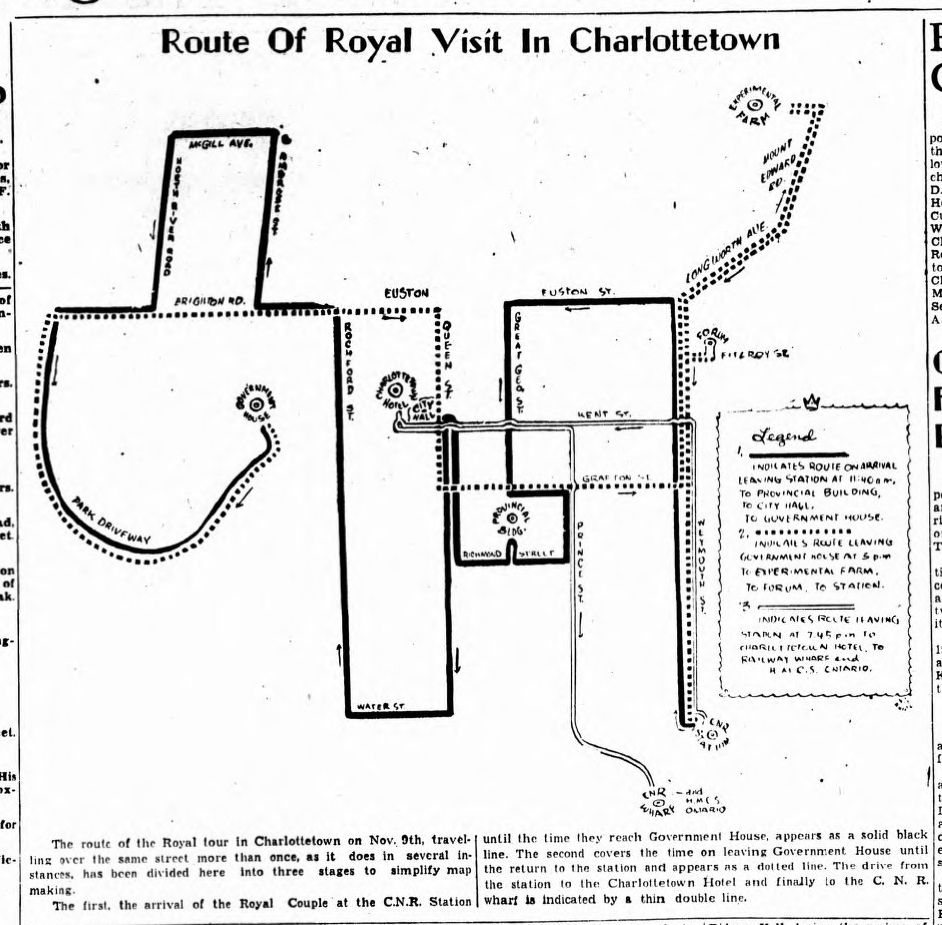
The route they followed in Charlottetown was described by this map in the paper:

Map of the royal visit route

Their program of activities was reported as follows:

Royal program of activities

For those of you watching the excellent Netflix series The Crown, this visit came only four months before the death of Elizabeth’s father King George VI and her becoming to Queen; this trip was part of a longer world tour that she took on behalf of her father. Her visit to Prince Edward Island was preceded by a visit to the United States and a meeting with President Truman.

🗓️

The plot that runs through the first season of the U.S. version of The Office is that the Scranton Branch of Dunder Mifflin is under threat of closure; much of what ensued over that short 6-episode season extends from this conceit:

News spreads throughout the office that Dunder Mifflin’s corporate headquarters is planning to downsize an entire branch, leading to general anxiety, but Michael chooses to deny or downplay the realities of the situation in order to maintain employee morale.

It’s hard not to think of this as we watch our Members of the Legislative Assembly this week debating how to best interpret the results of a non-binding plebiscite on electoral reform that concluded last week with Mixed Member Proportional Representation emerging the victor at the end of the ranked balloting calculations.

MLAs are, in my experience, honourable people who don’t receive enough credit for the demands the job places on them. The job, however, at least in its current incarnation, requires one to have an extraordinary belief in the truth of ones own convictions and the veracity of ones ideas. It is not a job given to attracting collaborators simply because the way we’ve opted to run our legislature is more cage-match-with-decorum than develop-consensus-together-for-a-better-future.

Which is to say that honourable as though they might be, they are not disinterested parties in determining how they and their successors should be selected: if you’ve jumped through the wrenching logistical hoops to get elected to the Assembly under System A, it is inevitable that when System B comes along as the popular favourite, a system that threatens to turn things upside down, redraw the districts, throw all the models and traditions out of whack, and create a new, largely unknown playing field, you would react negatively, or at least with deep suspicion. And that negativity needn’t be seen as selfish, at least not entirely: if you are part of a government doing what you perceive to be good works following a markedly different philosophy than others might, why would you volunteer to close the Scranton Branch and let the nogoodniks from Nashua and Buffalo take over? It would be irrational.

If I’ve learned anything in these mid-stages of my life, it’s that being right about something has little to do with anything, and simply trying harder to be even righter seldom produces a better result, and often has unintended consequences.

In this light it’s important that we all seek to understand more about the motivations that lie beneath the actions of MLAs who, some would say, are clinging irrationally to a first-past-the-post lifeboat, and, others would say, are defending a system that’s always worked and always will.

The people I trust the voices of most on electoral reform on Prince Edward Island are those Islanders who’ve served inside the belly of the beast and have had time to reflect on their experiences.

Alan Buchanan was an MLA from 1989 to 1996, in the Joe Ghiz and Catherine Callbeck governments, serving in cabinet as Minister of Health and Social Services and Minister of Provincial Affairs and Attorney General. Alan is a thoughtful soul, and one of the Island’s smartest minds. In his essay A Case for Accepting the Results he reflects on both the election of Donald Trump and the interpretation of the plebiscite results here on the Island; he writes, in part:

Just as in the United States, people here have grown tired and impatient with a system of government that appears to simply and routinely pass power back and forth between the two mainstream parties. They are tired of a system that appears to create a king-like premier who can reward his friends at court with contracts and largess. I am not for a moment suggesting this is a new phenomenon. Patronage has always been a part of the boss-follower model of politics we have practiced here on PEI. I was a part of it myself.

Cynthia King served as an MLA from 2007 to 2011 in the Robert Ghiz government. Cynthia has been a friend for a long time – she taught Oliver how to ride a bike – and she too has had cause to reflect on her time in the legislature. In Putting legislators back in legislature an opinion piece in The Guardian that ran last week, she reveals some of what she learned:

Let me be clear … these are not criticisms of the government of which I was a member. I believe that they are endemic to our electoral system and how it interacts with our provincial legislature.

I learned some hard lessons very quickly about being an MLA

I learned that MLA’s are expected to tow the party line, regardless of what an issue means to the constituents I was elected to serve.

I learned that being a career councillor was more important than being a legislator.

I learned that a perceived impression of doing people favours was the preferred modus operandi.

I learned that cynicism is as pronounced with government as it is with the electorate.

I learned that advancement in the system in the form of chairing a committee or getting into cabinet, for example, was based on a number of factors with partisan loyalty being chief among them.

Liberal or Conservative … it is all the same and will remain so as long as we continue to elect governments using FPTP.

This week, in the Other Side of Crazy, on her own website, a rumination on the results of the plebiscite, she elaborates:

And in order to level this imbalance of power there needs to be an illusion of opposition, because in reality, there isn’t much of one. Traditionally, anyone who ends up across from government, as the official Opposition, spews as much, if not more, rhetoric as government. Question Period is embarrassing at best and a complete waste of time, save for the sound bites for the media. There is no attempt at cooperation or collaboration as far as the public can see. Oppositions are generally ineffective at holding governments to account. They are on the other side which means they must oppose everything, even if it’s a good idea.

Allan Rankin had a very brief spate of party-political activity, running unsuccessfully against sitting Premier Alex Campbell in the election of 1974 for the NDP; chastened, he found his strong suit in other areas of the democratic process, serving, over a distinguished career, as a public servant, Deputy Minister, Clerk of the Legislative Assembly and Clerk of Executive Council (he’s also a talented musician; I designed his first website, years ago, and we’ve been friends since). There is no Islander alive today who’s seen more of government from more perspectives. He called the plebiscite back in March in his column in The Eastern Graphic, The Forces Against Electoral Reform:

Given Premier MacLauchlan’s outspoken opposition to changing the present voting system, and the reluctance of the two major political parties to weaken their own stranglehold on power, it is difficult to imagine any plebiscite vote producing a call for reform, or the present government signing off on it.

I attended the Special Committee’s meeting last week in Hunter River, and the forces both in favor and against democratic reform were strongly represented.

The reformers of course were there, schooled in electoral science, and they spoke about the Finland and New Zealand experiences, although that discussion seemed to go over the heads of many.

Also present at the United Church gathering were a few local residents whose kinship with the two major political parties in the province was obvious.

I noticed at least two former District Poll Chairmen.

Their skepticism and fear of electoral reform is understandable, because broadening the tent politically threatens the two old line parties, who have taken turns governing the Island for the past 150 years.

Strong majority governments dispensing favoritism and patronage is their preferred political landscape.

Alan and Cynthia and Allan have been locked inside the panopticon of our democracy; each has a deep understanding of how things work on the inside of our first-past-the-post two-party system. And while each has had reasons, since leaving public service, to grind axes, their axe-grinding days are long since over, and their contemplations are among the best, least-biased user’s guides to democratic reform we have.

We would do well to heed their wise words.

🗓️

Catherine is spending the week in an apartment in the hills of San Sebastián, Spain with our friend Cindy Hanson.

They have one set of keys to the apartment.

This afternoon Catherine found herself, without keys, at the door to the apartment and without a way of contacting Cindy, who was, with keys, inside the apartment.

Catherine has a mobile phone with a global SIM in it, and can call me here in Canada for 25 cents a minute.

So she called me. I was having lunch with my friend Kevin at The Noodle House here in Charlottetown.

I Skyped Cindy: “Can you let Catherine in. She is downstairs.”

Cindy, fortunately, was online at the time.

Cindy let Catherine in the door.

Such is life in the digital world.

🗓️
Catherine  •  Cindy Hanson  •  Spain

About This Blog

Photo of Peter RukavinaI am . I am a writer, letterpress printer, and a curious person.

To learn more about me, read my /now, look at my bio, listen to audio I’ve posted, read presentations and speeches I’ve written, see things I’ve favourited elsewhere, or get in touch (peter@rukavina.net is the quickest way).

I have been writing here since May 1999: you can explore the 25+ years of blog posts in the archive.

You can subscribe to an RSS feed of posts, an RSS feed of comments, an RSS feed of favourites elsewhere, or a podcast RSS feed that just contains audio posts. You can also receive a daily digests of posts by email. I also publish an OPML blogroll.

Instagram • YouTube • Vimeo • ORCID • OpenStreetMap • Internet Archive • PEI.art • Drupal • Github.