
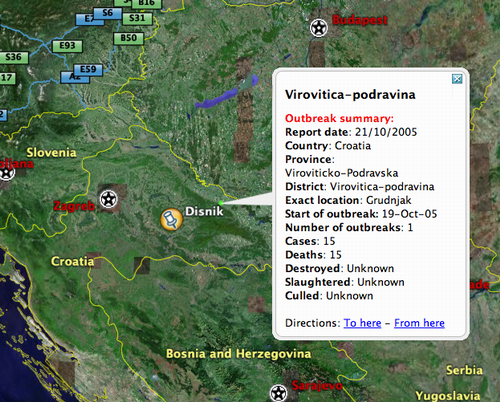
Browsing Google Earth using reporter Declan Butler’s excellent avian flu map layer, I found a report that hit close to home: on October 19, 2005, 35 swans were found dead of H5N1 in Viroviticko-Podravska County, Croatia (according to this FAO report). That’s about 35 miles from the area of Croatia where my relatives live in Disnik. Fortunately there have been no reports of human to human (or even bird to human) transmission in Croatia to this point.
The World Health Organization has an RSS feed for Disease Outbreak News. Right now you’ll find a lot of information about the avian influenza situation in Turkey. The same information is available on a companion web page.
Last week I made the mistake of watching Black Dawn: The Next Pandemic, a fifth estate special on CBC Television. This is a “fact-based docu-drama” that takes the viewer through a fictional avian influenza pandemic as it spreads around the world. The essential message of the special was “there’s very little you can do except wash your hands, and you have a pretty good chance of dying anyway.” I can only assume that their goal was to shake us out of complacency; on that level, they did their job.
Unfortunately they dropped the ball on the “steps you can take to mitigate the problem” end of things, leaving we viewers to simply cower in fear. They did prepare a Answers to Questions page that is somewhat helpful, but the program itself could have used a companion hour with practical advice: show us the best way to wash our hands, for example. Run through a checklist of good items to have around the house. Offer suggestions for doing things like shopping during a pandemic.
If the pandemic is, as the special suggests, inevitable, it would seem a prudent use of broadcast time to concentrate on offering useful, practical advice now instead of waiting until it’s too late and we’re all wrapped up in panic.
It’s been four days since the CBC News updated its visual and sonic identity (details). And I must say that I absolutely love the changes: the typography is clean, crisp and bold, the sonic pageantry is dialed way back, the “graphics for graphics sake” quotient is greatly reduced, and everything seems to have an extra spring in its step.
I even like the new Compass introduction: short, to the point, and great looking.
Favourite change: the [too] subtle “when the item we’re promoting now is coming up” analog clock they used during The National has been replaced with an actual count of the minutes until said item airs: much more useful.
Directional change: Boomer now appears on the other side of Bruce on Compass (I like the new weather graphics too).
Subtlest change: all the Compass reporters got new socks for the ends of their microphones.
I’ve heard lots of grumbling about the CBC “wasting lots of money on stupid design changes when things were perfectly good before.” But I don’t agree: design matters, and I laud any organization that invests in it; good design lets CBC News communicate more effectively, and that makes everything they do more valuable.
Google Earth for the Mac was released today. I’ve just downloaded it, and I’ve been playing with it for half an hour. It’s truly an amazing product: so much more than Google Maps, and something that has the potential to change how we think about the earth.
I thought the whole “flying around” animated thing was a gimmick, but it’s not: it works to reinforce that the world isn’t a discrete collection of maps sheets, but rather an interconnected whole upon which we’re all scattered. That might sound like a lofty idea, but I think it’s a powerful one, and something that will affect our view of the planet as much the pictures of earth from the moon did back in the 1960s.
If you haven’t experienced Google Earth yet, I recommend you grab a copy: it’s a small download, it’s free, and it may blow your mind.
Let this be a lesson to me: never blog about being sick, especially when the closing words of the post are “the end is near” (meaning the end of the sickness, not of me).
After blogging about said sickness, I returned to almost full health for a couple of days. I cleaned the bathroom, got a lot of work done, and even took the small family to Brookvale for an afternoon of cross-country skiing.
My hubris got the better of me, however, come Monday morning when the cold returned in a new a meaner form, settling in the upper reaches of my head and making me feel like my brain had turned to cotton. And the mucus, oh the mucus — my nose has been running a tap all week.
I’m back in the office this afternoon, as I’m feeling more like my head is full of dandelions than cotton (a distinct improvement), and there’s work to be done. I’m bolstered by a bracing cup of the Ginger Black Tea from Interlude. But I know enough not to tempt fate this time around, and I’m going to be home before Compass is over.
The crazy thing about all of this is that the usual vector for sickness into our family is Oliver, but he’s been the picture of health since Christmas. Catherine too. Here’s hoping they stay that way.
In the meantime, if you happen to join me in my stuffy-headed misery, buy lots and lots of Kleenex. You’ll need it.
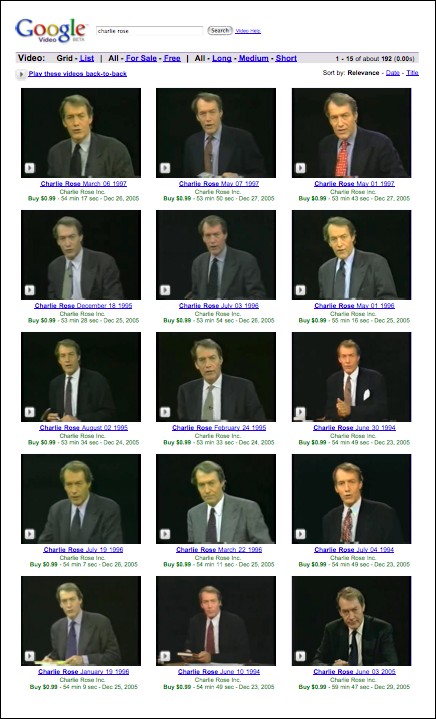
You can now buy old episodes of the Charlie Rose show from Google Video for 99 cents each (compared to DVD copies of episodes that cost $34.95). It seems that some episodes — like this one — are available for free download. Here’s a screen shot of a Google Video search for “Charlie Rose”:
So now it’s officially the “cbc news at six.” Ironically I missed the first episode because our DVR was set to record a program titled “Canada Now.” And there wasn’t one. So I watched it on the web. Where I was delighted to find that the web address for the RealVideo stream has a filename of compass.ram.
Editor in Chief of CBC News Tony Burman outlines the branding changes for all CBC News programmes that kick in today. Inside this Windows Media file you’ll see a montage of the new visuals and, at the end, the new “signature sound.”
My world has become much less confusing now that I’ve learned that Amanda Peet and Piper Perabo are different people.
Once you start playing with the Google Maps API, making your own maps using various bits of JavaScript, you’ll eventually come under attack from single quotes.
Look at this code, for example, which is a mixture of Javascript and PHP:
var point = new GPoint(<? echo $longitude . "," . $latitude; ?>);
var marker = createMarker(point, '<? echo $html; ?>');
map.addOverlay(marker);
The role of this snippet is to add a marker to the map at the given longitude and latitude, with the given HTML appearing when the marker is clicked.
So you stick this JavaScript inside a loop that grabs the appropriate values from a database, and sticks a bunch of markers on the map. Things go horribly wrong, however, when you try and create a marker for St. Dunstan’s Basilica, and you can’t figure out why. Here’s what’s happening:
var point = new GPoint(-63.12516,46.23367);
var marker = createMarker(point, 'St. Dunstan's Basilica');
map.addOverlay(marker);
I’ve highlighted the problematic area. And the problem is this: your browser’s JavaScript interpreter is getting confused by the single quote (aka “apostrophe”) in the string St. Dunstan’s Basilica — it thinks that single quote is the end of the string. And if you look in your Javascript console (Tools \| JavaScript Console in Firefox), you’ll see an error like:
Error: missing ) after argument list
How to solve this problem? Simply escape all of your single quotes in your HTML, using PHP, before you insert the HTML into the JavaScript. So:
var point = new GPoint(<? echo $longitude . "," . $latitude; ?>);
var marker = createMarker(point,
                '<? echo str_replace("'","\\'",$html); ?>');
map.addOverlay(marker);
The change has the effect of converting all of the single quotes into escaped single quotes (\'). Note that you use \\' in your str_replace because the backslash is also an escape character in PHP, so you need to “escape your backslash” in PHP too.
The resulting JavaScript will now look like:
var point = new GPoint(-63.12516,46.23367);
var marker = createMarker(point, 'St. Dunstan\'s Basilica');
map.addOverlay(marker);
And it will no longer cause problems.
About This Blog
 I am Peter Rukavina and this is my blog. I am a writer, letterpress printer, and a curious person.
To learn more about me, read my /now, look at my bio, listen to audio I’ve posted, read presentations and speeches I’ve written, or get in touch (peter@rukavina.net is the quickest way).
I have been writing here since May 1999: you can explore the 25+ years of blog posts in the archive.
You can subscribe to an RSS feed of posts, an RSS feed of comments, or a podcast RSS feed that just contains audio posts. You can also receive a daily digests of posts by email.