
I’ve had an interesting email dialogue with my friend Rob Paterson today, extending from a post of Rob’s weblog in which he wrote, in part “I think and write about war because I think that it is part of who we are - it is an unavoidable part of being human.”
I took exception to that comment: I believe that we are all essentially good, and that war is a temporary aberration that we can eventually overcome. I realize that this puts me at odds both with reality, and with Accepted Religious Doctrine, but I simply couldn’t survive if I had to feel that conflict will win out.
Our dialogue led in several directions, and at one point I wondered aloud whether the Internet and “social software” might play some role in “bringing us all together:”
In other words, is the Internet, and the social networks that increasingly overlay it, the bringing to life of the old Coca-Cola commercial (“I’d like to buy the world a home and furnish it with love…”) and inasmuch as that is true, does it hold any promise in helping to mitigate or eliminate the brutality (i.e. it’s harder to shoot someone if they’re your Facebook friend).
Thinking about this some more, and with some additional push-back from Rob, I’ve realized that there’s a problem with this plan, and it is this:
The social software rhetoric is all about connecting with like-minded people. So whereas in the old world you were forced to hang out with the two other Mongolian comics fans in your small town, the Internet lets you connect with the thousands of others out there in the rest of the world, geography be damned.
Don’t like the girls in Smallville? The Internet is moist with the possibilities of the girls of Capital City. Miss the folks from the Old Country? You’ll find a Google Group full of them.
This is, almost universally, talked about as a Good Thing.
And if you’re a Goth in Nail Pond I’d have a hard time convincing you otherwise.
But here’s the thing: so much of what ails the world right now (and perhaps forever) has to do with our inability to connect with non-like-minded people. Whether the lines in the sand are religious, political, ethnic or otherwise, Rob’s state of “permanent war” is fed by conflict between people who aren’t drinking from the same Coca-Cola.
In other words, it might be hard to shoot someone if they’re your Facebook friend. But it’s unlikely that the person you’re keen on shooting is your Facebook friend because Facebook serves simply to reinforce old loyalties. It’s easy to befriend someone your brother went to school with; it’s unlikely you’ll befriend someone from the other side of the world with a worldview that’s completely in conflict with yours.
One of the great things about geography, at least some of the time, is that it often places us in situations where we have to learn how to live in harmony with a whole range of people. You want to praise God on Sundays while your neighbour wants to listen to Motorhead. I like french fries, you like gulab jaman. You raise goats, I play chess. You’re Catholic, I’m not. Learning to live, and thrive, with the thousand little incompatibilities we share with our neighbours and fellow citizens builds up “social dissonance muscles” and leaves us with skills that allow us to, at the very least, tolerate difference.
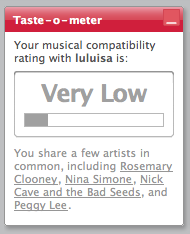
I’m wondering if the more we jump into the online orgies of the like-minded, the more time we spend exclusively with people who share our passions, the weaker these muscles are going to become.
Is it possible to create technology tools that work in the opposite direction, tools that somehow exercise our skills at mitigating conflict by exposing us, in some real and honest way, to people with whom we might otherwise never communicate? I’m thinking of a sort of Bizarro Facebook where our social network is made up of the least likely people we’d otherwise connect with.
Even as I write this it seems absurd, if only because it would probably be painful for most people. But it seems to me that the more we seek solace among the coalitions of the like-minded, the more Rob’s permanent war becomes likely.
Brickbats to Tabi, the Canadian clothing store, for having their robot call customers on Christmas Eve to crow about their Boxing Day sales. Not cool.
The old Variety Video location on Grafton Street has been “under renovation” for a couple of months now. When we walked by yesterday we found out why: it’s being transformed into a delicatessen:
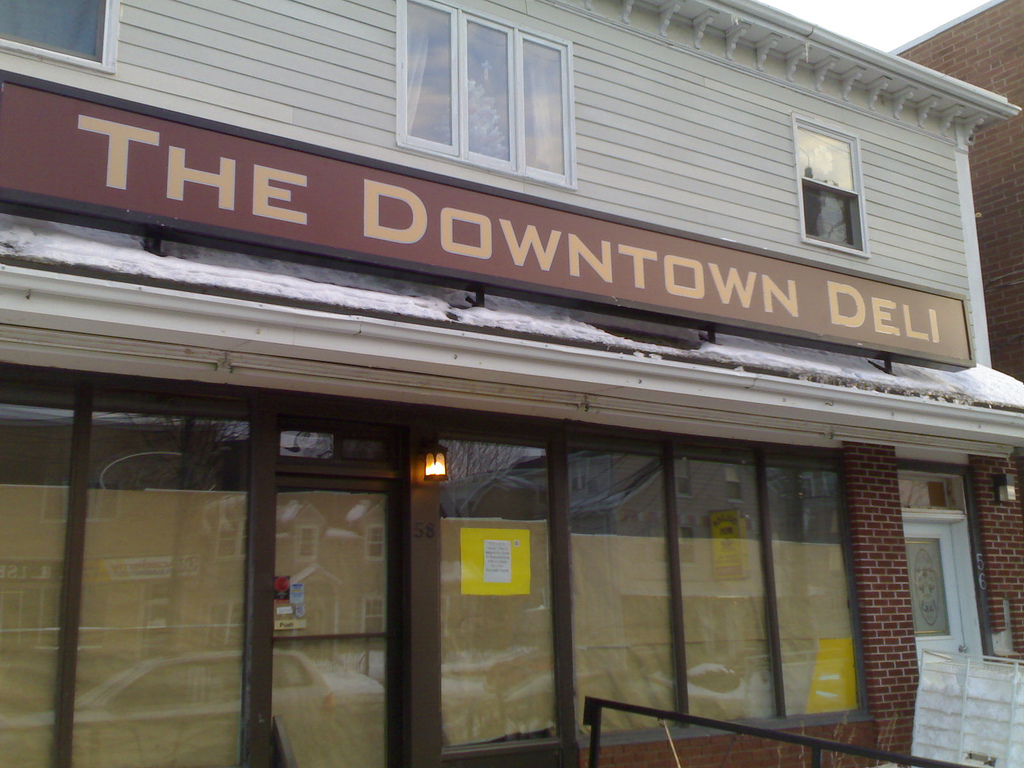
Some Googling about reveals a job ad (since removed) for two cooks with the following particulars:
Work Setting: Restaurant, Fast food outlet, Bistro
Cuisine Specialties: Canadian, Vegetarian
Food Preparation Specializations: Bakery goods and desserts, Stocks, soups and sauces, Eggs and dairy, Cold kitchen (salads, appetizers, sandwiches), Vegetables, fruits, nuts and mushrooms, Meat, Pasta, Pizza
All in all this seems very promising (although we’ll miss the handy source of video rentals).
Section 114 of the Prince Edward Island Election Act says, in part:
The Chief Electoral Officer shall, subject to this Act, retain in his or her possession the papers transmitted to him or her by any returning officer, with the return, for at least three months.
What this means in practice is that the ballot boxes, along with their contents (ballots, poll books) are delivered to Elections PEI and stored for at least three months after the election.
After three months Elections PEI destroys the ballot boxes, something done in recent years at the incinerator in Charlottetown (they had to seek special dispensation to allow this to happen after the Waste Watch program was introduced, as such materials would normally be slated to be composted, which is not a sufficiently rigorous method of destruction for these purposes).
The incinerator in question drives the Charlottetown District Energy System, which provides hot water to heat many of the buildings in downtown Charlottetown, including Province House, home to the Legislative Assembly of PEI.
That would be the same Legislative Assembly the members of which are elected using the ballots inside those ballot boxes.
This past week happened to be the week that this all happened; good timing given how cold it has been.
There’s something very appropriate about all this.
Toronto-area Catholic school board bans Pullman fantasy trilogy reports the CBC:
At a board meeting Tuesday evening, the trustees of the Halton District Catholic School Board voted to ban the title [The Golden Compass] as well as the remaining two books in atheist author Philip Pullman’s His Dark Materials trilogy: The Subtle Knife and The Amber Spyglass.
It’s remarkable to me that such things can still go on, especially given that, although Catholic in name, the Halton District Catholic School Board is completely funded by the public. Kind of makes you wish we had some sort of over-arching law that protected our fundamental freedoms from book banners like this. Oh, wait, we do.

On the newsstands in Europe, the Middle East and Africa, but not, alas, in North America, you can now find Intelligent Life, a magazine from the The Economist. It’s website — MoreIntelligentLife.com is well designed and a good read.
A year after it closed in its first incarnation it looks like the Town and Country Restaurant in Charlottetown has closed in its second: there are ‘For Rent’ and ‘For Sale’ signs on the building, and it’s closed for business.

The asking price is $380,000; here’s the real estate listing.
The CBC is reporting that singer-songwriter Dan Fogelberg has died at age 56.
They call him an “easy rock” singer, but I don’t think that pejorative term does justice to his style — Fogelberg wrote the kind of songs that don’t really get written any more, “folk-pop story songs” of the sort that his peers Ian Thomas and Harry Chapin were also famous for. Perhaps Bruce Guthro is the closest modern analog (Fogelberg’s hit Same Old Lang Syne, minus the synth, could very well be a Guthro song; he should cover it).
Radio doesn’t have time for 5 minute long songs any more, and so artists like Dan Fogelberg no longer have a popular niche. His music may sound over-produced and be written off as “easy listening” these days, but his hits are important parts of the 1970s and 1980s American songbook, and I think they’ll stand the test of time.
The beer was empty and our tongues were tired,
And running out of things to say.
She gave a kiss to me as I got out,
And I watched her drive away.
Just for a moment I was back at school,
And felt that old familiar pain.
And as I turned to make my way back home,
The snow turned into rain.
About This Blog
 I am Peter Rukavina and this is my blog. I am a writer, letterpress printer, and a curious person.
To learn more about me, read my /now, look at my bio, listen to audio I’ve posted, read presentations and speeches I’ve written, or get in touch (peter@rukavina.net is the quickest way).
I have been writing here since May 1999: you can explore the 25+ years of blog posts in the archive.
You can subscribe to an RSS feed of posts, an RSS feed of comments, or a podcast RSS feed that just contains audio posts. You can also receive a daily digests of posts by email.