
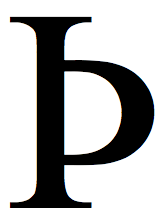
 The letter Þ, which you come across these modern days in Icelandic (like in “Þingvellir”, the historical site of the Icelandic assembly), but almost nowhere else, is called Thorn. Or, more recursively, Þorn. And it’s pronounced like the “th” in the English word “thin.”
While the Þ isn’t used in today’s English, this was not always the case: in Middle English the word “the” was spelled “þe”. And the story goes that because early printing equipment lacked the letter Þ the compositors of the day substituted the letter Y when they needed to set it.
Which is how we’ve ended up with Ye olde as a device used to telegraph “old Englishness” — “Ye Olde Fudge Shoppe,” for example.
Hannah Donovan from last.fm held a session called “Design as Service” at Zap Your PRAM last week. One of the things she talked about was designing for what she called “personas,” essentially made-up people with certain characteristics that a designer holds in their head when creating something.
I’d encountered a similar concept through a recent information architecture exercise we went through with a client and an IA consultancy: one of the things they had us do was to concoct three archetypal users that embodied some of the different characteristics that a possible user might — “Sally, a 42 year old mother of three children, works out of the home, technically savvy, drives a Volkswagen and travels twice a year” and the like.
Both in Hannah’s description of the process, and in the actual carrying out with our client it seemed rather odd and uncomfortable and imperfect, partly because people like Sally don’t actually exist (we’re all unique and special and cannot be typified, etc.), and partly because it seems vaguely like the sort of racial, ethnic and economic profiling that’s become insidious of late.
But mostly because it didn’t seem to remind me of the way that I actually create things.
And so it was with some pleasure that I read Tim Bray on this very topic (pointed to by John Bruber):
It’s like this: There’s only one person in the world whose needs and problems you really understand and whom you know exactly how to satisfy: that would be you. So build something that you use all the time, and, unless you’re really weird and different from everyone else, you’ve got a potential winner.
This resonates with me, and make me recall a non-digital example of this, an example that I used when asking Hannah a question on this issue.
Several years ago I was working for a local retailer. The previous manager of their shop was a woman who knew their customer intimately, because she was one of them: you had only to see inside her living room to know that the approach, the aesthetic and the product mix of the store reflected her tastes. And that was a good thing: the store had an attitude, a position, a editorial point of view (so to speak). It felt like more than the sum of its parts. Because it was: the manager had merchandised a store for people like her.
Later, when she’d moved on to other things, the store fell under the management of a much different group, of which I was one: middle-aged men who could only try to imagine what products, styles and merchandising would appeal to our customers. While we managed to get this right some of the time, we were, at best, making educated guesses and, at worst, relying purely on fictional stereotypes of what we thought our customers were like.
The store survived, but it has never been as good as it was in the very beginning because, as Tim Bray says:
Sometimes you can guess what people want, and you might get lucky. But probably not, so go ahead and build what you know for sure one person needs.
The Reykjavík Grapevine, the city’s English-language newspaper, makes every issue available as a free PDF. The cover of Issue #16 (PDF) declares “Welcome to Icelandistan” and the editorial begins:
I think I speak for everyone here when I write this: HOLY FUCK! The last few weeks have wrecked more havoc on this country than anything that’s not directly caused by a natural disaster. Our economy has been reduced to the standards Eastern Europe at end of the Cold War. As a nation, we are more or less bankrupt.
There’s some good reporting inside about the financial meltdown of the country, how and why it happened, and suggestions as to what might happen next (“cancel Christmas” is one).

At Ray’s Barber on Kent Street there’s a clock that runs backwards. I thought this was just a curiousity, but there’s actually such a thing as a Barber’s Clock.

First heard (recorded) at Baba’s last week, and then last night on Dirty Sexy Money (the two ends of the music promotion spectrum?), I’ve become addicted to The Weepies.
Oliver and Catherine and I went out to see City of Ember last night — we’ve got to seize any opportunity to see non-animated films that don’t involve evisceration or casual drug use.
There were few scenes of implied giant-rat-on-man violence that caused Oliver to shriek loudly, but otherwise the film lived up to its “family” designation and I think we all enjoyed it.
On one hand it’s a simple adventure story, but it’s also got good doses of “kid empowerment,” “self-reliance will win the day” and “wonderfully executed whirligigery.” If you liked Charlie and the Chocolate Factory I think you’ll like City of Ember for many of the same reasons.
By the way, with runs up and down University Avenue every 30 minutes it’s super-convenient to get to the movies on the bus. Leave a little early and have dinner at Café So-Ban in the mall’s food court: they serve great Korean and Japanese food and make a mean kimchi.
The Tourism Research Centre at the University of Prince Edward Island has released its Wind Energy Report, a study to “capture perceptions of wind energy production and wind farms, and their perceived effects on the landscape.” While the findings on wind energy are predictable (“82% of visitors and 75% of residents either agreed or strongly agreed that ‘There should be more wind farms on PEI’”), impressions of the Island’s branding as “Canada’s Green Province” showed a strong difference between Islanders and visitors:
There is some disagreement between visitors and Islanders as to PEI’s position as “Canada’s Green Province”. While over 83% of visitors feel this statement is either accurate or very accurate, only 30% of Islanders feel the same way. In addition, 37% of residents feel this statement is not accurate or not at all accurate. Only 7% of visitors feel this way.
I wonder who’s right.
Pop quiz: when you type, do you put two spaces between sentences, or just one?
About This Blog
 I am Peter Rukavina and this is my blog. I am a writer, letterpress printer, and a curious person.
To learn more about me, read my /now, look at my bio, listen to audio I’ve posted, read presentations and speeches I’ve written, or get in touch (peter@rukavina.net is the quickest way).
I have been writing here since May 1999: you can explore the 25+ years of blog posts in the archive.
You can subscribe to an RSS feed of posts, an RSS feed of comments, or a podcast RSS feed that just contains audio posts. You can also receive a daily digests of posts by email.