
Mom and I were sitting in the back yard the other night after supper, listening to the birds. I pulled out my phone and showed her Merlin, which will help identify birds from their song.
The app identified two birds, song sparrows and European starlings:
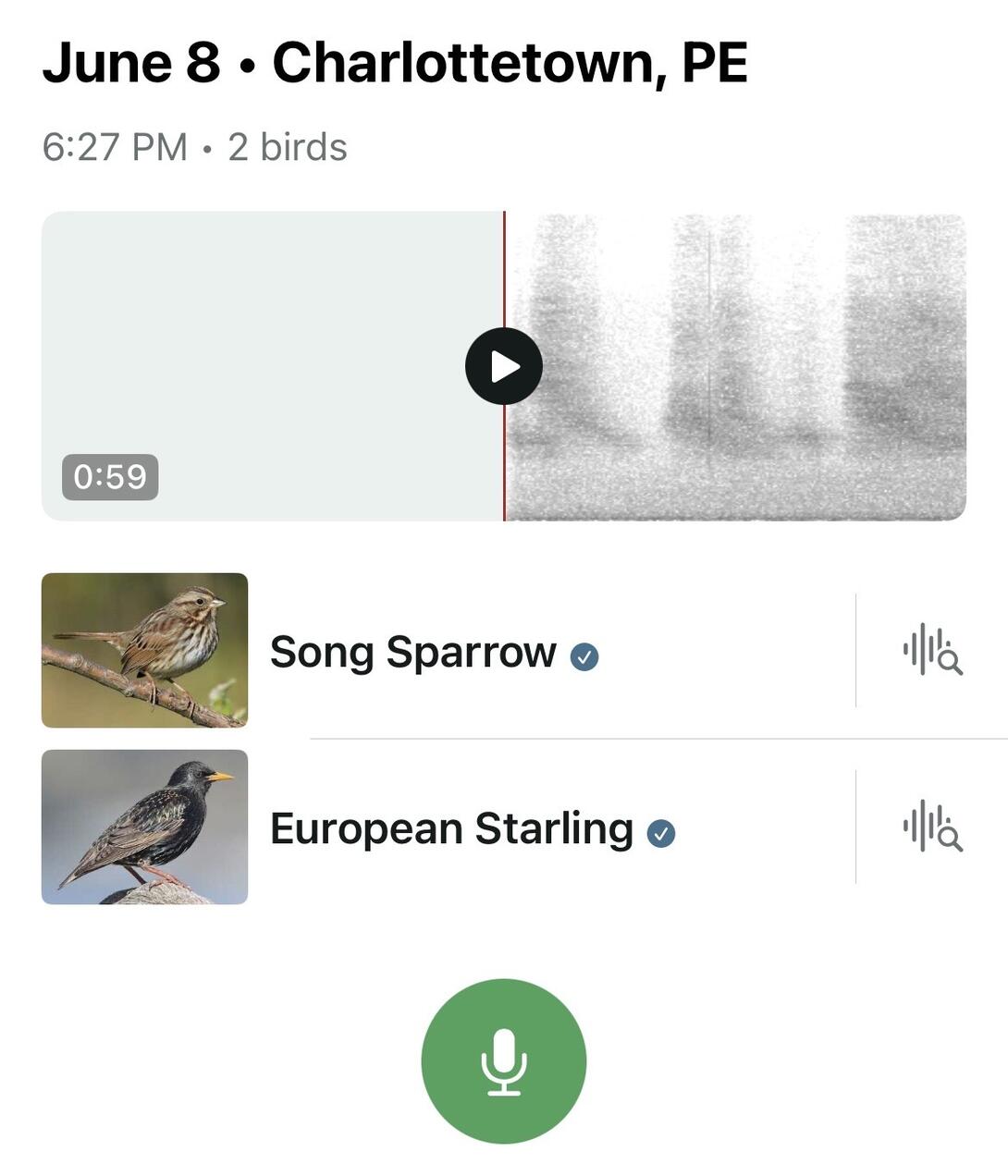
We got curious: if the starlings were European starlings, how did they get to Charlottetown.
I asked Claude, and received a definitive sounding answer:
The European starling (Sturnus vulgaris) is the starling you see throughout North America, introduced in the 1890s when about 100 birds were released in Central Park. So when people say “American starling,” they usually just mean the same European starling that’s now extremely common across the continent.
Claude went on to report this as an environmental tale:
Whatever his reasons, the releases happened in 1890 and 1891, and the birds thrived spectacularly — today there are estimated to be around 200 million European starlings in North America, making it one of the most consequential wildlife introductions in history.
We found this amazing, and I repeated the story several times, to several people. “Imagine that!”, I would say, marvelling at such an unlikely source for such a substantial population of birds.
I turns out not to be true.
In Shakespeare’s Starlings: Literary History and the Fictions of Invasiveness, from the journal Environmental Humanities, Lauren Fugate and John MacNeill Miller demonstrate, by examining literary history, that most of it was made up:
Scientists, environmentalists, and nature writers often report that all common starlings (Sturnus vulgaris) in North America descend from a flock released in New York City in 1890 by Eugene Schieffelin, a man obsessed with importing all the birds mentioned by Shakespeare. This article uses the methods of literary history to investigate this popular anecdote. Today starlings are much despised as an invasive species that displaces native birds and does almost a billion dollars worth of damage to agriculture annually. Because of the starling’s pest status, the Schieffelin story is considered a cautionary tale about the dangers of ecological ignorance. Diving into the history of the Schieffelin story reveals, however, that it is almost entirely fictional. Tracing how its elements emerged and changed over a century of retelling clarifies how the story came to shore up uncertainties in the bird’s environmental history and to distract from the lack of data supporting the starling’s supposedly disastrous impacts. In explaining how a fiction repeated over time attained the status of fact in debates about invasive species, this literary history suggests humanistic methods can serve as useful tools for understanding the value-laden narratives underpinning environmental attitudes and practices today.
I asked Claude if it would correct itself when others asked the same question, but it told me it couldn’t:
I appreciate the thought, but I’m not able to do that. Each conversation I have is independent — I have no way to update my underlying training or share information across conversations with other users.
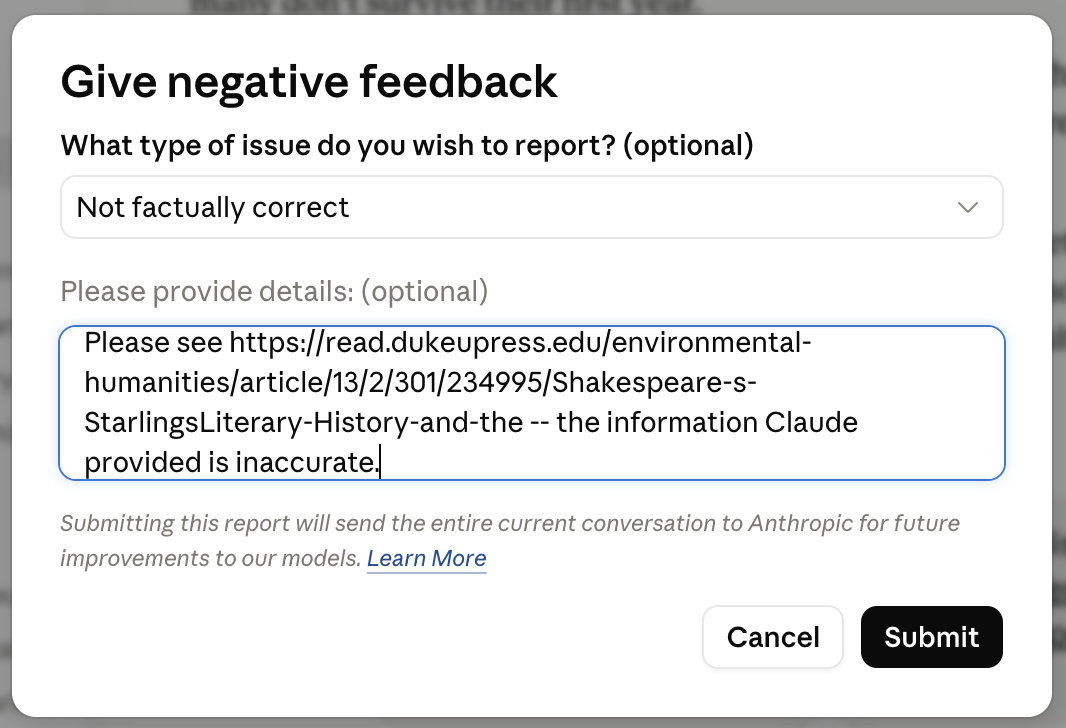
I was able to submit a report to Anthropic:
Comments
I'm always taken aback by the phrase "invasive species." It's such a characteristically human distinction. We call a species invasive if we can pinpoint the time of its introduction, and if we don't like how well it outcompetes species around it. Of course the formerly-dominant species would necessarily have outcompeted some predecessor, of whom we are usually unaware.
Species vie for survival. It's just how life is. As Steve Irwin used to say, "It's nature's way!"
 I am
I am  You can subscribe to an