
My friend G. just sent word that Brian Cudmore, one of my favourite people, died this morning at 3:00 a.m.
Brian has been almost about to die so often over the last 5 years that I sort of got to believe that perhaps he would live forever: every time he was on death’s door, he made an amazing surprise recovery, and kept living. Alas, this time not.
Brian lives on, of course, through his son Chris, and daughters Cynthia and Carolyn; indeed in each of them you can see some of him.
I know they will miss him dearly. As will I. Good-bye, Brian.
Today’s mission: get the firmware on my Nokia N70 mobile phone upgraded. The “firmware” is really the software inside the phone — its guts, so to speak. And my phone guts dated back to October 2005 and many bug fixes and upgrades have been released since then, so it was time for a trip to the repair centre to have updated guts inserted.
The problem with owning a cool bleeding edge euro-phone like the N70 is that, because it hasn’t been released in Canada or the U.S. yet, you can’t actually get the firmware upgraded in North America. So this was my chance.
After some careful study of the Nokia Denmark website, I came across their locate a repair centre page and, from there, sent out a couple of email enquiries around town — “here’s what I need — can you help me?” — last night.
This morning I had two replies, and I choose one of them, from the Sonofon repair shop on Fredrikskaj, a location that appeared easy bicycle distance away.
I hitched up the bike (and figured out how to get on a bike that has a child seat attached — requires careful leaning) and headed south, rough directions printed out and in my pocket.
Fifteen minutes later I was inside the “Butik” at the gleaming Sonofon HQ (map) and found an extremely professional staff ready to help with the guts upgrade. They popped out my SIM card and my MMC card, took my name, told me it would take 30 minutes and cost me 250 kroner, and ushered me to the waiting room.

Thirty minutes later I had my phone back in hand, and the old “V 2.0539.1.2” firmware had been upgraded to “V 5.0609.2.0.1”. The tech apologized that he couldn’t install a Canadian firmware because one doesn’t exist; his compromise was to install the U.K. version, which was fine with me.
While I was there, I decided to up for a local SIM card; I’ve written a detailed guide to using a Sonofon prepaid SIM in the Rukapedia for anyone else who might want to go down the same path.
The only stumble this morning: I got really, really confused when I understood the Danish word øre to mean “euro”. I couldn’t for the life of me figure out how Danes could withstand mobile telephone rates of 80 EUR/minute. Øre, as it turns out, is what the Danish kroner is divided into 100 of — think “cents.”
As to the bike ride, I again experienced that sort of transcendental feeling I got last year when I rode in Copenhagen for the first time. There’s something so life affirming about being in a community of bicycle riders in a city that’s specifically tailored for your needs (bike lanes everywhere, special bike traffic lights, etc.). My only biking challenge was to get coordinated with the new (to me) combination of hand brakes and “back pedal to brake” bike I’m borrowing; the main pinch point is at intersections where, because you can’t back-pedal, you need to made sure the pedal is in a “take off” position when the light turns green.
When traveling in Europe, I’ve found ViaMichelin.com is the best site to use for web-based maps and routing. I’ve never given it an address it couldn’t find, in France, Portugal and Denmark. And it does route planning for car, walking and travel by bicycle.
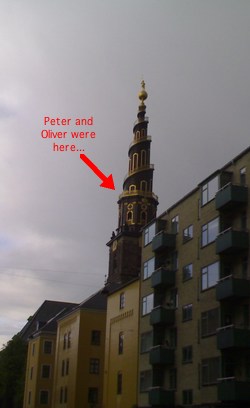 When I saw people walking around the spire of Vor Frelsers Kirke — The Church of Our Saviour — this afternoon, I just knew that Oliver and I had to climb up.
Catherine made it clear, back in 1998 when we were in Prague, that she would opt out of all “climb tall structure” travel activities — her knees just can’t take it — and this was the first time that a tall structure presented itself with Oliver old enough to climb it with me.
So we scrounged up 30 kroners from the bottom of the knapsack, paid the man at the bottom, and headed off up towards God.
God, I must tell you, lives very, very high up in the sky. Many, many stairs must be climbed. And some of the stairs have that precarious “scenario plan me tumbling to my death while Oliver looks on in horror” quality to them — windy stairs, steep stairs, cramped stairs.
Now for a guy so ready and willing to drag himself up tall structures, you would think I’d be pretty free of fear of heights. But, oddly (even to me), I am not.
So when, after 15 minutes of stair climbing, we reached the outdoor platform, I could feel the vertigo coursing through my veins. Fortunately I had Oliver to calm me — he would have happily continued on the additional slippery outdoor stairs to the very top of the spire if I’d let him, and was completely unaware of the whole “we’re up really, really high” quality of the expedition.
As it was we spent about 15 minutes at the top marveling at the view — as it turns out some of the only rain-free minutes of the day — and then made our way back down the stairs.
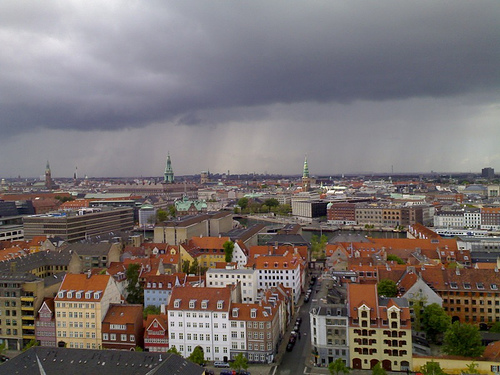
I’d do it again in a heartbeat — the stairs may have seemed precarious, but the church was build like a rock, and there was never any danger of everything going to hell (as it were).
I’m sure it will be the first of many tall structures that Oliver and I drag each other up.
One final image from Portugal. The public transit system around Porto is very integrated: under the andante brand name, metro, bus, tram and train are all part of the same RFID-based payment system. You purchase an andante card from an automated machine, and then “validate it” before you ride; it’s good for a certain amount of time for a certain number of zones (see this post to learn how we didn’t quite figure this out properly).
Another interesting aspect of the transit system is that every bus stop has a code printed on its sign, along with a telephone number. You send the code as an SMS text message with your mobile phone to the number, and a few seconds later you get back a return SMS with a list of the times the next buses stop there:
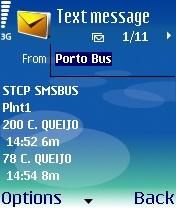
It works, and turned out to be really useful a couple of times.
Looked at from one perspective, our time here living in a little apartment in downtown Copenhagen is a sort of anthropological dig through modern day urban life. Yes, it’s only two weeks, but it’s amazing what you find out:
- When purchasing milk, the lighter the colour blue of the packaging, the lower the fat content.
- In France and Portugal I was (at 6 feet) always bumping my head when passing through doorways; I have no such problems here: Danes know how to make their doorways nice and tall.
- The showers here (assuming our apartment’s setup is common) have a “flow” dial and a “heat” dial. This makes so much practical sense: you just set your preferred heat level and leave it there, just turning on the “flow” every day when you want a shower.
- We’re learning a lot about living vertically. We’re on the fourth floor, and so getting in an out is all about stairs (lots of stairs), and looking out is all about your across the street neighbours — people you might never meet but otherwise have an intimate relationship with. Oh, and the rain passes by on it’s way down to the street. Neato.
- Food packaging is all Danish, all the time; while Danes speak impeccable English, they package in their native language. So as a unilingual English speaker, you might be buying sugar. Or perhaps it’s salt? Or freeze-dried hydrochloric acid?
- The hydrochloric acid problem is somewhat mitigated by the wonderful typography on the packaging; this place loves the sans serif.
- There is something called “DAB” radio here that appears to be digitally-transmitted radio over the air; the radio in the kitchen lists the “kbps” of stations it’s tuned to.
More as we dig further down.
You know those reality TV shows where cameras shoot a sort of “day in the life” of an airport? There’s one that’s shot at Heathrow that airs in Canada; every episode focuses on one or two little plots — someone trying to smuggle head cheese into the country, or a VIP flying in for the day, or a 12 hour delay on the flight to Australia. We’re taken “behind the scenes” and shown how the airport system deals with its everyday challenges.
Well, on Friday, flying through London Stansted, we became one of those stories; but for the lack of television cameras following us around, we’d have fit right into the exciting airport drama.
We had a six hour layover at Stansted. The first 3 hours were spent huddling against a wall on three “seen better days” chairs (Stansted’s pre-security areas are woefully lacking in chairs), having a little lunch, some fresh-squeezed juice from the juice bar, and generally trying to not perish from the exhaustion of already having woken up at 6:00 a.m. and flown in from Portugal.
Around 3:30 p.m. we were finally allowed to check in for our 6:15 p.m. easyJet flight to Copenhagen, and once we’d checked in, and loaded Oliver’s car seat through the oversized bagged chute, we went through security and headed over to Pret a Manger for some sushi.
Just as we were about finished up our lunch, Oliver started to rub his right eye. We didn’t pay attention for the first bit, but after he started complaining that his eye was hurting, Catherine took a closer look: turns out his eye was a little puffy, and looked like maybe he had something in it. I headed over to the washroom with him to see if we could wash his eye out; by the time we got there, his eye was very puffy, and surrounded by white puffy hives. A kindly baggage agent passing by noticed my obvious distress, and told us that if we tracked down a green-jacketed security guard, they could connect us with the airport’s medical team.
We stopped back to tell Catherine where we were headed, and then went off in search of the green jacketed.
While I’m certain that we saw many such green jacketed people on the way in, there were none at all in evidence as we walked around. We eventually came upon the “airline information” desk, and the clerk there let us borrow the telephone to call the emergency hotline (222 if you ever need it).
The emergency operator — presumably the same person you call if your plane is on fire or you’re having a heart attack — was very capable, took my details, and said she would dispatch a first aid officer shortly, and that we should stay where we were.
About 5 minutes later (it was probably 2 minutes, but felt like 5) said first aid officer — about the single most helpful man I’ve ever met in my life — was on the scene, looked at Oliver’s eye, and suggested we come in to the on-site medical clinic for an examination by a paramedic. He went off to fetch Catherine — by this time thinking the worst, of course — and then ferried us back through security (with promises to “fast track” us back the other way) and into a rabbit warren of little rooms behind an “airport personnel only” door.
And there in a little room that looked much like a doctor’s office, we found Peter the Scottish Paramedic, perhaps the second most helpful man I’ve ever met in my life. He gave Oliver a thorough going over — checked his airway, looked at his eye, listened to his breathing — and suggested that our best course of action would be to get some antihistamine from the airport pharmacy to see if that would help (the fact that Oliver was not otherwise in distress, and could breath normally, appeared to suggest he was not in imminent danger).
So while Catherine and Oliver stayed with Paramedic Pete, the first aid officer and I headed out into the airport to find the pharmacy.
When we arrived at the pharmacy the pharmacist was in the middle of some highly complex operation involving sticky tape. It turns out that the customer ahead of us was ordering what looked like a lifetime supply of some medicine or another, the label printer was broken, and the pharmacist was forced to hand-make and hand-apply individual labels on about 25 little boxes.
Reasoning that if I flipped out I would lose the support of the helpful first aid man (and the pharmacist), I calmly waited for 15 minutes while the sticky tape was applied. When this operation was over, the pharmacist listened to our tale, and immediately pulled a bottle of Piriton syrup from the shelf and told me how to dose it.
Then it was back to the rabbit warren to check on Oliver and give him the healing solution. By the time we returned his eye puff had subsided considerably, and the around-the-eye hives were gone. Catherine and Paramedic Pete, meanwhile, had deduced the likely source of the puffiness: the fresh squeezed orange juice Oliver had consumed earlier in the day. Apparently this was the 3rd or 4th report the paramedic had handled that could be traced back to the same retailer’s juice; his assumption was that some sort of spore or fungus on the orange was the culprit. He immediately placed a call to the juice place to warn them.
With a dose of Piriton in his belly (and a warning that it would knock him out — which it never did), we were indeed fast tracked back through security, huffed our way to the train to the gate, and as we came up the escalator the “passengers traveling with small children” announcement for our flight came over the PA.
Oliver was quite happy and normal by this point, and over the last 36 hours his eye has gradually returned to its normal state.
While the situation turned out to be not-so-serious, I still wouldn’t wish it on anyone. That said, it was nice to know that a team was waiting behind the scenes ready to deal with all that life could throw at the airport. Our heartfelt thanks go out to Paramedic Pete and nameless helpful first aid man (who turned out to be also responsible for elevators and myriad other airport quirks).
Oliver, of course, is never going to eat or drink another thing if I have any say in the matter.
By my calculation, I have spent about three months away from Prince Edward Island, in small and large gaps, over the last year. I’ve traveled more, and to more places, and for longer periods, than ever before in my life. It’s been great.
And one of the things I’ve learned is that the very act of moving about the planet, no matter how smoothly things go is inherently stressful. Because we’re not really programmed to move faster than our own feet can carry us, I assume that there must simply be built-in incompatibilities between human nature and, say, hopping across the Atlantic in six hours, or traveling from Portugal to Denmark in a day.
This isn’t about jet lag — at least not entirely — because north-south travel seems equally stressful. I think it’s the stresses of moving around so quickly, with so little control over the conditions, inside complex apparatus known to suddenly explode and dealing simultaneously with so many little worries — did I forget my passport? what if they find drugs in my pocket? what if the bus doesn’t stop where we’re supposed to get off? will I be able to understand road signs in Danish?
Regardless, travel takes it out of you.
And so we’ve come to understand that the post-rapid-travel day is necessarily set aside as the “get up late, take things easy, remember to eat, and don’t get ambitious” day. Sometimes we pull this off, sometimes we don’t.
Today we started well, stumbled, and the made an excellent recovery.
None of us were up until 10, and we phased into full operations mode slowly. So far so good. Our fatal flaw was — and isn’t it always? — after a late breakfast, thinking that we could just ignore lunch: around 1:30 p.m. we set out to see a little of the core of Copenhagen on three half-empty stomachs.
We quickly faded, and as we faded our ability to figure out just how to eat faded too. And so by 2:30 p.m. we were in the centre of the city, hungry and catatonic and wondering just what to do. Fortunately my “oh, I’ve already been to Copenhagen!” auto-pilot kicked in, and we were able to find our way to the good old shwarma place over near city hall. Thirty minutes later, we were fueled and happy. Isn’t eating amazing!
We spent the balance of the afternoon rambling around, Catherine taking picture of interesting gargoyles and me simply happy to be back in a city I got to know and love last June.
In the late afternoon, Olle rang in with news that he and Luisa were available for supper. Practical negotiations ensued and the decision was made to rendezvous at our place for a cooperatively constructed meal.
Regular readers will recall that I met Olle last year at reboot when he came up to me and said “hey, you’re Peter Rukavina.” Who could turn down an opening line like that? After hanging out at reboot, we’ve stayed in touch over the year digitally, conspiring and cooperating as opportunity arose, and my return trip this year with family in tow was, in no small way, designed to allow for some non-digital time with Olle, to let him get to know Oliver and Catherine, and to meet his [then fiance, now wife] Luisa.
It is always slightly intimidating to meet the partner of someone you’ve known for a while. What if they don’t like me? What if I don’t like them? What if the friend I know solo becomes odd and different when in combo? Fortunately for us, in Olle and Luisa’s case, any worries I might have had were without any basis. It is immediately obvious that they are sensationally compatible and complementary, and we found them delightful dinner guests.
And they were both very kind to, and respectful of Oliver, which goes a long, long way in my books.
And so Catherine and Luisa went out to scare up some food, we cooked up a stir fry, Olle went out and finagled some wine, and we sat down to the first of what I hope will be many happy dinners around the table here at Oehlenschlægersgade 5.
After 12 hours of travel (with lots of standing still), we’ve arrived in Copenhagen, and are happily installed in the little apartment we’re renting until mid-June. We were up at 6:00 a.m. in Portugal, in a cab to the airport at 7:00 a.m., en route to London on Ryanair at 9:25 a.m. (on time departure; arrived 15 minutes early), had a 6 hour layover at London Stansted, and then took the 6:15 p.m. easyJet flight to Copenhagen, arriving here at 9:00 p.m. By the time we gathered our luggage, took the train downtown, and walked over here, it was nigh on 10:00 p.m.
Peter, our gracious host, gave us the lowdown on the apartment — which keys do what, how to unlock the bicycles, how to start the stove — most of which I’m sure we’ll have completely forgotten come morning. We’re right in the thick of urban Copenhagen, which is exactly what we wanted. And there are toys here, and a playground and rumours of excellent hot chocolate, so Oliver is happy too.
Lots more tales to tell, but exhaustion getting the better of me, so must sleep.
Just because my Dad assumed otherwise, I’ll mention that all of the photos I’ve taken here in Portugal I’ve taken with my Nokia N70 camera phone (or is it a phone camera?). I’m very happy with the result, especially compared with the horrible photos my old T610 used to take.
As I’ve used the N70 to take photos, check email, navigate maps, set my Plazes location, take notes, look up phone numbers and, oh, make telephone calls, I’m more and more convinced of the “one integrated device is best” school of gizmology.
About This Blog
 I am Peter Rukavina and this is my blog. I am a writer, letterpress printer, and a curious person.
To learn more about me, read my /now, look at my bio, listen to audio I’ve posted, read presentations and speeches I’ve written, see things I’ve favourited elsewhere, or get in touch (peter@rukavina.net is the quickest way).
I have been writing here since May 1999: you can explore the 25+ years of blog posts in the archive.
 You can subscribe to an RSS feed of posts, an RSS feed of comments, an RSS feed of favourites elsewhere, or a podcast RSS feed that just contains audio posts. You can also receive a daily digests of posts by email. I also publish an OPML blogroll.
Instagram • YouTube • Vimeo • ORCID • OpenStreetMap • Internet Archive • PEI.art • Drupal • Github.