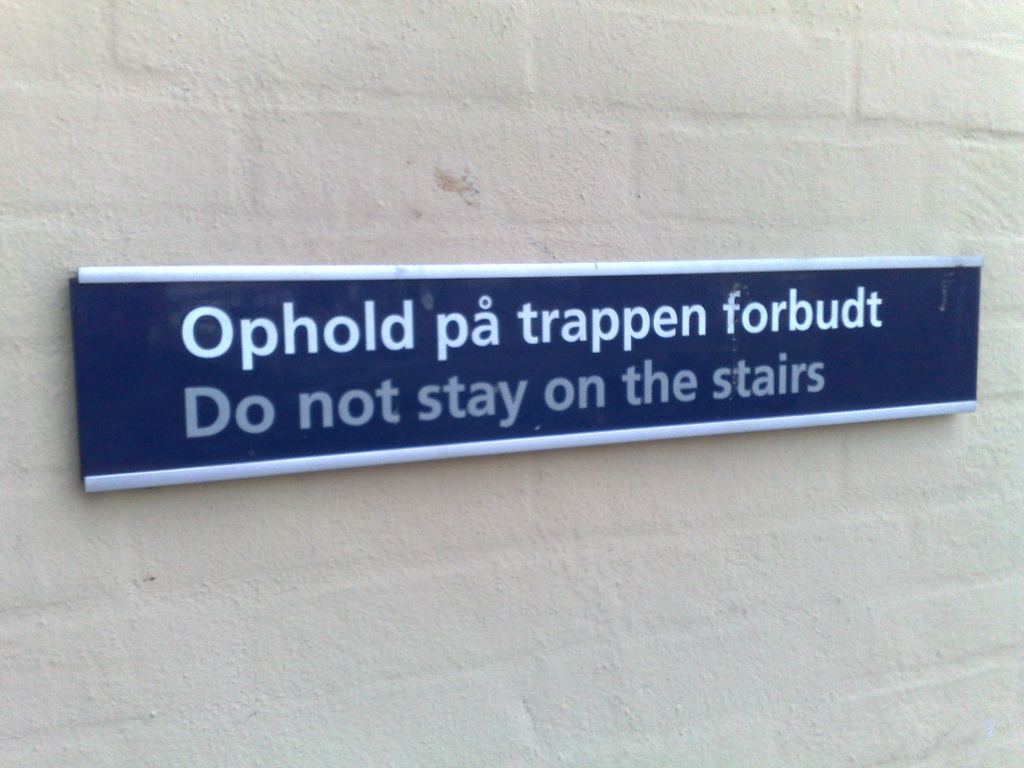
At Folk å Rock in downtown Malmö:
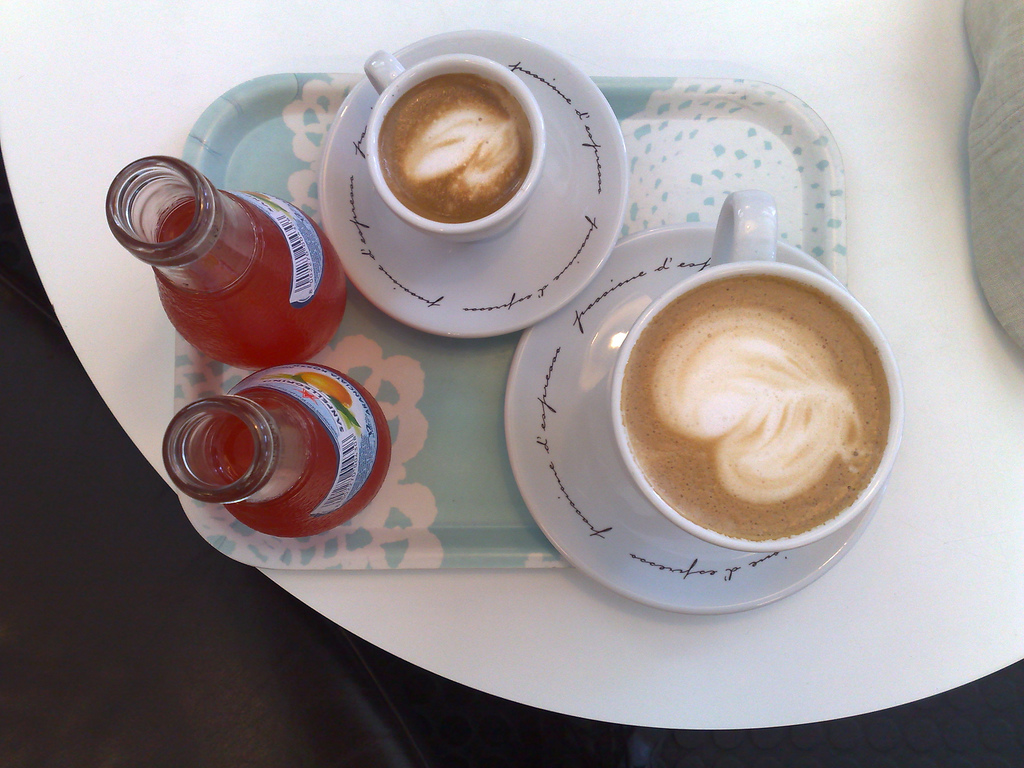

Can you help me identify this music, snapped in a clothing store in downtown Malmö?
A random assortment of experiences at day two of this year’s reboot conference:
It’s 2:02 a.m. as I finish this up; should be asleep, but there’s a lot to process and this is one way that helps. This was reboot number five for me, and reboot number one for Catherine (more about that when I’ve talked to her more about it); it’s a special place with special people and I’m thankful I somehow found my way here.
Oliver wrote me an email last night from his grandparents. He signed it “love your sun.” How right he is. Tears in my eyes.
A random assortment of experiences at day one of this year’s reboot conference:
Today, day two.
Back in the late 1980s the bee’s knees of “you don’t have to be a programmer to make awesome stuff” tools was HyperCard for the Mac. It was, in its essence, a visual data juggling tool that let applications get “painted” rather than “programmed.”
Making systems that allow complex, powerful and interesting things to be constructed with a simple tool-set with a gentle learning curve is not easy: believe me, it’s what I’ve been asymptotically doing this for years. Simple is never simple.
Yesterday I attended a workshop about Hoist. Going in I had no idea what Hoist was about; Luisa invited me to go along with a group from Signal Digital and I was intrigued by the “something cool in the state of Denmark” prospect to set aside the “oh, and the first hour is in Danish” as something I could press on through and overcome.
Through a combination of good visuals, kind translators, and a hands-on workshop that was quickly hacked into English for my benefit, I emerged with a fairly complete picture of what Hoist is.
Hoist is, in its essence, HyperCard for Drupal.
Drupal is a fabulously capable open source toolkit for making websites. It is part content management system, part programming framework, part pattern language. Like any open source fabulously capable system, Drupal has rough edges and UI bottlenecks; the modern Drupal 6 is light years ahead of the antique Drupal 4 in this regard, but there’s still ground to cover before Drupal’s ease-of-use catches up with its awesome power, and it’s into these crevices that Hoist is shining its light.
If you’re Drupal-literate, the technical description of what Hoist does is roughly as follows:
If you’re not Drupal-literate, the simpler explanation of what Hoist does is “makes creating websites that gather and report on different sorts of information easier.” So if you need to have your staff of 35 salespeople enter their nightly prospect reports, you can, with relative ease, create a “Nightly Prospect Reports” application in a few minutes of drag-and-drop action:
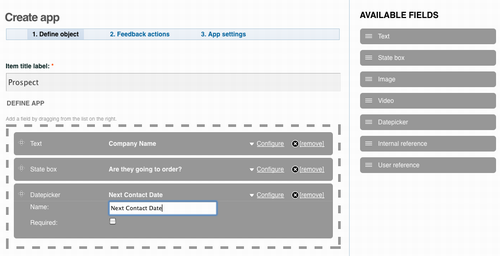
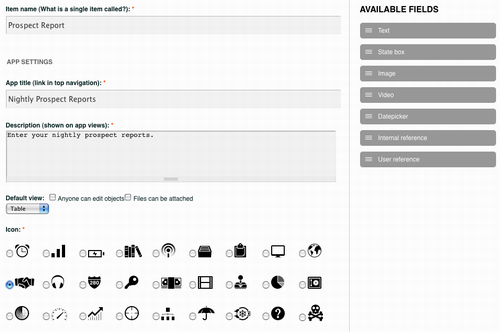
You end up with a new menu option that gets exposed to all the “members of your Space:”

And they can start entering their Nightly Prospect Reports:
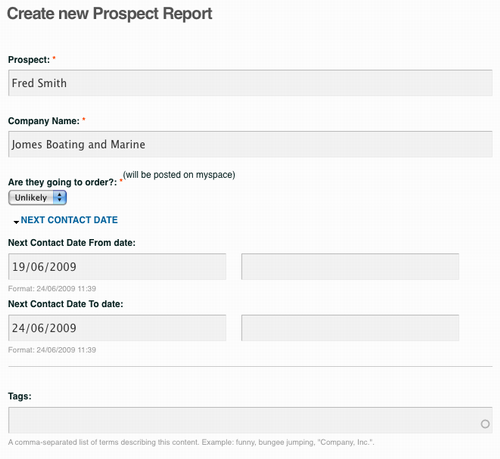
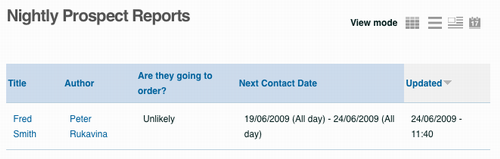
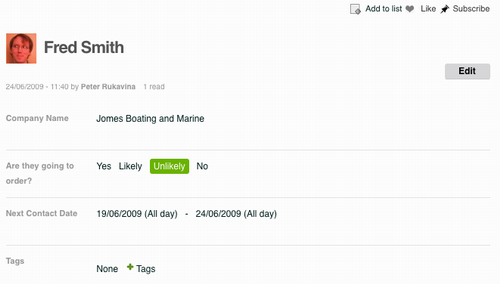
While it might be something of an exaggeration to anoint Hoist with HyperCard ease-of-use, especially in these early days, compared to the regular Drupal “create a new CCK content type, add new views, configure the display of the fields, create Views to all the content type to be reports on” string of actions required to achieve the same thing, Hoist is a considerable leap forward in the HyperCard direction.
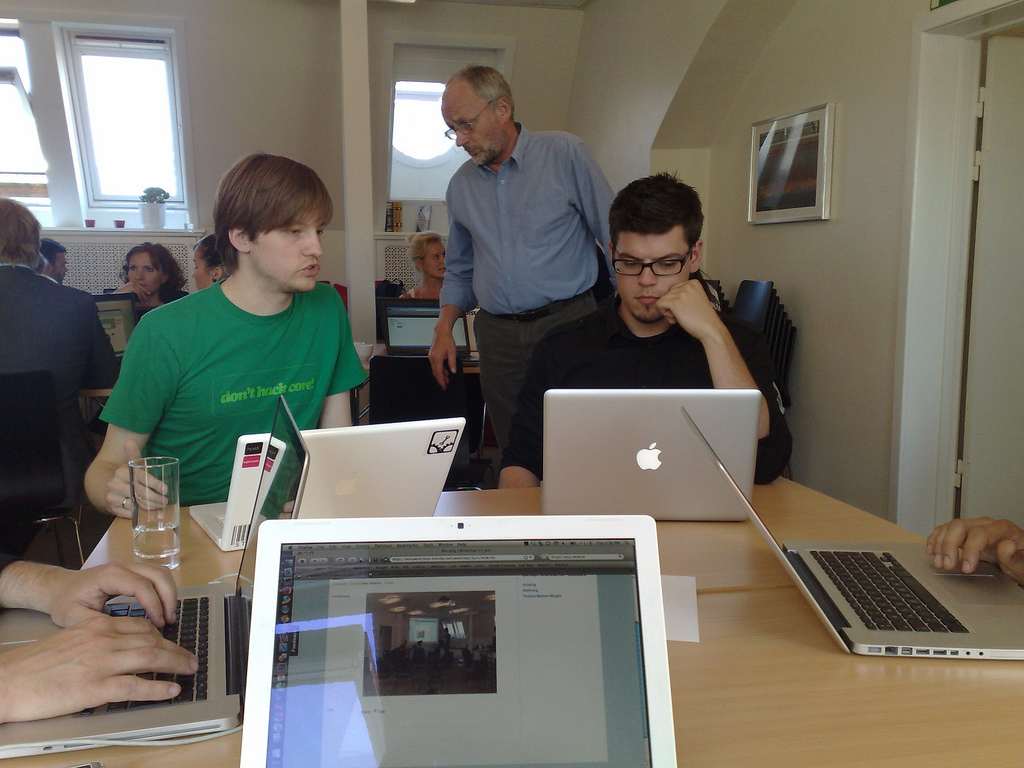
While Hoist is still a little rough around the edges, something exaggerated, perhaps, by the abysmal wifi at the workshop, there’s clearly considerable talent involved in rounding these off, and kudos must go to the entire Hoist team for being involved in the workshop, and for listening as much as telling. They hold their workshops every week, and at the intermission between the format presentation and the hands-on they serve cake, coffee and fresh fruit; it’s hard not to love a company that serves cake.
Today was my day to go exploring outside of the immediate neighbourhood of our apartment here in Malmö and south into so-called “integrated Malmö,” which is to say “interesting Malmö,” which is to say “the rich and diverse part Malmö that includes people from many cultures.”
The dividing line between downtown touristic commercial Malmö and the other Malmö is quite stark: you walk past the Triangeln shopping centre on Södra Förstadsgatan and all of a sudden H&M gives way to Myrorna, and the innumerable Espresso House of downtown disappear, replaced with innumerable places to buy falafel.
Both sides of Malmö have their attractions, but this “other” Malmö certainly pulses with a more dynamic energy.
My immediate destination was Restaurang Nowroz — and I had a wonderful meal of grilled chicken and rice there — but I spent an hour or so wandering around the streets and alleys, eventually ending up in front of Carib Kreol, our destination for tonight’s pre-reboot supper (as I picked the place, I felt the least I could do was to ensure it was actually there).
On the way back to our neighbourhood I came very close to buying, for 125 SEK, a fetching dark-green waist-length wool jacket at the aforementioned Myrorna used clothing shop; I ultimately decided, despite its wonderfulness, that it was about a size too small for me (or I a size to large for it). If you’re more L than XL and are in the market for a nice jacket, it’s waiting there for you…
I walked back to our Västergatan apartment in time to meet up with Guy, just arrived from Manchester. On the way I stopped at the Five o’clock tehandel tea shop to pick up a small bag of 2009 first-flush Darjeeling, which sounds more impressive until I tell you I’ve no idea what that means and even less impressive once I managed to bungle its preparation and produced the evilest, foulest-tasting tea ever prepared. To his credit, Guy grimaced, but finished his cup. Nobody asked for more. Darjeeling needs a gentler touch than I can offer it, I fear.
After some time in our beautiful courtyard knocking around ideas with Guy, we were joined by Olle and headed back into Other Malmö for supper with Luisa, Morgan and, later, M.C. Widerkrantz (who introduced himself by saying “Deb Richardson says to say hello,” thus proving the Escher-like nature of the hacker community that we think is vast but that actually only includes 112 people).
After supper (tasty, served with friendliness, but ultimately not life-changing) we stopped for a brief spot of coffee and Setúbal-sourced alcohol and then walked Guy back to retrieve his gear and set him off on the train over to Copenhagen (the other Other Malmö).
Tomorrow morning it’s up before the dawn to join Luisa at Signal Digital for the day, where they’ve kindly offered me a temporary desk to set down and do a day of concerted paying work amidst all this merriment.
Odd and sad coincidence given my post referencing Projects for Change: I just got word that Jim Hamilton, one of the original P4C gang, has died. Jim and I never lived in the same place at the same time, but our lives overlaid in many places and he was always very nice to me. Thoughts to his brother Richard (my old roommate and fellow warrior) and everyone else who knew Jim.
 I am Peter Rukavina and this is my blog. I am a writer, letterpress printer, and a curious person.
To learn more about me, read my /now, look at my bio, listen to audio I’ve posted, read presentations and speeches I’ve written, see things I’ve favourited elsewhere, or get in touch (peter@rukavina.net is the quickest way).
I have been writing here since May 1999: you can explore the 25+ years of blog posts in the archive.
 You can subscribe to an RSS feed of posts, an RSS feed of comments, an RSS feed of favourites elsewhere, or a podcast RSS feed that just contains audio posts. You can also receive a daily digests of posts by email. I also publish an OPML blogroll.
Instagram • YouTube • Vimeo • ORCID • OpenStreetMap • Internet Archive • PEI.art • Drupal • Github.