
From the CBC story:
Van Loan also said if a snap election were to be called before the issue is resolved, the chief electoral officer has assured him that he’s prepared to use “his adaptation power to ensure that no Canadian loses their right to vote” in the ensuing election.
Adaptation power? I’m intrigued.
In an attempt that I dramatized here, I dropped in on the weekly Plazes Product Forum in Berlin this morning via Skype videochat. While it was a great idea in theory, the technical side of the operation was such that while the audio was sufficient to get a sense of the room, the audio was muffled to the point where everyone sounded like they had socks in their mouths.
This is understandable, as the setup was simply a PC with a camera and a standard computer mic in a room with smooth echo-inducing walls.
iChat — which I think would have had better echo-cancellation — didn’t work on the spur of the moment because of firewall issues; the Skype connection was dead simple to set up.
So I seem the advice of the readership as to best practices for low-cost, Mac-friendly, higher-quality IP video-conferencing, with a focus on maximizing audio quality in a small room with up to 10 people gathered around a table.
Since I reported on our attendance at the Speaker’s Reception earlier in the week, I’ve learned that, in fact, this was an invitation only even. So, technically-speaking, Oliver and I crashed the event. Party crashing is also a good skill for children to learn.
Catherine and I are, in most ways, of completely opposite sensibilities and temperament. Our relationship works, thus, more because of “hybrid vigor” than anything else.
But there are a few points where we are completely in sync (which is probably equally required for relationship success).
Send us both, alone, into a new city with a camera and the photos we end up taking will have considerable overlap; we tend to focus on the same shiny bits (although Catherine is more obsessed with doors than I could ever be).
Another example: earlier this month we had our 16th anniversary (living in sin as we are, it’s the 16th anniversary of our first kiss, not of the marriage-we-don’t-have). We both ended up ordering an iPod Touch for the other; I placed an order online for hers and she ordered mine from Little Mac Shoppe.
When it became clear that the ship date for Catherine’s wasn’t going to make our anniversary deadline, I cancelled my online order and opted for an alternative palette of gifts that included giant twist ties
Catherine ended up persevering through the shipment deadlines and ended up pickup up an iPod Touch for me on her trip to Toronto last week. So this morning I got to place with the new-fangled pinch-n-slide interface while Catherine, alas, was left to play with her giant twist ties, needle threader and collapsing Japanese pen box.
News just in on the wire that National Road Network 2.0 has been released. For the uninitiated, the NRN is:
…the representation of a continuous accurate centerline for all non-restricted use roads in Canada (5 meters or more in width, drivable and no barriers denying access) to which will be added a set of basic attributes, street name, place name and block face address ranges.
In non-map-geek terms this means a high-quality royalty-free digital road map of Canada.
For anyone interested in GIS, map-hacking and similar pursuits, the NRN is an amazing dataset. That it’s made freely available for any use is a dramatic departure from usual practice with government data in Canada, where we usually have to pay for data that is, by all rights, already “ours.”
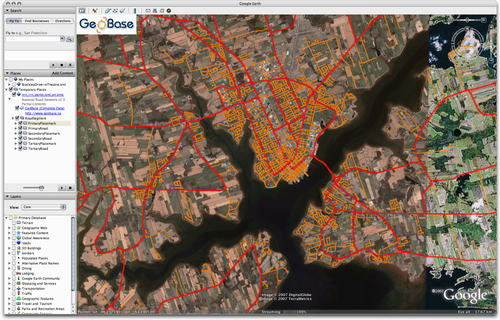
Locally here in Prince Edward Island, Dan MacDonald and his team at the Department of Transportation and Public Works deserve the credit for leading the PEI contribution to the project. What’s more, the PEI dataset is being used for the NRN 2.0 demo dataset and is available as a Google Earth-compatible KML file, which means that viewing the data is as easy as grabbing a single file and loading it into Google Earth:
Prediction: the Timothy Chaisson song all over again will be used as closing credits power ballad on a prime-time television U.S. program in the next 12 months. You heard it hear first.
After school today, Oliver and I went to get hair cuts at Ray’s Place (we hadn’t been since the day before he graduated from kindergarten in the spring), then went to Tai Chi Gardens for a late, late lunch, and then finally, on the way home, we stopped by the Confederation Centre of the Arts for the Speaker’s Reception following the opening of the fall session of the Legislative Assembly.
Oliver may be afraid to go down a slide at the playground, and have an aversion to playing “What Time Is It Mr. Wolf,” but he is a natural in social settings, and managed to wrangle himself a tour through the receiving line not once but twice. He also made cold introductions to several people in line, shaking hands and telling them his name, and generally catching them unawares.
The Speaker’s Reception was, unfortunately I think, almost entirely the preserve of adults. Other than Oliver, age 7, and the members of the Colonel Gray Jazz Band, there was almost nobody under 30. If kids are going to grok democracy, I think it would be good to have them deeply integrated into things like this.
In any case, the child-free nature of the event meant that Oliver had all the adults to himself. And so when Premier Robert Ghiz and his wife Kate walked in, Oliver knew it was time to make his move. After making introductions and shaking hands, we left the the Premier to greet others; Oliver, however, felt it important to make another swing around on the way out, and managed to convey that he is 7 years old, attends Prince Street School and, I believe, something about how he has plans to rearrange our living room tonight.
On the way home he suddenly realized that he’d forgotten to tell the Premier about his new computer game and also to seek the Premier’s counsel on what adult computer games he enjoys. It was all I could do to steer him home with the promise that he would be free to query the Premier on these weighty matters on his next encounter.
Some days there is just no doubting that you live in Prince Edward Island.
We recorded the first episode of The Plazes Podcast last week, focusing on an upgrade to Plazes.com that went live on Friday. This was my first podcast edited completely with GarageBand, which worked surprisingly well. It’s also my first attempt at hosting podcast files on Amazon S3, which is also working surprisingly well.
The whole experience reminds me, though, of wise words I read recently from a prolific podcaster; he suggested that if you open the door to doing anything other than simply wrapping up raw audio in an MP3 — in other words if you decide to do any editing at all, from “um” deletion to trimming down for clarity — you’ve got to be prepared to put in some time.
It only took us 30 minutes to record the podcast (I recorded Skype using Audio Hijack Pro); to edit it down to the 18 minutes it ended up at, with intro, extro and my voiceovers edited in, to convert to MP3 and AAC, and to set up a podcast feed and hosting, took about 6 hours all told.
Oh, and apparently in Germany you say “places” when you read “plazes”. Here in Charlottetown we say “plazes” to rhyme with “blazes.”
Helpful reader Mike pointed out that the RSS feed for comments for this website haven’t been working properly since August 17th. I’ve fixed the problem — this will teach me to carelessly modify database tables without thinking of The Implications — and all should be back to normal now. Thanks, Mike.
So I’ve got some Euros in my PayPal now, and I want to move them to a Canadian bank account. But I don’t want to lose anything in the conversion from Euros to Canadian dollars, so I want a Canadian bank account with the balance held in Euros. Here’s what I’ve learned after sending email to the major Canadian banks:
- Bank of Montreal: “Regrettably, our accounts are provided exclusively in Canadian and U.S. currency.”
- Citizens Bank of Canada: “Citizens Bank of Canada does not offer foreign currency accounts except for US dollar chequings/savings accounts.”
- Bank of Nova Scotia: “We advise that we currently do not currently offer accounts for Euros.”
- Royal Bank of Canada: “We offer accounts in Canadian or US dollars only at this time.”
- National Bank of Canada: “This message informs you that the e-mail you sent has not reached its destination because the domain “sibn.ca” is not valid. Please resend your message with the corrected domain.”
- CIBC: No response received.
The only positive response I received from from TD Canada Trust, which emailed back:
I am pleased to advise that TD Canada Trust does offer foreign currency accounts. However, you can only access our foreign currency accounts directly at your TD Canada Trust branch in Canada. They cannot be accessed via bank machines, EasyLine or EasyWeb.
Foreign currency accounts allow you to maintain your deposit without the need to exchange to Canadian Dollars, which may assist you if you are looking for an account to hold a large amount of another currency. In addition to being non-chequing, our foreign currency accounts:
- are non-interest-bearing accounts
- carry no service charges
- do not allow overdrafts
- are not eligible for coverage through the Canada Deposit Insurance Corporation
All of which makes their option even less attractive than PayPal. So that’s where my Euros are staying for now.
About This Blog
 I am Peter Rukavina and this is my blog. I am a writer, letterpress printer, and a curious person.
To learn more about me, read my /now, look at my bio, listen to audio I’ve posted, read presentations and speeches I’ve written, or get in touch (peter@rukavina.net is the quickest way).
I have been writing here since May 1999: you can explore the 25+ years of blog posts in the archive.
You can subscribe to an RSS feed of posts, an RSS feed of comments, or a podcast RSS feed that just contains audio posts. You can also receive a daily digests of posts by email.