
G. sent a link to a collection of historical air photos of Charlottetown that includes this beautiful shot from 1935:

Unfortunately their Air Photo Search feature doesn’t work with Safari or Firefox, so seeing what else they have available is behind a Windows wall.
Canada’s Radio Sweetheart, Dan Misener pointed to an episode of The Sound of Young America a couple of weeks ago, and in so doing inspired me to explore the amazingly rich episode archives of the show.
One of the most interesting interviews is with Ira Glass, the host of This American Life, the public radio show he hosts (another listening habit of mine inspired by Dan).
You can listen to the interview here.
The interview is interesting in part because it affords an opportunity to hear the unscripted Ira Glass, which is quite different from, although no less enjoyable to listen to, the well-worded and deliberate Ira Glass we hear on This American Life. It becomes immediately obvious what an incredibly deliberate and well-crafted show it is when you note this difference; you realize the show isn’t just Ira Glass hanging out in the studio and ad-libbing.
The other item of note is Glass’ description of the importance of a narrative thread to This American Life stories, and how this differentiates them from run-of-the-mill radio “feature reporting.” When host Jesse Thorn asks Glass about an episode of the show that focused on Improv Everywhere and their Best Gig Ever. Thorn wanted to know why the episode focused on this particular project — one that, in a certain sense at least, backfired — rather than any of the more “successful” projects from the group. To which Glass responded:
I know what you’re saying: you’re saying that basically 90% of what Improve Everywhere does is actually quite dear and really wonderful and we happened to choose two cases where they had dramatic failures…
…but I have no interest in a story about Improv Everywhere. Like I think that Improv Everywhere is totally interesting and if I were a feature reporter working for a daily news show or working for a newspaper, maybe I would do the story that you’re talking about, which is the story that goes “There’s this cool group, they do these funny little happenings,” and we’d go along on one of their happenings, and we’d quote some people at one of the happenings.
That’s not what I’m interested in doing. Because I don’t think it’s that compelling.
I’m more interested in a story with a plot and a conflict and characters and something that’s more engaging. And truthfully the story that I’m describing as the theoretical straight news version of this story isn’t as interesting as the story of “they accidentally screwed up.”
I feel like, in a way, it gets to something really interesting about Improv Everywhere, which is they mean well, they totally mean well, but even with the best of intentions, and even being very imaginative, creative people, occasionally they screw up… that to me is more interesting than “hipsters putting on happenings around New York.”
Those few sentences are as good an explanation of the difference between boring radio and compelling radio that I’ve ever heard.
And indeed they also cut to the heart of the difference between boring blogging and compelling blogging. So many times I’ll sit down and carefully craft a blog post, a blog post that I think will be the greatest blog post ever written, only to find that, in the end, to plot sort of, well, trails off. There’s no punch line, no resolution. No story. And so I close the browser and try and walk away with some notion that I’ve learned something, and vow to write another day.
Bill C-10, with the obscure-sounding title “An Act to amend the Income Tax Act, including amendments in relation to foreign investment entities and non-resident trusts, and to provide for the bijural expression of the provisions of that Act” has my television-making friends all atwitter. The offending matter is found in a proposed amendment to Section 125.4(1) and concerns the definition of what a “Canadian film or video production certificate” is.
The current version of the Income Tax Act says simply:
“Canadian film or video production certificate” means a certificate issued in respect of a production by the Minister of Canadian Heritage(a) certifying that the production is a Canadian film or video production, and(b) estimating amounts relevant for the purpose of determining the amount deemed under subsection 125.4(3) to have been paid in respect of the production.
The amended version, which has already passed the House and is to be considered by the Senate, contains several additional provisions, including this caveat:
(ii) public financial support of the production would not be contrary to public policy
The film and television making community suggests that this amounts to “essentially government censorship of the arts” and has mounted a campaign to have the bill overturned.
The Minister of Canadian Heritage disagrees, saying the intent of the amendment is to:
…make sure that we will take fiscal measure to make sure that the Canadian taxpayers’ money won’t fund extreme violence, child pornography or something like that.
Meanwhile, the Canada Family Action Coalition, a group “with a vision to see Judeo-Christian moral principles restored in Canada,” says in a recent release, in part:
[T]he argument that filmmakers and some media industry have a Charter Right to be funded and given tax breaks exposes years of liberal entitlement mentality…. Let them argue this one before the public, ask the taxpayer in the next election, if they want to spend 1.5 million dollars for a film called ‘Young People F***..ing’ - a pornographic film that even some Toronto Film Festival people thought questionable. Cronenberg and his friends will lose that argument and the one about their Charter right to be funded.”
Setting aside any debate about whether this is good public policy or not, it strikes me as a brilliant tactical move by the Government.
By burying the provision deep within a long bill, the Government is able to suggest in public both that it’s simply a well-intentioned administrative change, and also that, as it passed through the House without notice, it’s the fault of the opposition for not reading the bill before voting for it.
At the same time, they can also claim credit for the provision with their socially conservative base. And they can do this with the conservative code-word “contrary to public policy,” which their brethren will understand to clearly mean “no bestiality movies starring Rick Mercer.”
There’s almost no political downside, as the artistic constituency that’s up in arms is never going to vote Conservative, and even any hard-right Libertarian faction in the party that might otherwise oppose “Government control of the arts” is going to be against taxpayer-supported arts anyway.
On the opposition side, in addition to the “wait, we passed this without reading it?” problem, there’s also the challenge of appearing to be against something that is designed, says the Government, only to protect against “excessive violence or any heinous attacks against targeted groups in society.” For every artistic freedom argument the opposition raises, the Government can simply counter with any manner of fictional constructs — “so, the Honourable Member would support public financing of a pro-Nazi movie about ducks having sex with cows?”
Those of us who consider ourselves on the opposite side of the fence from the socially conservative aspects of the current Government treat these elements as though they are thick-skulled dullards at our peril: these people obviously know a thing or two about how to forward a their agenda without appearing to.
We may think that they’re going to win their revolution by introducing bills like “An Act to Curtail Swearing” or “A Bill to Limit Genital Contact between the Unmarried,” when, in fact, they’re smart enough to achieve their aims with considerably more finesse.
I released an updated version of PresenceRouter today that supports Yahoo’s new Fire Eagle engine. For those of you new to the app, PresenceRouter lets you route your Plazes geopresence stream to many different social networks and web services (Twitter, Facebook, Jaiku, Pownce, and more). This version also fixes Adium support, and adds routing the current location to Jaiku.
Our friends at Island Morning posed the question “Should condoms be made available in Island schools?” for this morning’s regular Friday-morning phone in. Yes, this is still an open question here on PEI. Sigh.
Of course we got to hear to usual range of “having condoms easily available will only encourage them” calls from people who presumably have forgotten completely what it was like to be a teenager and thus are completely divorced from any ability to be realistic about this issue (has there ever been an example in history of a teenager sitting on the fence about sex being pushed over the edge by the ‘implicit permissiveness’ that condom machines in schools are supposed to have? — “I know you think it’s wrong, Billy, but the school board wouldn’t install condom machines in the washroom if they didn’t want us to have sex”).
In this puritanical environment, those fair-minded people who can see the upside of making condoms as freely and widely available as possible are forced to couch every argument they make inside a fog of “and of course we also encourage abstinence.” Any suggestion that if teens are going to have sex it might as well be good sex would, I imagine, be greeted with expulsion, trial for heresy, or worse.
In other words, it’s somewhat okay to admit that kids are having sex — as young as 11 or 12 years old they said this morning — and it’s somewhat okay to seek a sort of “medical intervention” in the process by providing them with condoms, but these things are only somewhat okay if it’s generally suggested that sex is still wrong.
I can only imagine that the sex that results is inevitably conducted in non-optimal conditions, tinged with guilt, shame and fear of being found out, and likely often not symmetrically consensual. What kind of introduction to sex is this?
Perhaps a more useful question for the CBC to pose would be something like “What could we be doing to give our kids a healthier introduction to sex?” The longer we waste time on issues like condom availability — issues that the much of the rest of the world has grappled with and dealt with already — the longer we allow a culture of “sex as regrettable but possibly necessary evil” to persist.
Pownce, a web service co-founded by friend-of-ruk Daniel Burka, released an updated API today that adds support for “posting links” programatically. In turn I’ve released an updated version of PresenceRouter with Pownce support. And thus:
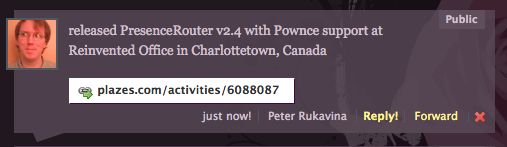
For those of you who are new to the game: PresenceRouter is a Mac OS X application that allows you to echo your Plazes geopresence stream to other web services.
- Zurich
- Zuta
- Zutphen
- Zuver
- Zwingle
- Zwolle
- Zyba
- Zylks
- Zylonite
- Zzyzx
Baghdad Bureau is a new weblog from the New York Times:
The goal is to provide a sense of the lives of ordinary Iraqis as well as of the country’s politicians, police officers and military forces, and to offer a more informal portrait of the American-led troops, the growing numbers of private security contractors and the foreign diplomats. All have a part in the painful drama unfolding here and stories that deserve to be told.
The Playmobil online store sells a variety of Playmobil figures including African/African American Family, Asian Family, and Mediterranean/Hispanic Family. You can also buy Caucasian Family and, somewhat oddly, Roman Family.
Five years ago the Provincial Library Service here in Prince Edward Island had a convenient web form that patrons could use to make inter-library loan requests. This was nice, in part, because it meant that you could build applications that depended on it.
Alas this handiness has been replaced, inexplicably, by an unhelpful page that directs one to download a PDF about inter-library loans. It appears, thus, that you now have to actually go to the library itself and fill out an “interlibrary loan request form.” With a pencil.
It’s like 1952 all over again.
There is a web-based form to make a request to have the library purchase something. Alas it too harkens back to an earlier era of unhelpfulness; read this, for example:
Patrons who submit a suggestion for purchase are encouraged to keep checking the catalogue and if the item appears, place the request themselves at that time. If the title does not appear in our catalogue after three months, assume that it is not going to be purchased.
While it’s understandable that the library can’t purchase everything that’s requested, their low level of online literacy suggests perhaps that they record purchase requests with quill pens in a ledger and review them once a year. If nothing else one can sense “exhausted, understaffed and overwhelmed” behind the verbiage on those pages; they might just as well say “look, we’re not really going to purchase anything you request, so stop asking already and go to Indigo.”
So here’s my idea: take the engine that runs Digg, the “social news” website, and repurpose it as a web application that allows library patrons to collectively decide which books the library system should purchase. Patrons would “login” to “LibraryDigg” with their regular library card number and password, and then could enter books, DVDs, etc. that they want opened up for consideration.
Every library patron would be allowed access to the list of requests, and could “Digg” — vote that they be purchased — things they want to see purchased too.
While you’d want to leave a certain amount of the book budget to librarian’s discretion to ensure a well-rounded collection, another certain portion could be devoted to “community determined” purchases.
In theory this would make the book purchase budget more responsive to actual patron interests, and over and above that utility I think it would provide an interesting platform around which to build interest in and discussion about things in the library.
About This Blog
 I am Peter Rukavina and this is my blog. I am a writer, letterpress printer, and a curious person.
To learn more about me, read my /now, look at my bio, listen to audio I’ve posted, read presentations and speeches I’ve written, or get in touch (peter@rukavina.net is the quickest way).
I have been writing here since May 1999: you can explore the 25+ years of blog posts in the archive.
You can subscribe to an RSS feed of posts, an RSS feed of comments, or a podcast RSS feed that just contains audio posts. You can also receive a daily digests of posts by email.