
When I got home from work today there was a voicemail from Eastlink, our phone, cable and Internet provider, asking us to call their Accounts Receivable department. So I got on the phone and talked to an agent who ultimately had no idea why they’d called originally, and suggested that I was the victim of their system placing random calls to innocent customers.
When I got off the phone I went to use the Internet, and found that we had no service. I did the usual checks of the wifi access points and the cable-modem, but nothing jumped out at me. Later in the evening I phoned technical support, explained the mysterious call earlier in the day, and was assured that there was no problem with my account. They asked me to call back when I could be in front of the cable-modem.
So, just now, I trudged back down to the basement, got tech support on the horn again, talked to a different (and very helpful) chap who told me that my “modem had been deactivated” on their end. He put me on hold for 5 minutes and came back on the line to explain what had happened.
When our ISN service was switched over to Eastlink service last week we ended up with the original ISN-provided cable-modem when Eastlink replaced it with their own. The installer made mention of the fact that we should return it to ISN, and told us to call them to find out where. So a few days later I called ISN and was told that I had to return it to the Charlottetown Mall Eastlink kiosk.
As I’m not in the habit of going to the Charlottetown Mall every day, nor indeed am I regularly in its neighbourhood, I put the cable-modem on the dining room table with plans to take it out there this weekend.
Apparently this wasn’t soon enough for Eastlink: they decided to punish me for my tardiness by cutting off my Internet service. Without warning. They then made matters worse but bungling the follow up.
I knew that the halcyon days of ISN customer service were gone, I just didn’t realize how quickly and arbitrarily the faceless corporateness of Eastlink would manifest itself.
Sigh. I’ve been a Eastlink customer for more than 7 years, and an ISN customer for more than 10 years. It’s not like I’m selling my second cable-modem on eBay and making off with the proceeds. I can understand cutting off service after, say 60 days and a few phone calls. But after 8 days? 17 years of customer goodwill eroded seriously by a single careless act.
I got another “I’ve switched Internet providers so here’s my new address” email from a friend today. I get several of them every month.
Which prompts me to make a very basic suggestion: I recommend that everyone register their own domain name and use that domain to receive their email. When you do this — and it’s really very simple — then you’re no longer tied to a particular Internet provider or web mail service, freeing you to decide the best way of receiving your Internet and decoupling your Internet service from your email.
Now this used to be something that was very complicated: drenched with arcane rules, complex to set up, and really only possible if you had your own hardware and dedicated Internet connection.
This is no longer the case: it’s now possible to get up and running in minutes.
Here’s what you need to do.
First, go to a “domain name registrar” website — we use both Webnames.ca and GoDaddy.com — and use the prominently-placed domain search box you’ll almost certainly find there to search for possible domains to register. You’ll likely find that almost any common name is already taken, so you have to be creative: if “johnsmith.com” doesn’t work, try “johnsmithrocks.com”.
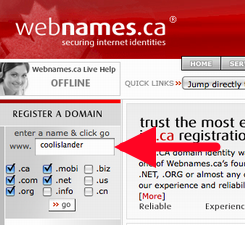
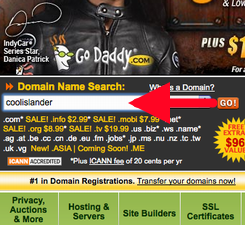
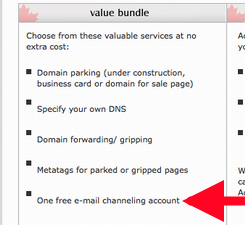
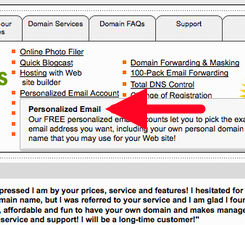
Once you find a domain that’s available, proceed with the registration and watch out for a feature called, variously, “email forwarding” or “email channeling” and make sure you opt for it (it’s usually free, at least for the first email address associated with your new domain).
Proceed through the purchase process (this is where you’ll find the biggest difference between Webnames.ca, which is more expensive but less drenched in confusing up-sell messages, and GoDaddy.com, which is much cheaper, but mind-numbingly overwhelmed with “hey, why not add this special domain security protection deactivation feature” offers). You’ll have to spend anywhere from $1.99 to $35 a year for the registration depending on where you do the deal; ask your geeky friend who they deal with if you need advice.
Once your domain name is registered you’ll have access to some sort of “domain configuration tool” that will let you set up email forwarding. The idea here is that you’re going to set up your permanent, this-will-never-change email address — say “jorge@johnsmithrocks.com” — to forward any email that’s sent to that email address somewhere else. That somewhere else can be any of:
- The email address that comes with your Internet service — jorge@pei.sympatico.ca, jorge@eastlink.ca, whatever, or
- A free webmail account, like the ones you can set up at Yahoo, GMail, Hotmail, etc., or
- Your work email address.
So, in other words, you’re not setting up a “new place to get your email” — that can stay the same as what you’re using right now — you’re setting up a new way for people to email you there. So you can still login to Yahoo, let’s say, and use your “BarvoBlox23@yahoo.com” address like you always have, but you can give out your cool new “doug@barvoblox.com” address to your friends, and set that address up to simply forward your email onto Yahoo.
They key here is that you can always change where your email gets forwarded by going back to the place you registered the domain and pointing your email elsewhere.
So if Yahoo gets purchased by Microsoft and you don’t like their new privacy policy, you can get a Gmail account, and just point your permanent, this-will-never-change email at your personal domain at your new account. That’s all you’ll need to do, and you don’t have to tell anyone that you’ve done it.
Remember psychogeography, the discipline I’m apparently now a practitioner of? Well now we have agroecology:
…the integrative study of the ecology of the entire food system, encompassing ecological, economic and social dimensions. This definition will lead to a practical approach that encourages researcher, educator, and student to embrace the wholeness and connectivity of systems, and will stimulate a focus on uniqueness of each place, and solutions appropriate to its resources and constraints. The definition expands our thinking beyond production practices and immediate environmental impacts at the field and farm level.
 I find it fascinating that the reaction to the intellectual confinement of existing disciplines — “ecology” and “agriculture” or “psychology” and “geography” — is to create new disciplines rather than going all the way and abandoning the walls of disciplines altogether.
I suppose I’m advocating for a “just hang out and do shit” approach that might work extremely well only for obsessive generalists like me; perhaps this new middle ground is required for those uncomfortable with simply knowing a very thin slice about everything, but with a desire to build bridges between existing intellectual towers.
But I also wonder if the desire to name and formalize these new mashups is fed by a need to coddle funders, facilitate business cards and to provide an answer to the “so, what do you do” question. “I’m an Integrative Contemporary Agroecologist” sounds a lot more credible as an answer than “well, I hang around and do interesting shit.”
As proof positive that air fares bear no relationship to the cost of flying, Air Canada is having a two-day sale this week with one-way fare from Charlottetown to London as low as $159, and to Paris as low as $180 each way. By way of comparison, the fare from Charlottetown to Montreal is $194, to Hamilton is $164.
Using the direct great circle distance, that puts the fare to London at 5.6 cents a mile and the fare to Montreal at 37.6 cents a mile. So somehow flying to Montreal is 7 times more expensive than flying to London. Weird.
Should you wish to take them up on this crazy folly of a fare, the rules are as follows for London:
Tickets must be purchased by March 13, 2008. Fares are valid for departures from March 27 to April 14, 2008. Minimum stay: Saturday night Maximum stay: 12 months. All travel must be completed by April 30, 2008. Seats are limited. Day-of-week restrictions may apply: advertised fares are valid Monday through Wednesday departures. Higher seat sale levels are also available for weekend departures.
A brief note for you fans of Monsoon, Charlottetown’s sushi destination: I had lunch there this afternoon and confirmed their latest opening hours policy is “Noon to around 2:30 p.m., except if school is cancelled.”
Interesting fact of the day: P.E.I. is about 100 times the size of Bermuda. Turns out that Bermuda is very, very tiny.
Remember the clock that couldn’t be adjusted for daylight time back in November? Well it looks like it got the upgrade it needed, because this morning, the day we “spring ahead,” it’s telling the correct time:

We who are Rogers Wireless customers do a lot of complaining about their crazy data rates. But maybe I’ve found a loophole?
I was doing some experimenting this afternoon with my Nokia N70, my RoyalTek RBT-1000 GPS and some of the excellent Python scripts for Series 60 phones from Nick Burch. This included setting up the S60 Python Lat/Long URL Loader to take my current GPS location and send it to a URL.
The URL I set up to receive the data doesn’t actually return anything, it just sends back a “202 Accepted” HTTP header. So the total data used, including the original HTTP request and the resulting response, is probably less the 1KB.
Rogers’ standard charge for pre-paid wireless data is advertised “5 cents a page” (which seems like a lot like selling gasoline in units of “number of drives to work”). If you thrash through their thicket of a website for a while you find this translates to “$0.05 per kb”. So the charge to transfer, 300 bytes should be about 1.4 cents. And yet, somehow, it is not, as the following screen snip from my online bill shows a charge of $0 for my two tests, spaced 13 minutes apart:
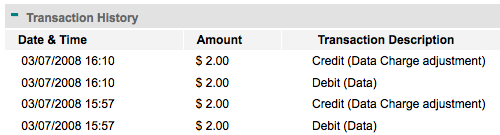
Have I found some sort of “less than some threshold” level that causes Rogers not to bill for data?
Update: Oh how naive I was to think that Rogers would let anything slip through. After a delay of 10 minutes a 5 cent charge finally showed up on my bill:
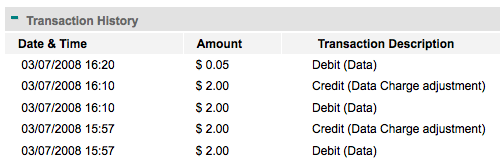
This explains why their data billing system uses the weird “debit $2 then credit $2” method: it can’t keep track of data usage in real time. It also suggests, alas, that the minimum charge is 5 cents, even if you use less than 1KB of data.
I knew it was too good to be true.
Maybe Dan McTeague, Liberal MP for Pickering-Scarborough East, should be leading the Liberal Party? Mr. McTeague managed to get a Private Members Bill through the House and on to the Senate yesterday — a rare feat — that would, in effect, turn RESPs into RRSPs. This is a brilliant political move, perhaps more brilliant than the C-10 dodge by the Government. Bravo.
Has anyone with Eastlink broadband service ever figured out how to get them to turn off the filter they have in place on outbound Port 25 (SMTP) traffic? There was no filter in place on our ISN-branded Eastlink-provided broadband, so it must be possible.
About This Blog
 I am Peter Rukavina and this is my blog. I am a writer, letterpress printer, and a curious person.
To learn more about me, read my /now, look at my bio, listen to audio I’ve posted, read presentations and speeches I’ve written, or get in touch (peter@rukavina.net is the quickest way).
I have been writing here since May 1999: you can explore the 25+ years of blog posts in the archive.
You can subscribe to an RSS feed of posts, an RSS feed of comments, or a podcast RSS feed that just contains audio posts. You can also receive a daily digests of posts by email.